Qatar e-commerce licence 2026: what your website must show
Qatar e-commerce licence website requirements under Decision 25 of 2026: CR and licence numbers, returns, complaints, e-payment, .qa domain and PDPPL consent.

Qatar e-commerce licence website requirements come from one short text: Ministerial Decision No. 25 of 2026, in force since 16 March 2026. Anyone selling an approved activity online without a shop needs a licence for each website, and the site must clearly show the commercial registration (CR) and licence numbers, contact details, product details with the exchange and returns policy, and a complaints procedure. It must also offer electronic payment.
The Ministry of Commerce and Industry (MOCI) opened applications on 17 September 2026: QAR 500, 194 approved activities, applied for online. Launch reports add a .qa or .com.qa domain, a rule I could not find in the decision. Older laws still shape the checkout: the 2010 e-commerce law, the 2008 consumer protection law and the PDPPL, Qatar's data privacy law.
This guide is for founders and developers building an online store in Qatar. It goes page by page, names the rule behind each item and flags what is not yet official. To hand the build over, see how I approach website design and development for Doha companies. I am a designer, not a lawyer, so have counsel confirm how the rules apply to you.
What Ministerial Decision No. 25 of 2026 requires
The decision was issued on 4 March 2026, published in the Official Gazette on 15 March and took effect the next day. Its only official text is Arabic, on Al Meezan, the Ministry of Justice's legal portal; translations are mine.
| Article | What it means for your website |
|---|---|
| 1 | "Website" covers any technology for communication or transactions, social media included, so an app or Instagram shop may count |
| 2 | No trading until the licence is issued; MOCI publishes the list of permitted activities |
| 3 | You need a CR, any approvals your activity requires, and a named website |
| 4 | One licence per website, carrying that site's name and details |
| 5 | Trade only through the licensed site, get approval for changes, offer electronic payment, show four sets of information |
| 6 | Personal-use sales are out of scope, unless in commercial quantities |
The text sets no fine, language rule or domain rule. Its title limits it to websites "that do not need a physical site", so if you trade from licensed premises, ask MOCI whether your existing licence covers online sales.
The QR500 licence: fee, activities and the .qa domain
MOCI's announcement of 17 September 2026 gives a QAR 500 issuance fee, 194 approved activities and electronic applications. The Peninsula lists example activities (fashion design, consulting, digital design, AI consulting, photography, translation) and adds that applications go through the Single Window platform and cannot be withdrawn once submitted. Finish the website details before you press submit.
The domain rule is reported, not yet written
The Peninsula and Qatar Living report that the domain must end in .qa or .com.qa, registered through one of eight approved providers regulated by the Communications Regulatory Authority (CRA). That rule is not in Decision 25 or MOCI's English announcement, so treat it as ministry guidance for now. The CRA's own pages say a .qa name is open to anyone and a .com.qa name is for businesses registered in Qatar; on 5 October 2026 its accredited registrar list named nine companies, not eight.
Follow it anyway, and register the name to the company, never to your developer, before you apply: Article 4 ties the licence to the website's name. I also found no published validity period, renewal fee or penalty for trading unlicensed.
Qatar e-commerce licence website requirements at a glance
"Clearly" is the decision's word, so I read it as plain text on the page, never inside an image or behind a login.
| Item | Where it goes | Rule |
|---|---|---|
| CR and e-commerce licence numbers | Footer, every page | Decision 25, Art. 5(4)(a) |
| Phone, email, customer service | Footer and Contact page | Decision 25, Art. 5(4)(b) |
| Business name and address | Footer and Contact page | Decree-Law 16/2010, Art. 51 |
| Product or service details | Product pages | Decision 25, Art. 5(4)(c); Law 8/2008, Arts. 7, 11 |
| Exchange and returns policy | Own page, linked at checkout | Decision 25, Art. 5(4)(c) |
| Consumer protection and complaints | Own page, linked in footer | Decision 25, Art. 5(4)(d) |
| Electronic payment | Checkout | Decision 25, Art. 5(3) |
| Terms, total with delivery, cancellation | Before the pay button | Decree-Law 16/2010, Art. 55 |
| Edit step, order acknowledgement | Checkout, confirmation | Decree-Law 16/2010, Art. 56 |
| Privacy notice, marketing consent | Every form | Law 13/2016, Arts. 9, 22 |
| .qa or .com.qa domain | Address bar | MOCI launch, as reported |
Product pages and prices: what the consumer law adds
Decision 25 asks for "goods and services data" and stops there. Law No. 8 of 2008 on Consumer Protection adds:
- Clear prices on every item (Article 8), never more at checkout than advertised (Article 10).
- What the product is: type, nature, ingredients and any risk warning (Article 7); for services, features and prices (Article 11).
- Instalment terms before the contract (Article 15): cash price, instalment price, period, number and amount of instalments, total cost and down payment. A pay-later panel needs all six.
- Arabic for everything in Articles 7, 8 and 11 (Article 17), other languages allowed alongside.
So the Arabic product page is not optional. My guide to Arabic and English website design in Qatar shows how one CMS entry holds both languages.
Returns, exchange and complaints pages in Arabic and English
Write these two pages from the law and your real practice, not a template.
| Question | What the law sets |
|---|---|
| Can I cancel? | Within 3 days, unless agreed otherwise, if the order is not fully performed and goods are unused (Decree-Law 16/2010, Art. 57) |
| What if it is late? | Over 30 days late, the buyer may cancel for a refund, unless another period was agreed (Art. 58) |
| What if it is faulty? | Refund, exchange or free repair (Law 8/2008, Art. 5), with a set return period once a defect is found (Art. 12) |
| What if I change my mind? | No general rule I found: state your own policy |
| What if I never ordered it? | No payment for unordered goods or for returning items sent by mistake (Art. 58) |
The complaints page needs a channel, a reply time and an escalation route: MOCI's consumer hotline, 16001.
No text I read requires these pages in Arabic. But Article 17 of the 2008 law puts product, price and service data in Arabic, and the National Cyber Security Agency (NCSA) wants privacy notices in every language you serve, so publish both.
Checkout: electronic payment with QPay, NAPS and Himyan
Article 5(3) makes electronic payment compulsory, and one method needs planning: Himyan, the national debit card Qatar Central Bank launched in March 2024. It runs over NAPS, the national network, and pays online through the QPay portal. As SADAD, a Qatari payment provider, puts it, sellers without NAPS integration cannot accept Himyan.
What I design into a Qatari checkout:
- Local debit near the top, then Visa and Mastercard, then wallets such as Apple Pay. Test the order.
- The QPay step as a handover: say the bank's page opens next.
- Terms before the pay button. Article 55 of the 2010 law lists them: who you are, what is bought, prices with tax and delivery, payment and delivery arrangements, how long the offer stands and whether the buyer may cancel.
- A review step with edit links, because Article 56 requires a way to correct input errors before ordering.
- Arabic error messages written for the failures your gateway returns.
Ask every gateway whether it is licensed by Qatar Central Bank, reaches NAPS and works in Arabic. The decision says nothing about cash on delivery; offer it beside electronic payment, not instead.
Order confirmation, invoice and delivery updates
Article 56 of the 2010 law requires an order acknowledgement "without undue delay". Article 8 of the 2008 law entitles the buyer to a dated invoice showing type, price and quantity, and Article 17 puts it in Arabic. The confirmation page and email should carry:
- Order number, date, items, quantities, prices, delivery fee and total.
- The dated invoice, in Arabic, with English alongside if you like.
- The delivery window, and a promise to warn the buyer of delays, which Article 58 requires.
- Links to the returns and complaints pages, and the CR and licence numbers.
Step by step: launching a licensed online store in Qatar
- Confirm your activity is on MOCI's approved list.
- Hold a CR in the name the licence will carry.
- Register the .qa or .com.qa domain to the company through a CRA-accredited registrar.
- Sign a QCB-licensed gateway that reaches NAPS.
- Write the legal pages in Arabic and English, reviewed by counsel.
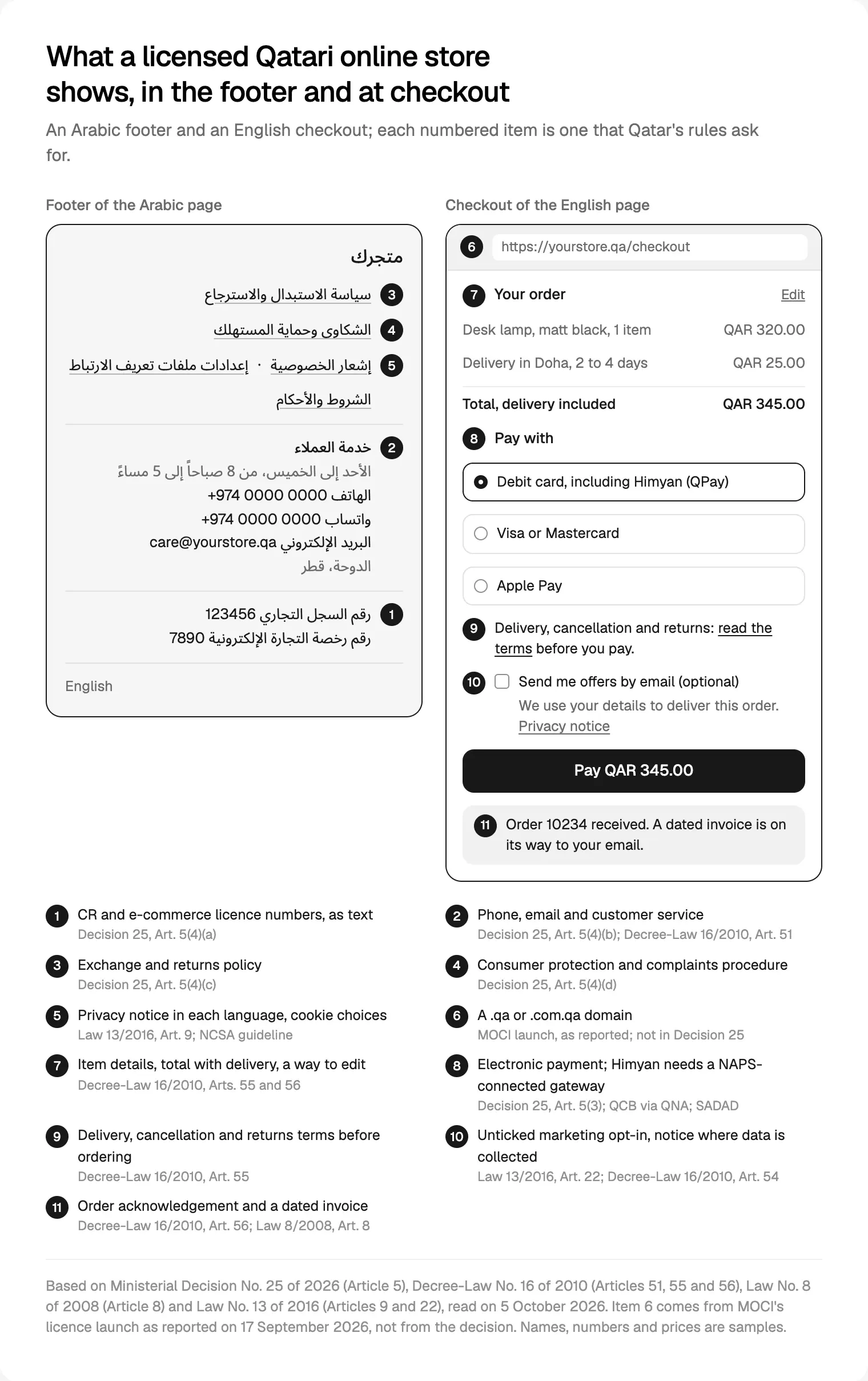
- Design and build the store with the eleven items in the diagram, Arabic first.
- Apply through the Single Window once site details are final.
- Take no orders until the licence is issued (Article 2), then add its number everywhere.
- Test both languages: a Himyan payment, a failure, a cancellation, a return, a complaint.
- Get MOCI's approval before changing the domain or business name.
My guide to website design cost in Qatar prices this build in riyals; here is how I scope a bilingual store for a Doha business.
Decision framework: which store set-up fits the licence
| Your situation | Set-up I would choose | Watch |
|---|---|---|
| Testing a few products | A hosted platform on your .qa domain | NAPS gateways, Arabic legal pages |
| Selling through Instagram or WhatsApp | A small .qa store for payment and policies | Each account may need its own licence; ask MOCI |
| Custom catalogue or integrations | A custom build with a headless CMS | Keep the licensed domain fixed |
| Qatar plus Saudi Arabia | One codebase, a site per country | Each site is its own "website" |
For a custom store, my team designs it and builds the front end in React and Next.js. For the Saudi side, see Salla, Zid or a custom store.
Common mistakes and what they can cost
- CR and licence numbers in an image, or only on the About page.
- A returns policy written for another country, which skips the 3-day and 30-day rules.
- A gateway without NAPS, turning away Himyan cards.
- Pre-ticked marketing boxes, or consent merged with the terms.
- Product data and invoices in English only.
- Changing the domain, or selling, without MOCI's approval.
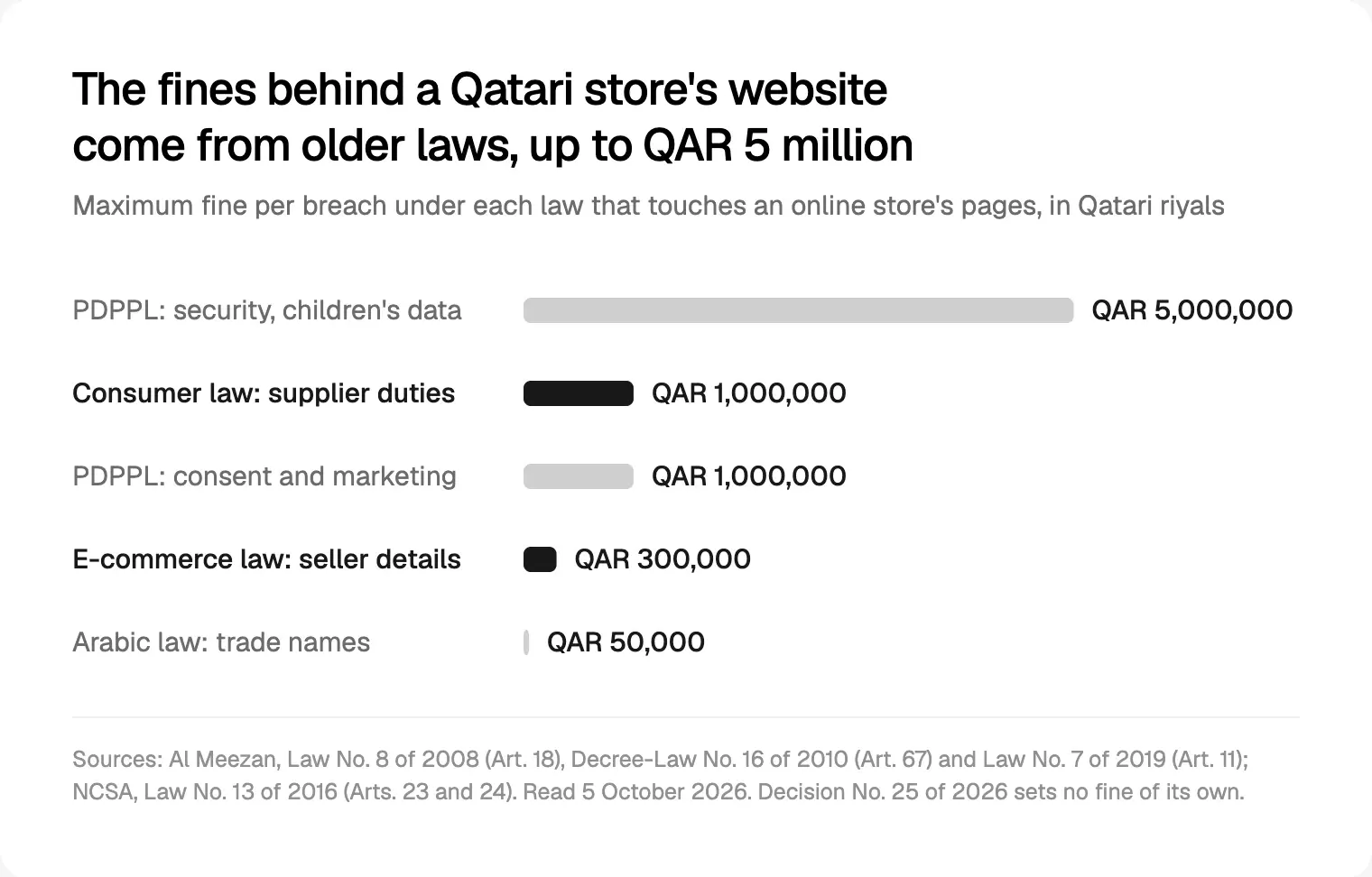
The fines sit in older laws. The consumer law's supplier duties, Arabic included, carry QAR 3,000 to 1,000,000 and up to two years in prison (Article 18). Articles 51 to 55 and 59 of the e-commerce law carry up to QAR 300,000 (Article 67). The PDPPL reaches QAR 1 million for consent and marketing breaches and QAR 5 million for security and children's data (Articles 23 and 24). Law No. 7 of 2019 adds up to QAR 50,000 for a trade name without prominent Arabic (Article 11).
Frequently asked questions
Do I need an e-commerce licence to sell on Instagram in Qatar?
Probably, if the activity is commercial and you have no licensed premises. Decision No. 25 of 2026 defines a "website" to include social media platforms and requires a licence for each one you trade through. Personal items in non-commercial quantities are exempt (Article 6). I found no MOCI guidance on social accounts, so confirm with the ministry.
How much does the e-commerce licence cost in Qatar?
MOCI's announcement of 17 September 2026 sets the issuance fee at QAR 500, covering 194 approved activities, with applications made online. Neither the decision nor the announcement states a validity period or renewal fee, so ask when you apply. Budget separately for the CR, the domain, the payment gateway and the website.
What information must a Qatari e-commerce website display?
Article 5 of Decision No. 25 of 2026 lists the CR and e-commerce licence numbers; contact numbers, email and customer service; product or service details with the exchange and returns policy; and consumer protection measures with the complaints procedure. The 2010 e-commerce law adds the business name and address, plus the order terms before checkout.
Does my online store need a .qa domain?
According to MOCI's launch, as reported by The Peninsula and Qatar Living, yes: a domain ending in .qa or .com.qa, registered through an approved provider. The rule is not in Decision No. 25 itself. A .qa name is open to anyone, while .com.qa is for businesses registered in Qatar. Register it in the company's name.
Which payment methods must a Qatar online store accept?
The decision requires electronic payment but names no method. In practice, accept local debit cards, including Himyan, plus Visa and Mastercard. Himyan pays online through QPay over the national NAPS network, so your gateway must connect to NAPS. Choose a provider licensed by Qatar Central Bank and test a Himyan payment before launch.
Does the returns policy have to be in Arabic?
No text I read says so directly. The consumer protection law requires product, price and service information in Arabic, and the NCSA expects privacy notices in every language you serve customers in. A store selling in Arabic should therefore publish its returns, complaints and privacy pages in Arabic, with English alongside.
How long do customers have to cancel an online order in Qatar?
Under Article 57 of the 2010 e-commerce law, a consumer may cancel within three days of the contract unless the parties agreed otherwise, provided the order has not been fully performed and the goods are unused. If delivery is over 30 days late, the buyer may cancel for a refund (Article 58).
Can I change my store's domain after the licence is issued?
Only with approval. Article 4 makes the licence carry the website's name and details, and Article 5 requires MOCI's approval for any change to licence data. Settle the domain before you apply, and treat a migration as a licence change first.
My recommendation
Treat the licence as a page list, not paperwork. Put the eleven items into the first wireframe, design Arabic first, sign a gateway that reaches NAPS, register the .qa name to the company, and apply when the site details are final. Retrofitting later touches every template and email at once.
That is the work of my website design service: Arabic and English pages designed together, legal pages laid out for counsel to fill, and a checkout tested with Qatari payment methods. It starts with a free 30 minute intro call, then a written scope and one fixed quote, with no retainer; more is on my about page. To see how I work with Qatari teams from Dhaka, start with my website design work for Doha.
Sources and method
I read every source on 5 October 2026. Decision No. 25 is on Al Meezan only in Arabic, so its translations are mine; other laws come from Al Meezan's English texts and the NCSA's unofficial English PDPPL. Fines are in riyals as the laws state; no conversion was needed. Data is thin on the domain rule (press only), the registrar count (eight reported, nine listed), the licence's validity, how MOCI treats apps and social accounts, and penalties for trading unlicensed. SADAD, a payment provider, is used only for the NAPS point, which the Qatar News Agency's Himyan report supports.
- Al Meezan, Ministerial Decision No. (25) of 2026 (Arabic), 4 March 2026: almeezan.qa
- Ministry of Commerce and Industry, E-Commerce Licence launch, 17 September 2026: moci.gov.qa
- The Peninsula, MOCI launches QR500 e-commerce licence for 194 business activities, 17 September 2026: thepeninsulaqatar.com
- Qatar Living, MoCI e-commerce licence covering 194 activities, 17 September 2026: qatarliving.com
- Crowell & Moring, Qatar's e-commerce licensing framework, 17 March 2026: crowell.com
- Communications Regulatory Authority, domain registrants and accredited registrars, read 5 October 2026: cra.gov.qa, cra.gov.qa
- Al Meezan, Decree-Law No. 16 of 2010 on Electronic Commerce and Transactions, 19 August 2010: almeezan.qa
- Al Meezan, Law No. 8 of 2008 on Consumer Protection, 15 May 2008: almeezan.qa
- National Cyber Security Agency, Law No. 13 of 2016 (PDPPL), unofficial English text, read 5 October 2026: ncsa.gov.qa
- National Cyber Security Agency, Privacy Notice Guidelines, version 2.0, September 2022: ncsa.gov.qa
- Al Meezan, Law No. (7) of 2019 on Protection of the Arabic Language, 14 January 2019: almeezan.qa
- Qatar News Agency, Qatar Central Bank launches Himyan debit card, 30 March 2024: qna.org.qa
- SADAD, accepting payments for an online store in Qatar, 25 April 2026: sadad.qa
- The Peninsula, MoCI on consumer rights and the 16001 hotline, 24 August 2026: thepeninsulaqatar.com