Real estate website requirements in Dubai: Trakheesi and QR
Real estate website requirements in Dubai and Abu Dhabi: Trakheesi and Madhmoun permits, the DLD QR code, broker numbers, expiry, feeds and PDPL forms.

Real estate website requirements in Dubai start with one rule: no property goes on your site without a valid Trakheesi permit from the Dubai Land Department (DLD), and every listing shows that permit's number and its Madmoun QR code. The QR code has been required on property ads since 24 April 2023; scanned, it opens a DLD page confirming the ad is approved and the unit still available. Brokerages also show their office registration and broker card numbers. Fines start at AED 50,000 and double for a repeat.
Abu Dhabi runs its own system. Since 7 July 2025, every property ad there needs a Madhmoun permit from the Abu Dhabi Real Estate Centre (ADREC), issued through Dari for one to three months, with at most three brokers per property. A listing permit costs AED 50 to 250, plus VAT.
On a website, that becomes a build spec: a permit record per listing, a publish button that refuses to work without one, automatic takedown on expiry, portal feeds with the same numbers, Arabic pages with the same proof, and PDPL-ready enquiry forms. This guide is for brokerages, developers and the teams building their sites, and it is how I scope a real estate website for a Dubai company.
The rules a property website must follow in Dubai and Abu Dhabi
Dubai's property ads are regulated by RERA, the Real Estate Regulatory Agency inside DLD; Abu Dhabi's by ADREC. A listing on your own site is an ad in both: DLD's permits cover electronic and classified ads, and ADREC's notice "all types of real estate advertisements".
| Requirement | Dubai (DLD and RERA) | Abu Dhabi (ADREC) |
|---|---|---|
| Permit before the ad | Trakheesi permit; brokers attach the owner's marketing contract | Madhmoun permit via Dari, since 7 July 2025 |
| Permit on the ad | Permit number (Circular 1 of 2020) | Permit number, as portals show it |
| QR code | Madmoun QR since 24 April 2023 | No QR rule found |
| Who placed the ad | Office registration and broker card numbers (2012 circular) | Broker's registration number (Law No. 3 of 2015, Article 7) |
| Validity | Start and expiry dates on each permit | One, two or three months, renewable |
| Brokers per property | No cap found | Up to three |
| How buyers verify | Scan the QR; check brokers in Dubai REST | ADREC's Verify Document page |
| Penalty | From AED 50,000, doubled on repeat; licence at risk | "Legal and administrative measures" |
Mind the names: Dubai's QR service is Madmoun and Abu Dhabi's permit platform Madhmoun, two spellings of مضمون, "verified". In Dubai it is the QR layer on a Trakheesi permit; in Abu Dhabi it is the permit itself, on what ADREC calls the GCC's first government multiple listing service.
Enforcement is automated. In 2020 RERA fined 10 companies and warned 30, and told property websites to carry "a link to ensure that the displayed ads adhere to the permit conditions". By April 2025, DLD's AI platform had monitored over 279,000 portal ads and automatically modified 29% of them.
Developers need a permit too, and off-plan projects must be registered with RERA, with an escrow account, before brokers market them; Abu Dhabi's Law No. 3 of 2015 (Article 14) also bars off-plan ads without written permission. A launch page for an off-plan project in Dubai waits for both.
Real estate website requirements in Dubai, element by element
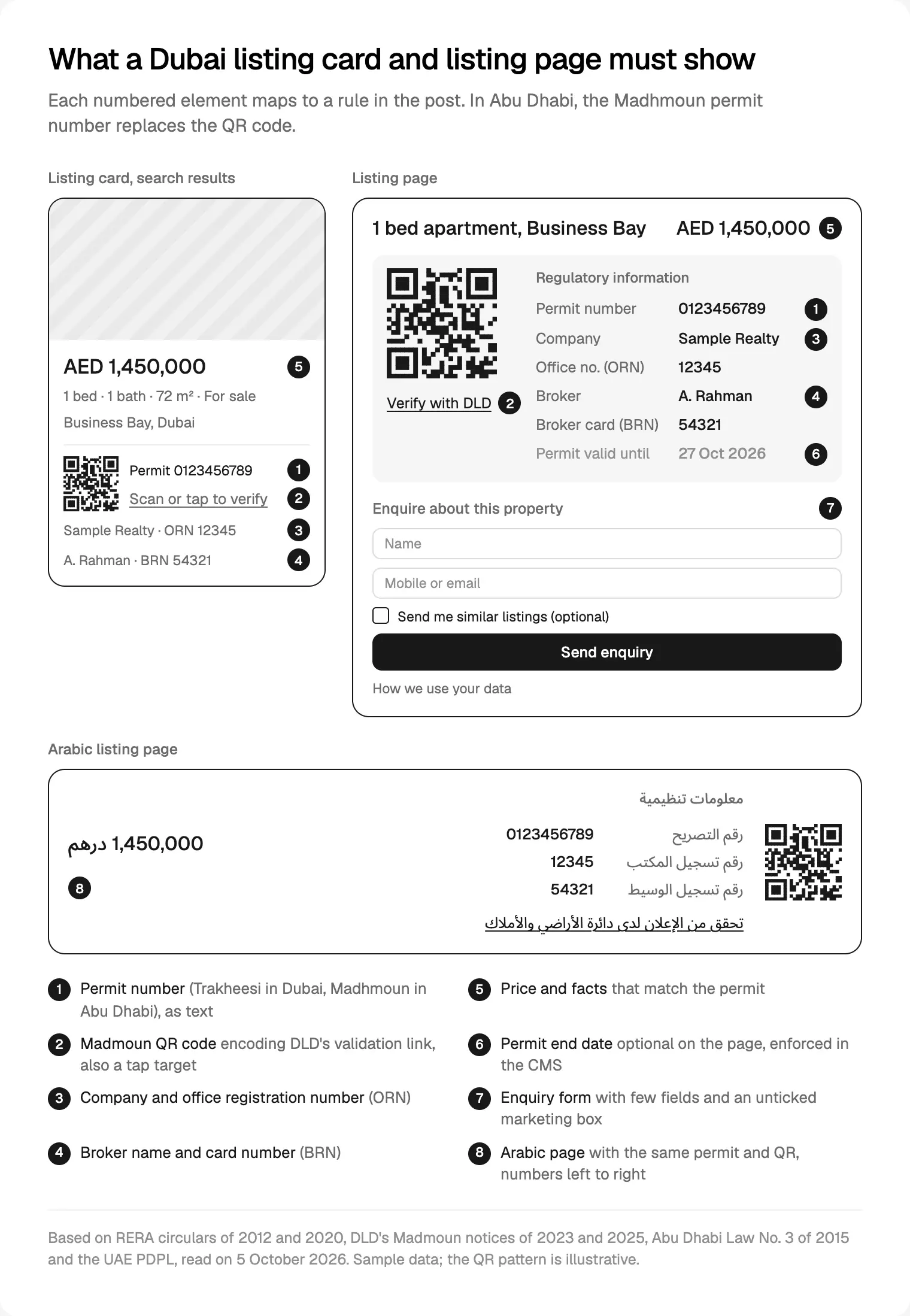
- Permit number as text, on card and page (the Madhmoun number in Abu Dhabi).
- Madmoun QR code encoding DLD's validation link, and also a link.
- Company and office registration number of the permit holder.
- Broker name and card number for the broker on the permit.
- Facts that match the permit: price, size, rooms, area, sale or rent.
- Permit end date, optional on the page, enforced in the CMS.
- Enquiry form with few fields and an unticked marketing box.
- Arabic version with the same permit and QR, numbers left to right.
Where the QR code and the verification link go
The QR code must encode the validation link DLD issues for that permit, never a page on your own site. On a live Dubai listing I opened on 5 October 2026, it led to a DLD "Real Estate Permit Card" showing the permit's end date, the agency's licence number, the broker, and the property's type, size, zone, value in AED and rooms. DLD says a sold or rented unit shows a message when scanned.
- Make the QR a link. Nobody can scan a code on their own phone screen, so wrap it in a link to the same URL, labelled "Verify this listing with DLD". DLD's Arabic announcement also lets companies link the QR badge into ad platforms through electronic integration.
- Render it from the stored URL, as SVG with a white margin, never from an old uploaded image. Test it with two phones.
- Keep it beside the price, in one "Regulatory information" block with permit number, company and broker, and in brochures and social posts. DLD's 2025 notice covers "all real estate advertisements, whether visual or written".
The rules do not separate a search card from a page, and a card with a photo, price and area advertises that unit. I put the permit number on every card, with a small QR or a verify icon opening the same link; for a firm answer on your layout, ask RERA.
On that listing, Property Finder showed the "DLD Permit Number" only as a QR code, without digits. A broker's blog noticed this in August 2026 and found no DLD announcement behind it; nor did I. RERA's circulars still ask for the number, so show both.
In Abu Dhabi I found no QR rule, and Property Finder shows "Permit (Madhmoun)" as a 14-digit number. Show it as text with a copy button, linked to ADREC's Verify Document page, which returns the permit's type, duration, dates and broker.
How the CMS stores permits and blocks publishing
Treat the permit as its own record linked to the listing. These are the fields I specify:
| Field | Example | Why |
|---|---|---|
| Permit number | Unique text | Shown on the ad; one permit, one listing |
| Validation URL (Dubai) | trakheesi.dubailand.gov.ae link | Source of the QR and verify link |
| Permit type | Sell or rent | Must match the offer |
| Start and end dates | From the permit | Drive publishing and expiry |
| Contract reference | Form A, for a ready sale | Trakheesi asks for it |
| Company licence and office number | From the licence | Shown on every ad |
| Brokers | Names and card numbers | Shown; checked against the permit |
| Permitted facts | Price, size, rooms, zone | Compared before publishing |
The publish button runs a check in code: a permit is attached, today falls between its dates, the type matches the offer, the broker is on the permit, and price, size and rooms match. If anything fails, the listing stays a draft and the editor sees why.
Make permit numbers unique, since RERA fined their manipulation in 2020. The permit records the property's value, so a price change should prompt an amendment in Trakheesi.
Manual entry, a CRM or the DLD API: a decision framework
| Your situation | Approach | Trade-off |
|---|---|---|
| Developer, one or two projects | Typed in, with the publish check | Cheapest; depends on careful entry |
| Brokerage whose CRM feeds the portals | Pull permits from the CRM | No double entry; tied to the CRM's fields |
| Hundreds of live Dubai listings | DLD's Trakheesi API (Listing Validation, Delisting), AED 30,000 plus VAT a year | Automated, for a fee and integration work |
| Broker profile pages | Dubai Brokers API, same price, or manual checks | Live card status against cost |
| Abu Dhabi listings | Madhmoun's API-based publishing | I found no public documentation |
Expiry, renewal and sold units
Dubai permits carry start and expiry dates set in Trakheesi, which also takes renewal and amendment requests. Abu Dhabi listing permits run one, two or three months and renew through Dari. The law firm Al Tamimi notes that Madhmoun syncs with the portals, so unverified or expired listings come down in real time.
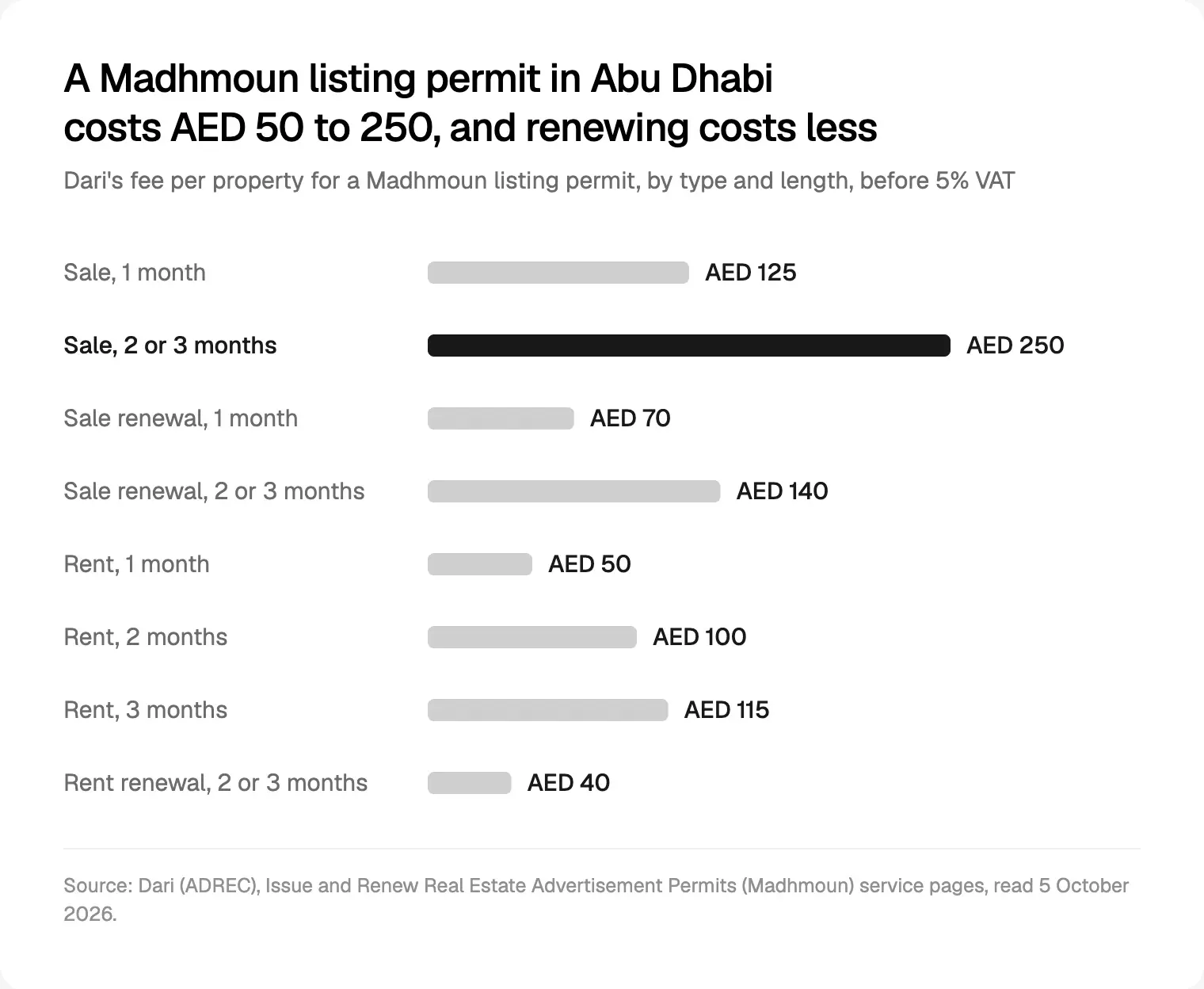
Dari's fees before 5% VAT: a sale listing costs AED 125 for one month and AED 250 for two or three; a rental AED 50, 100 or 115. Renewal costs AED 70 or 140 for a sale, AED 20 or 40 for a rental. In Dubai, DLD lists AED 1,000 for most permit types plus a AED 20 fee, without saying whether a single portal listing costs the same; check in Trakheesi.
Expiry needs a routine:
- A daily job finds lapsed permits, unpublishes both language versions and removes them from every feed.
- Reminders reach the broker a week and a day before the end date.
- The old URL returns 410 Gone, or a page without price that points to similar listings. Google drops indexed URLs that return 4xx codes (except 429); never keep an expired ad live for traffic.
- A renewal changes the end date only once confirmed; an amendment re-runs the publish check.
- Sold or rented units come down the day the deal closes. The QR will say so anyway.
Portal feeds: one permit record, every channel
Most brokerages also publish to the portals through a CRM feed, and the portals enforce permits: Bayut needs the correct Trakheesi permit on each listing so its data matches DLD's, marks invalid permits red and removes those listings. For Abu Dhabi it asks for a dedicated Madhmoun field in your CRM, mapped into the XML feed, and sends its feed specification on request. Property Finder's API documentation was not open to me.
So design one record and many outputs, the way I set up the CMS on a bilingual website design project in Dubai. The permit lives once; card, page, feeds and brochures read from it, and every channel drops an expired listing together. A CRM import must carry the end date and validation URL, and a listing a portal rejects should leave your site too.
Arabic listing pages
The Arabic page is the same ad, with the same permit, QR code and facts. I found no rule asking for a permit per language, but ads must follow "the conditions approved in the permit", so a translation cannot change the price or description.
Use the regulators' Arabic, not machine translation. The 2012 circular's Arabic text asks for رقم تسجيل المكتب (office registration number) and رقم تسجيل الوسيط (broker registration number); DLD writes QR code as رمز الاستجابة السريعة. Property Finder labels the Dubai permit رقم تصريح دائرة الأراضي والأملاك and the Abu Dhabi one تصريح (مضمون).
In right to left layouts, permit, price and phone numbers must stay left to right, so wrap each in bdi or give it a dir attribute, as the W3C advises. The QR is never mirrored, and both versions link to the same DLD page, which has its own Arabic switch. Hreflang pairs must expire together, since Google asks each version to list itself and its partner. My guide to Arabic RTL interface design for the UAE covers type, digits and mirroring.
Lead forms under the UAE PDPL
Federal Decree-Law No. 45 of 2021, the Personal Data Protection Law, has applied since 2 January 2022. Article 4 bars processing without consent except in listed cases, including steps a person asks for towards a contract, which may cover an enquiry about a unit; your lawyer decides. Marketing, listing alerts and passing leads to developers need consent that is provable, clear and easy to withdraw (Article 6). In practice:
- A separate, unticked box for marketing, with the wording, version, page and time logged.
- Only the fields you need (Article 5): name, phone or email, message. No Emirates ID upload.
- A short notice in Arabic and English: purpose, sharing inside and outside the UAE, and retention, which people may ask about (Article 13).
- An unsubscribe in every follow-up, since people can object to direct marketing (Article 17).
Free zones with their own data law, such as DIFC and ADGM, follow it instead (Article 2). The law's federal portal page, in a copy saved in late August 2026, listed no Executive Regulations, so design to the law itself; my guide to UAE PASS sign-in and consent screens goes deeper.
Dubai also lets brokers contact only owners on DLD's green list, so log when an owner reaches you first through a "list your property" form, and ask RERA whether that suffices.
Step by step: from permit to live listing
- Mandate: in Dubai, owner and brokerage sign the marketing contract (Form A); in Abu Dhabi, the owner, broker or developer applies in Dari.
- Permit: requested in Trakheesi or Dari.
- Draft: the editor creates the listing and attaches the permit record.
- Check: the publish check blocks anything that does not match the permit.
- Pages: card and page render permit, QR and numbers, in both languages, from one record.
- Feeds: the same fields go to the portals; their status comes back.
- Daily job: expiry, reminders, sold and rented units.
- Monthly audit: scan live QR codes and compare each DLD page with the listing.
Common mistakes on Dubai property sites
- The permit in the footer, or "on request", instead of on each ad.
- A QR that opens your own page or DLD's home page.
- One permit reused across duplicates, or a fourth broker on an Abu Dhabi property.
- Expired listings kept live for search traffic, or price cuts without an amended permit.
- An Arabic page that lags or drops the regulatory block.
- Pre-ticked consent, or leads passed to developers silently.
- Off-plan launch pages live before registration and permit.
Checklist for developers and brokers
Brokers and marketing teams:
- A valid permit for every listing and campaign, on every channel.
- Office and broker numbers on every Dubai ad; the broker's registration number in Abu Dhabi.
- Renewals booked before end dates; amendments for price changes.
- Arabic copy that matches the permitted facts.
The people building the site:
- A permit record per listing, a publish check, unique permit numbers.
- A clickable QR rendered from the stored URL.
- A daily expiry job, reminders, 410 responses and feed takedowns.
- Arabic pages with isolated numbers and paired hreflang.
- Provable, separate, withdrawable consent, and an audit log.
Frequently asked questions
What is a Trakheesi permit?
Trakheesi is DLD's system for licensing Dubai real estate companies and issuing broker cards, office registrations and advertising permits. An ad permit approves a listing or campaign between a start and an expiry date. RERA requires one before any property ad appears in Dubai, on websites, portals or social media, with the permit number on the ad.
Does every listing on a Dubai real estate website need a permit number?
Yes. RERA's Circular 1 of 2020 says properties must not be promoted without a permit whose number is clearly displayed on the ad, with fines of at least AED 50,000, doubled for a repeat. Each listing advertises one property, so each needs its own permit, shown on the listing page and, in my view, on the search card.
What is the Madmoun QR code, and where does it go on a website?
Madmoun is DLD's QR service in Trakheesi. Each ad permit gets a code that opens a DLD page confirming the ad is approved and the unit available. Since 24 April 2023 it must appear on all property ads. Put it beside the price, render it from the permit's validation URL, and make it tappable on phones.
What is the difference between Madmoun in Dubai and Madhmoun in Abu Dhabi?
They are one Arabic word, مضمون, spelt two ways. In Dubai, Madmoun is the QR code on a Trakheesi permit. In Abu Dhabi, Madhmoun is ADREC's permit system and listing service: every ad needs a Dari permit, valid one to three months, with up to three brokers per property.
How long is a Madhmoun permit valid in Abu Dhabi?
One, two or three months. A sale listing costs AED 125 for one month or AED 250 for two or three, a rental AED 50, 100 or 115, plus 5% VAT, and permits renew through Dari. Store the end date and remove the listing, in both languages and every feed, when it passes.
What are the fines for advertising property without a permit in Dubai?
At least AED 50,000, doubled for a repeat, under RERA's Circular 1 of 2020. In 2020 DLD fined 10 companies and warned 30 for missing permits, manipulated permit numbers and expired permits, and said progressive fines can end in a cancelled licence. Anyone can report an unpermitted ad through DLD's Real Estate Violations System.
Do I need the DLD API to build a compliant property website?
Not always. A developer with one or two projects can enter permits by hand if the CMS blocks publishing without a valid one and handles expiry. A brokerage with hundreds of listings may justify DLD's Trakheesi API, at AED 30,000 plus VAT a year. Most brokerages pull permits from their CRM.
Does a property enquiry form need consent under the UAE PDPL?
For anything beyond answering the enquiry, usually yes. The PDPL bars processing without consent except in listed cases, such as steps a person asks for towards a contract. Marketing, alerts and sharing leads need consent that is provable, clear and easy to withdraw: a separate, unticked box, logged. Your lawyer confirms the basis.
My recommendation
Build the permit into the data model before anyone draws a listing card. Once it is a record with an end date and a validation URL, the QR, Arabic page, feeds and expiry job follow, and the publish check stops the mistakes RERA fines. Bolted on later, it becomes a field editors forget.
Start with the rules table and your permit volumes. I lead a senior team in Dhaka that designs and builds bilingual websites for Dubai companies, with permits, Arabic and consent in the written scope from the first call. Read more about how I work, or see my website design service.
Sources and method
Read on 5 October 2026 unless dated. I opened one Dubai and one Abu Dhabi listing on Property Finder and the DLD page linked from the Dubai one; I do not link them, as they name brokers. Fees are in AED as published, so no conversion was needed. The UAE legislation portal blocked me, so I used a saved copy of the official PDPL text. Data is thin on Dubai's fee per portal listing, ADREC display rules, portal feed specifications, and whether DLD accepts the QR without the number.
- DLD, fines on 10 companies and warnings to 30, 20 October 2020: dubailand.gov.ae
- RERA, Circular 1 of 2020 on real estate advertising, 17 May 2020: dubailand.gov.ae
- RERA, circular to brokerage offices on advertisement rules, 1 March 2012: dubailand.gov.ae
- DLD, Madmoun QR service, 18 April 2023, English and Arabic: dubailand.gov.ae, dubailand.gov.ae
- DLD, AI-enabled advertising governance, 24 April 2025: dubailand.gov.ae
- DLD, Real Estate Ad Permit service, site updated 30 September 2026: dubailand.gov.ae
- DLD, Trakheesi User Manual 2025: dubailand.gov.ae
- RERA, Real Estate Brokerage Practice Guide, November 2024: dubailand.gov.ae
- DLD, API Gateway and FAQ: dubailand.gov.ae, dubailand.gov.ae
- DLD, Trakheesi permit card for a live listing: trakheesi.dubailand.gov.ae
- Dari (ADREC), issue and renew Madhmoun permits, published 27 March 2025: services.dari.ae, services.dari.ae
- ADREC, FAQs and Verify Document: adrec.gov.ae, adrec.gov.ae
- Abu Dhabi Law No. 3 of 2015, Articles 7 and 14, via ADREC: adrec.gov.ae
- Aletihad, Madhmoun comes into force, 8 July 2025: en.aletihad.ae
- Al Tamimi and Company via Mondaq, ADREC and ADGM transparency policies, 4 September 2025: mondaq.com
- Bayut HelpCentre, permits and invalid permits (26 March 2024), Madhmoun and CRM feeds (7 July 2025): support.bayut.com, support.bayut.com, support.bayut.com
- Property Finder, Dubai and Abu Dhabi listings: propertyfinder.ae
- The Foundry Realty, permit numbers no longer visible on portals, 7 August 2026: thefoundryrealty.com
- Federal Decree-Law No. 45 of 2021 (PDPL), official English text: uaelegislation.gov.ae
- Google Search Central, localised versions (21 September 2026) and HTTP status codes (4 February 2026): developers.google.com, developers.google.com
- W3C, inline markup and bidirectional text: w3.org