


Real estate app development starts with one decision: what the app helps someone do. Search and book viewings, compare homes, pay rent, or own a share of a building and collect income. Each of those is a different product with different screens, data and rules. Pick the job first, then the people it serves (buyer, renter, investor, agent, landlord), then where the property data comes from. Those three answers set the scope, and the scope sets the cost and the timeline.
I'm a design engineer: I design products and build them in production code, web apps in React and Next.js and iOS and Android apps in React Native or Flutter. Below are the features, mistakes, rules and process, plus two real estate products I designed: AQARI, a fractional investing web app for Saudi Arabia, and Lyvio, an AI property advisor for the UAE. The service behind this post is my product design work.
Types of real estate app, and what each one needs
- Listing and search apps for buyers and renters: search, a map, saved homes, alerts and viewing requests. The listing data decides the product.
- AI matching and advice apps: the app learns what a person needs and recommends homes, with the reasons. Lyvio is this type.
- Investment and fractional ownership apps: investors buy a share of a property, receive rent and later sell or vote on an exit. AQARI is this type.
- Property management apps for tenants and landlords: rent payment, maintenance requests, documents and messages.
- Agent and brokerage tools: leads, viewings and offers, used on a phone between appointments.
Many briefs mix two. One has to lead, because it decides the home screen and the first release.
Must-have features, and why each one is there
| Feature | App type | Why it's a must |
|---|---|---|
| Search with a map and a few strong filters | Listing, AI | People think in areas before they think in prices |
| Saved homes and alerts | Listing, AI | Buying takes weeks, and alerts bring people back |
| Property page with every number dated | All | A price or yield without a date reads as a guess |
| Viewing request or agent contact | Listing, AI | The app's job ends in a real conversation |
| Side by side comparison | Listing, AI | A choice between two homes is where people stall |
| Identity check before money moves | Investment, rent | Payments and investor records depend on knowing who is paying |
| Wallet, payouts and transaction history | Investment, rent | People open the app to see what they earned or paid |
| Documents and records | All | Contracts, receipts and certificates in one place |
| Account deletion inside the app | All on iOS | Apple requires it if the app lets people create an account |
Virtual tours, chat and mortgage calculators can usually wait for the second release unless they're the reason the app exists.
Common mistakes in real estate app projects
Designing the search before checking the data. Listings usually come from agents, a portal feed or a multiple listing service, each with its own licence and display terms. Those terms can decide which fields you show and how often you refresh. Ask before the first wireframe.
Too many filters. Lyvio's research found that complex filters slow a first-time buyer down. I start with location, price, type and bedrooms, then add filters the data can really support.
Scores with no reasons. An AI match score is only useful if the buyer can see what's behind it.
Numbers without a source. On an investment app, a yield without its valuation date erodes trust fast. AQARI puts every number beside its source.
Treating Arabic as a translation. Right to left changes charts, progress bars, digits and dates, so for the Gulf I draw Arabic first.
Rules that touch a real estate app
This is general information, not legal advice. Check with a lawyer in each market you launch in.
- Advertising and fair housing in the US. The Fair Housing Act makes it unlawful to publish an advertisement for the sale or rental of a dwelling that indicates a preference or discrimination based on race, colour, religion, sex, handicap, familial status or national origin (42 U.S.C. 3604). Keep that in mind for listing text, filters and any AI that writes listings.
- Property advertising permits in Dubai. The Dubai Land Department issues real estate advertising permits through its Trakheesi system, and its list of ad types includes electronic advertisements (DLD). I cover what that means per listing in my guide to a real estate website in Dubai.
- Investment rules. Fractional ownership can be a securities offering. In the US, Regulation Crowdfunding lets a company raise up to $5 million in 12 months, and every transaction must run online through an SEC-registered broker-dealer or funding portal (SEC). AQARI's brief named Saudi Arabia's Capital Market Authority, which asked for clear limits and full disclosure.
- App Store rules. Apple's App Store Review Guidelines say apps in highly regulated fields such as banking and financial services should be submitted by a legal entity that provides the services, not an individual developer (5.1.1 ix). An app that lets people create an account must also offer account deletion inside the app (5.1.1 v), and Location Services should only be used when directly relevant to the app's features (5.1.5).
How I'd approach your real estate app, from intro call to launch
- A free 30 minute intro call. I ask what the app does, for whom, where the data comes from and which markets you launch in.
- A written scope and one fixed quote for the whole project. No retainer, nothing billed by the hour.
- The data and trust map. Before screens, I list every number the app shows, where it comes from and how old it may be, plus every point where money or identity is checked.
- Weekly design sprints in Figma, with a written update in Slack every 48 hours and a review call each week.
- A documented design system, with tokens and components named the same in Figma and in code.
- The build. Web apps in React and Next.js, iOS and Android in React Native or Flutter, as on my development page. I use AI coding tools where they save time, and a person who knows the design reviews every change.
- Store review and launch, with account deletion, privacy text and permission prompts ready before you submit.
Case study: AQARI, a fractional real estate investing web app
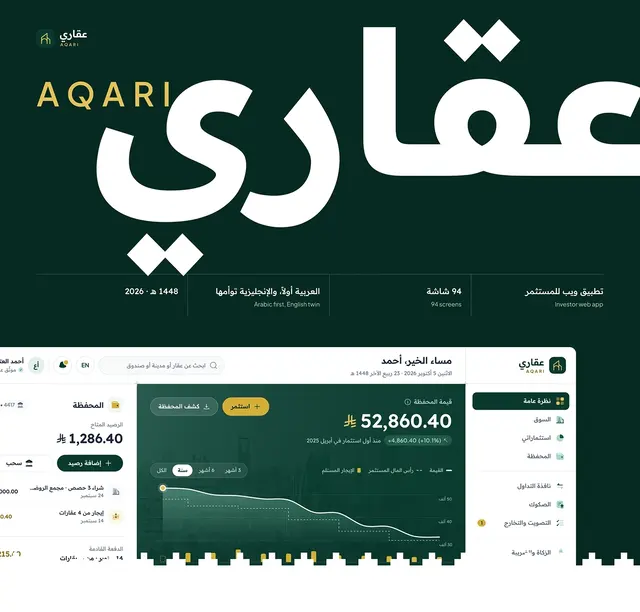
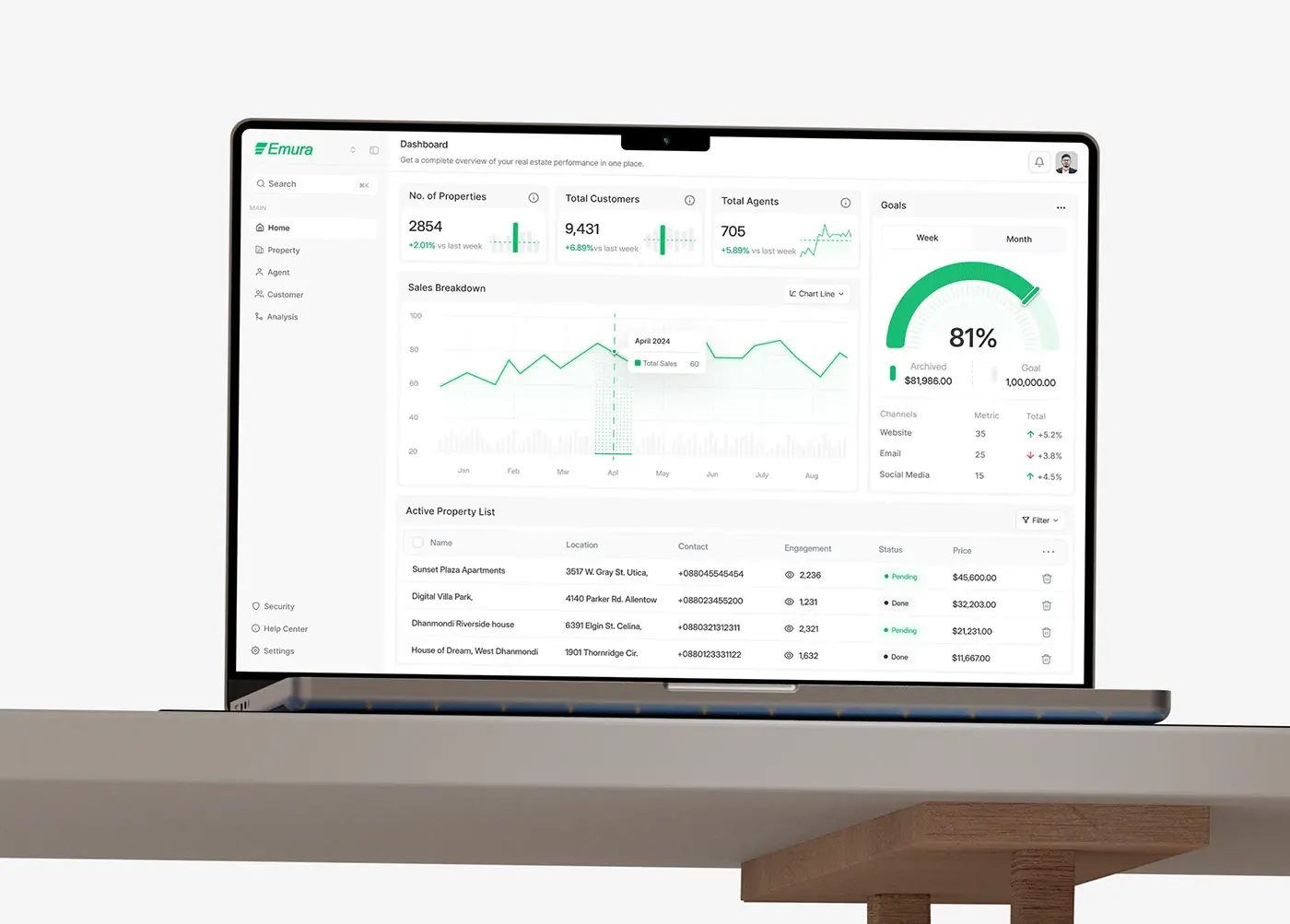
AQARI is a Shariah-compliant web app where investors in Saudi Arabia own property shares, collect rent, trade units and track Zakat. Investors buy a share of a building from 1,000 riyals. I designed the product end to end, Arabic first with full RTL layouts and an English twin, across 94 screens.
The brief had four voices: the investor, the Shariah board, the Capital Market Authority and the Taqeem valuer, who asks for two independent valuations of every property. Research named three fears: is the price fair, is my money locked for years, and how much Zakat do I owe.
The structure. I mapped how one share lives through a year: buy, monthly rent, the trading window, Zakat on the hawl and the exit vote. That cycle gave 12 sidebar pages, from Overview and Wallet to Trading window, Sukuk, Zakat and Learn. Every screen answers three questions: what do I own, what did it earn, and what happens next.
The screens. Marketplace cards show funding status, a Shariah certified badge, net yield and the minimum. The property page sets two certified valuations side by side, and their average sets the offering price. Investing is one modal in four steps: shares and review, SPV agreement with e-signature, Nafath verification and payment by mada, Apple Pay or SARIE. It ends on an ownership certificate.
Selling and records. Selling happens inside a price band set from the last valuation, with three states: inside the band, outside it with a plain reason, and filled. The wallet shows the next payout first, and the design system has one motion rule: money never animates.
Case study: Lyvio, an AI property advisor for the UAE
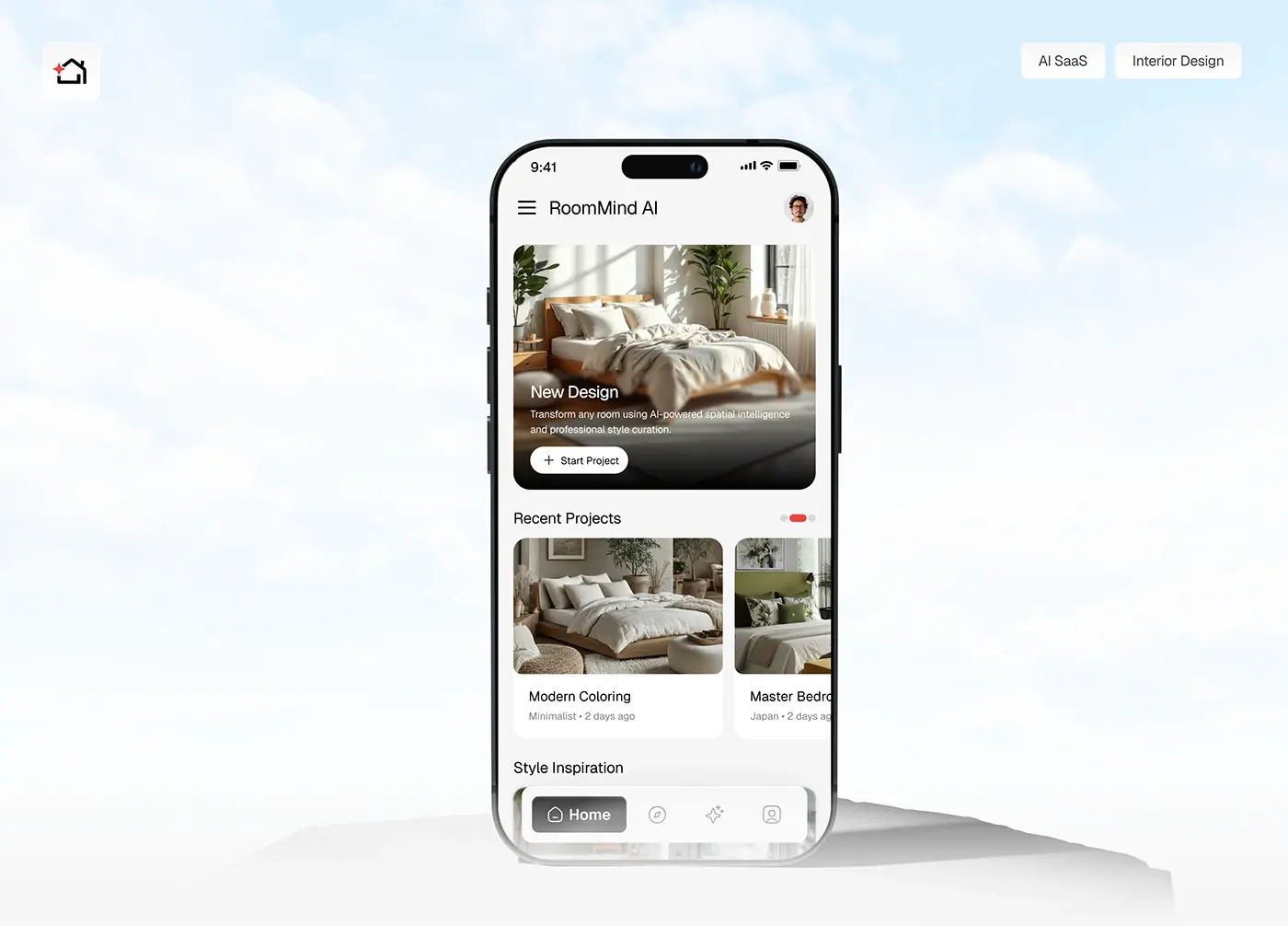
Lyvio is an AI real estate platform for the UAE market. Instead of endless listings, it learns how a person lives and recommends homes that fit. I designed the mobile app and the website.
The flow runs from sign up straight into a quiz, one question per screen with a "Quiz 1 of 8" label. The answers build a lifestyle profile with a radar chart for quiet, schools, safety, transit and green space. Home cards show price and a match score out of 100. Comparison puts two homes side by side with rows for price, commute time, green space and transit access, and the recommendation ends on one action: go with one property. Each score breaks into parts a buyer recognises, so the AI explains itself.
What decides the cost of a real estate app
I don't publish prices; after the intro call you get one fixed quote for your scope. These move it:
- The app type. Investment and rent apps carry identity checks, payments and records; search apps carry data feeds and filters.
- Platforms. Web, iOS, Android or all three. React Native or Flutter shares most of the work across both phones.
- Data and markets. A licensed feed or your own listings, how often it refreshes, and Arabic RTL or local payment methods.
- People. The US Bureau of Labor Statistics puts median pay for software developers at $135,980 a year, from May 2025 data, in its Occupational Outlook Handbook.
- Usage-priced services. On the Google Maps Platform price list, Dynamic Maps includes 10,000 free loads a month, then $7.00 per 1,000; Geocoding includes 10,000 free, then $5.00 per 1,000.
- Store accounts. The Apple Developer Program is $99 a year, and a Google Play developer account is a US$25 one-time fee.
For how design time is priced around the world, see my guide to app design cost.
How to choose who builds your real estate app
- Ask to see a real estate product they designed, with the investing, renting or booking flow, not only a home screen.
- Ask where they'd put the source of each number. A good answer names the screen and the date format.
- Ask who turns the design into code and how the build is kept matching the screens.
- Ask who owns the accounts and code. Developer accounts, map and payment keys and the repository belong in your company's name.
Frequently asked questions
How do you build a real estate app?
Decide the app's one job and its users, check the terms of your property data, map every number and every money or identity step, then design and build in weekly cycles. Launch with the smallest feature set that does the job well.
How long does real estate app development take?
It depends on the app type, platforms and markets; an investment app takes longer than a search app. Your timeline goes in the written scope after the intro call.
What features does a real estate app need at launch?
For a search app: search with a map, a few strong filters, saved homes, alerts, property pages and viewing requests. For an investment app: a marketplace, property pages with dated valuations, a guided investing flow with verification, a wallet and records.
Should a real estate app be a web app or a mobile app?
Investors often review numbers on a large screen, so AQARI is a web app. Buyers browse on their phones, so Lyvio has a mobile app beside its website. Many products need both, from one design system.
Can you design and build the whole app?
Yes. I design the product and build it, web apps in React and Next.js and mobile apps in React Native or Flutter, with a design system so the code matches the design. See my real estate industry page for the sector.
Sources and method
I read every source on 1 November 2026; prices and rules change, so check them before you budget. I give no market size figures, because the ones I found came from vendors' sales pages.
- Cornell Law School LII, 42 U.S.C. 3604 (Fair Housing Act), date read 1 November 2026: law.cornell.edu
- US Securities and Exchange Commission, Regulation Crowdfunding, date read 1 November 2026: sec.gov
- Apple, App Store Review Guidelines, 5.1.1 and 5.1.5, date read 1 November 2026: developer.apple.com
- US Bureau of Labor Statistics, Occupational Outlook Handbook, Software Developers, date read 1 November 2026: bls.gov
- Google Maps Platform, core services pricing list, date read 1 November 2026: developers.google.com
- Apple Developer Program, date read 1 November 2026: developer.apple.com
- Dubai Land Department, Real Estate Ad Permit (Trakheesi), date read 1 November 2026: dubailand.gov.ae
- Google, Play Console Help, registration fee, date read 1 November 2026: support.google.com
If you're planning a real estate app and want it designed and built as one product, with every number people rely on in the right place, book a free 30 minute intro call. After it, you get a written scope and one fixed quote.
Tags: Real estate, Proptech, Mobile apps, Case study, Product design