Rates, drivers and quotes: how much does app design cost around the world
How much does app design cost in 2026? Sourced USD rates from BLS, Upwork, Malt and Clutch, what drives the cost, and how to compare quotes.

How much does app design cost? On the published numbers, an hour of it runs from about $20 to $40 with a freelancer on Upwork, $25 to $49 with most agencies listed on Clutch, and $100 to $149 with the average agency in the US, Canada or Australia. Clutch's reviewed design projects typically land between $10,000 and $49,999. An employed US designer earns a median of $104,000 a year, which costs an employer about $72 an hour once benefits are added.
The rate is the smaller half of any mobile app design cost. The bigger half is scope: flows, states, platforms, user roles and languages decide the hours, and the hours decide the bill.
This guide is for founders budgeting an app before they talk to anyone. I'm a design engineer in Dhaka, and my mobile app design services are priced from a written scope, so I answer this question every week. Every number is sourced at the end.
App design cost at a glance
The market in one table, with my judgement of how far to lean on each number.
| Who designs it | Published cost in USD | Source | Data quality |
|---|---|---|---|
| Freelance app designer, worldwide | $20 to $40 an hour (median) | Upwork, historical contracts | Fair: medians, no spread |
| Freelance UX researcher, worldwide | $40 to $80 an hour (median) | Upwork | Fair |
| Freelance UX designer, UK | about $377 to $572 a day by experience | Malt UK, converted | Fair: active freelancers only |
| Agency, most common band worldwide | $25 to $49 an hour | Clutch pricing guide | Good: verified client reviews |
| Agency, US, Canada, Australia | $100 to $149 an hour (country average) | Clutch | Good |
| Agency, UK, Poland, Spain | $50 to $99 an hour (country average) | Clutch | Good |
| Typical reviewed design project | $10,000 to $49,999 | Clutch | Good, but wide |
| Employed designer, US | $104,000 a year median; about $72 an hour to the employer | BLS | Very good |
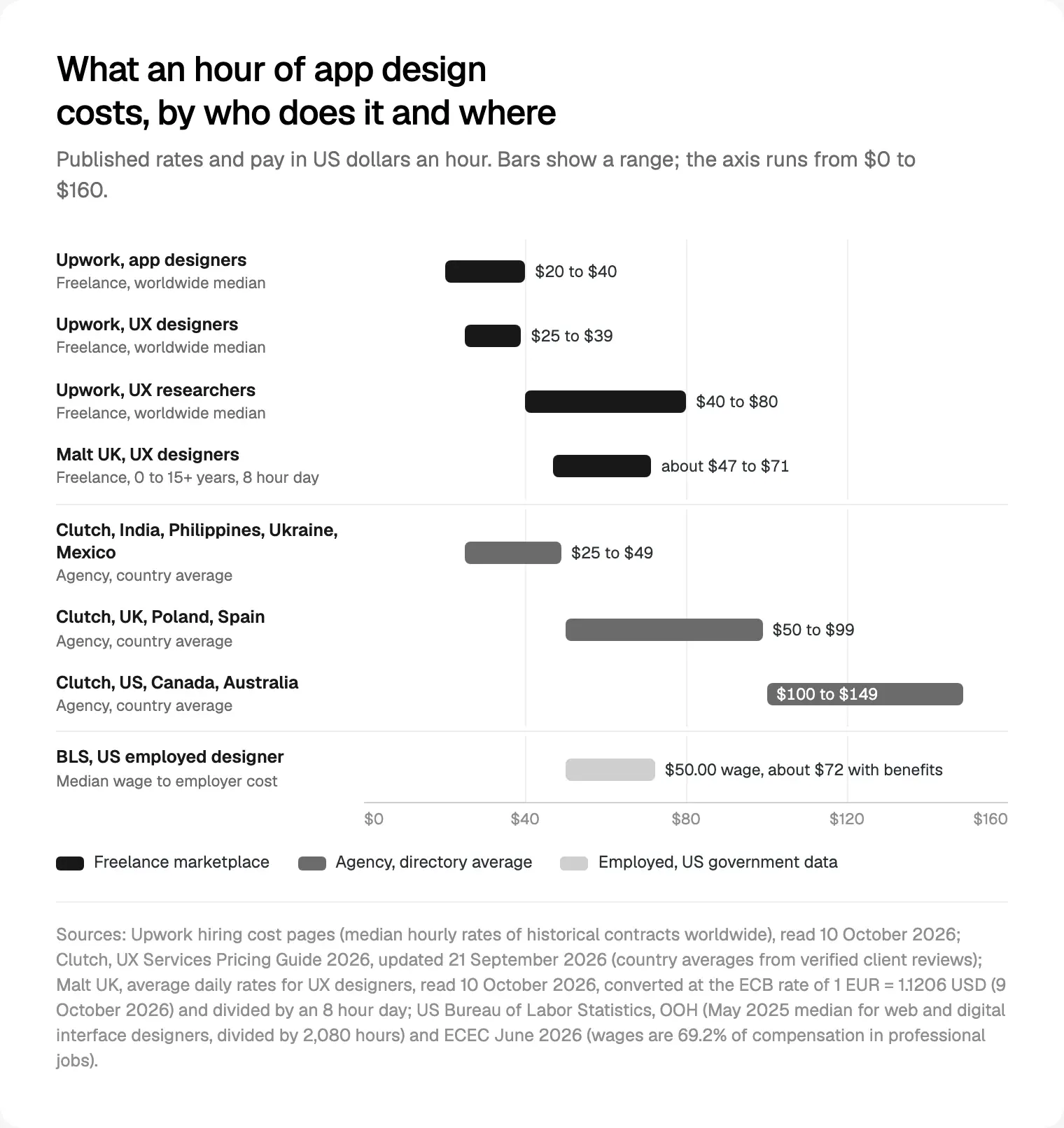
Two warnings. Upwork's figures are medians of past contracts, so they show the middle of a wide market, not the senior end. Clutch's come from client reviews of agency projects, so they lean towards firms that ask for reviews.
Screens, flows and states: where most of the hours go
When a founder tells me "it's about 20 screens", I ask for the flows instead, because a screen count hides most of what costs time. The map below is the picture I draw in my head on an intro call.
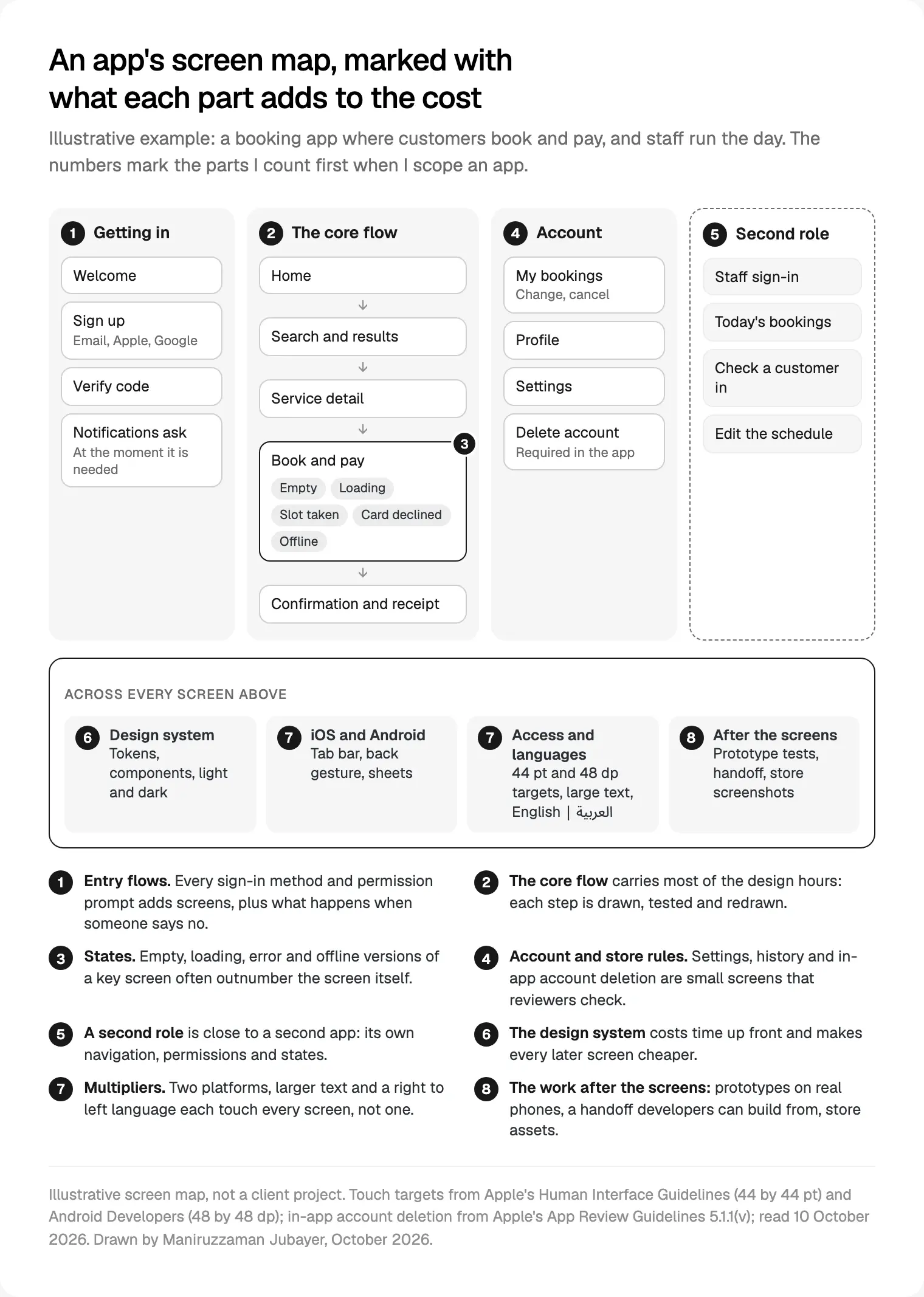
Here's how I read it, in the order I count.
Entry flows (1). Every sign-in method is another path with its own ways to fail: a wrong code, an expired link, a declined permission. Apple's App Review Guidelines ask apps to offer alternatives when people refuse access, for example typing an address when they won't share their location, so "they said no" is a screen, not an edge case.
The core flow (2). Book, send, order, track: the reason the app exists. It gets most of the design time, because it's drawn, tested on real phones and redrawn. To cut cost, cut a secondary feature, never this flow. My guide on how I scope an MVP shows how I decide what stays in it.
States (3). Each key screen needs empty, loading, error and often offline versions; a booking screen also needs "slot taken" and "card declined". On most apps I scope, states outnumber screens. A quote that lists no states has usually left them out, and you'll pay for them later as change requests.
Account and store rules (4). Settings, history and account deletion feel like housekeeping, but reviewers check them: Apple's guideline 5.1.1(v) says an app that lets people create an account must let them delete it inside the app. My list of design fixes that prevent App Store rejection covers the rest.
A second role (5). Staff, drivers or admins need their own navigation, permissions and states. A second role is closer to a second app than to a few extra screens, and it's the line most often missing from briefs.
Platforms, accessibility and languages: the multipliers
The band at the bottom of the map doesn't add screens. It changes every screen.
iOS, Android or both
Designing for both platforms doesn't cost twice as much, but it costs more than one. Layouts carry across; navigation, back behaviour, sheets, pickers and type differ, because Apple's Human Interface Guidelines and Material Design expect different things. One set of flows and one system, adapted where each platform differs, is how I plan iOS and Android app design. On a tight budget, launching on one platform first is a fair trade.
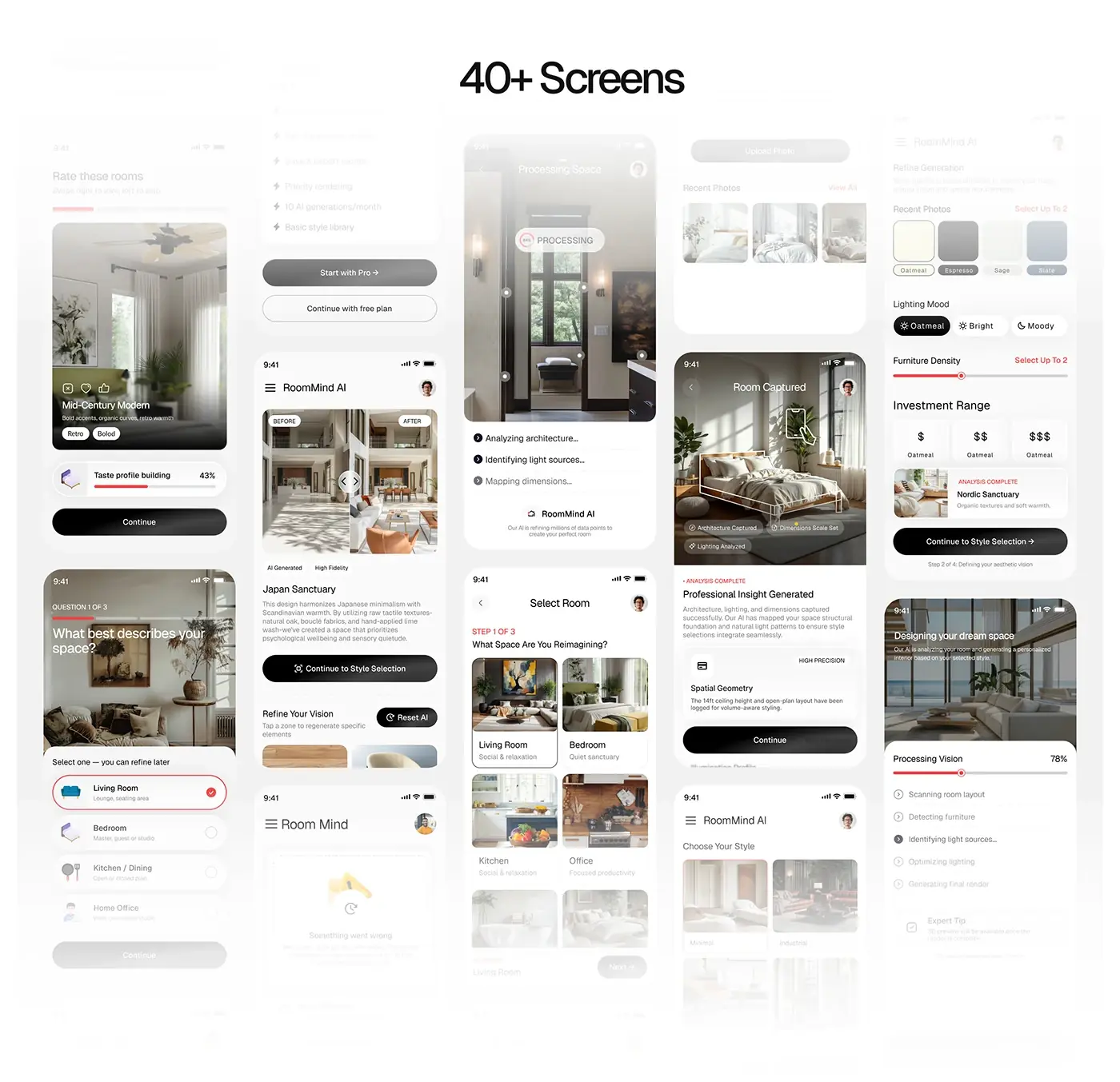
My team designed RoomMind AI, an iOS app that redesigns a room from one photo. One platform means one set of conventions, store assets and review process.
Accessibility
Accessibility is cheap in the components and expensive as an audit at the end. The numbers are public:
- Apple's accessibility guidelines give a default hit target of 44 by 44 points on iOS and ask that text can grow by at least 200 percent.
- Android Developers' guide to making apps more accessible recommends touch targets of at least 48 by 48 dp.
- WCAG 2.2, a W3C Recommendation since 5 October 2023, adds a minimum target size of 24 by 24 CSS pixels for web views.
Large text is the one founders underestimate: when text doubles, rows wrap and labels truncate, so key screens need a large-text pass. In the EU, the European Commission's AccessibleEU centre notes that since the European Accessibility Act entered into force on 28 June 2025, banking and transport services among others must be accessible.
Localisation, and Arabic in particular
A second left to right language mostly costs copy and testing. Arabic costs more, because the layout mirrors. Apple's right to left guidelines say system components flip automatically, but custom components, directional icons, charts and numbers need decisions, and every screen needs checking both ways.
I found no published figure for what Arabic adds to a design budget, so I quote none: plan it early and price it as its own line. Translation is the cheap part; Upwork's median for translators is $15 to $25 an hour. If you're also choosing a stack, my comparison of Flutter or React Native for Arabic apps covers how each one handles mirroring.
Research, prototypes, the design system and the handoff
A cheap quote drops these first. I'd keep them hardest.
Research and testing. Interviews before design, and usability tests on a clickable prototype during it. Jakob Nielsen's article on why you only need to test with 5 users (Nielsen Norman Group, 18 March 2000) found five people surface about 85% of usability problems in a first round. So I test small, early and often. On Upwork, UX researchers have a median of $40 to $80 an hour and usability testing specialists $25 to $50.
Prototypes. A prototype tapped on a real phone catches what a static screen hides, such as a keyboard covering the button. It adds days and saves weeks of rework.
The design system. Tokens, components and type, in light and dark, named the same in Figma and in code so developers never guess which grey is which.
The handoff and store assets. Annotated specs, exported assets, and the store listing. Apple accepts up to 10 screenshots per device size and Google Play up to 8 for each device type. If nobody owns them, they're made the night before launch.
An "app UI design" quote covers only the visual layer, so it's lower: research, flows, testing and the system are left to you. Right buy with tested flows; wrong buy without.
Who designs it: in-house, freelancer or a team
The cheapest hourly rate is often not the cheapest project.
An in-house designer
The US Bureau of Labor Statistics' handbook entry for web developers and digital designers (last modified 27 August 2026) gives a May 2025 median of $104,000 a year for web and digital interface designers, the occupation that covers app interface design. The lowest tenth earned under $53,750 and the highest tenth over $201,550.
Salary isn't the cost. The BLS Employer Costs for Employee Compensation table for June 2026 shows that in professional jobs in US private industry, wages were 69.2% of what an hour of work cost the employer, and benefits the other 30.8%. Applied to the designer median, $50.00 an hour in wages becomes about $72.25 an hour to the employer, or roughly $150,300 a year, before recruiting, tools and management time.
Hire when there's design work every week for years. For a first version, you'd be hiring before you know what the product needs.
A freelancer
Freelancers are the most flexible option and the widest range. Upwork's app designer rates page puts the worldwide median at $20 to $40 an hour, and its UX designer page at $25 to $39. Upwork's own UI designer page estimates $30 to $125 an hour for interface layout work by intermediate US-based specialists.
In the UK, Malt's rate grid for UX designers shows average daily rates of €336 with 0 to 2 years of experience, €380 with 3 to 7, €445 with 8 to 15 and €510 with more than 15. At the ECB rate of $1.1206 to the euro, that's about $377 to $572 a day, or $47 to $71 an hour over an eight hour day.
The risks are capacity and cover: one person rarely brings research, interface design, a system and both platforms at the same depth.
An agency or a senior team
Clutch's UX services pricing guide, updated 21 September 2026 and compiled from verified client reviews, says most agencies charge $25 to $49 an hour. Projects reviewed on Clutch typically cost $10,000 to $49,999; the average project was $84,973 and ran about 10 months, around $8,895 a month. That average includes long engagements with ongoing work, so don't read it as the price of one app.
With a team you're buying several skills at once, and continuity. The risk is paying for layers you don't need, which a written scope prevents.
What app design costs by region
Clutch's guide publishes average agency rates by country, ranked by its traffic: $100 to $149 an hour in the US, Canada and Australia; $50 to $99 in the UK, Poland and Spain; and $25 to $49 in India, the Philippines, Ukraine and Mexico.
A lower rate doesn't always mean a lower project. What moves the gap:
- Seniority. Every country has juniors and seniors. Ask who will draw your screens.
- Overlap. Ten hours apart needs a fixed rhythm of written updates.
- Market knowledge. Arabic, local payments and local accessibility rules take time to learn.
For local numbers in the local currency, I've written separate guides: app design costs in Dubai in dirhams, what app design costs in Saudi Arabia in riyals, and design prices in Dhaka, in BDT and USD.
A worked scope, illustrative
Here's the booking app from the map, written as I'd write a scope. It's illustrative, and it carries no price, because a price means nothing until these lines are agreed.
| Part | What's in it | States to design |
|---|---|---|
| Getting in | Welcome, sign up with email, Apple and Google, code check, notification ask | Wrong code, expired code, permission declined |
| Core flow | Home, search, results, detail, book and pay, confirmation | Empty results, loading, slot taken, card declined, offline |
| Account | Bookings, change or cancel, profile, settings, delete account | Cancelled, refund pending, nothing booked yet |
| Staff side | Staff sign-in, today's bookings, check-in, schedule edits | No bookings, clash, lost connection mid-check-in |
| Design system | Tokens, components, type that scales, light and dark | Large text pass on key screens |
| Languages | English first; Arabic as a separate line if needed | Every key screen checked in both directions |
| Testing | Two rounds of five people on a phone prototype | Fixes from each round |
| Handoff | Specs, assets, a walkthrough, store screenshots | Answers during the build |
Written this way, two suppliers can't quote different things as the same app, and you can see where to save: staff side on one platform, Arabic as a second phase.
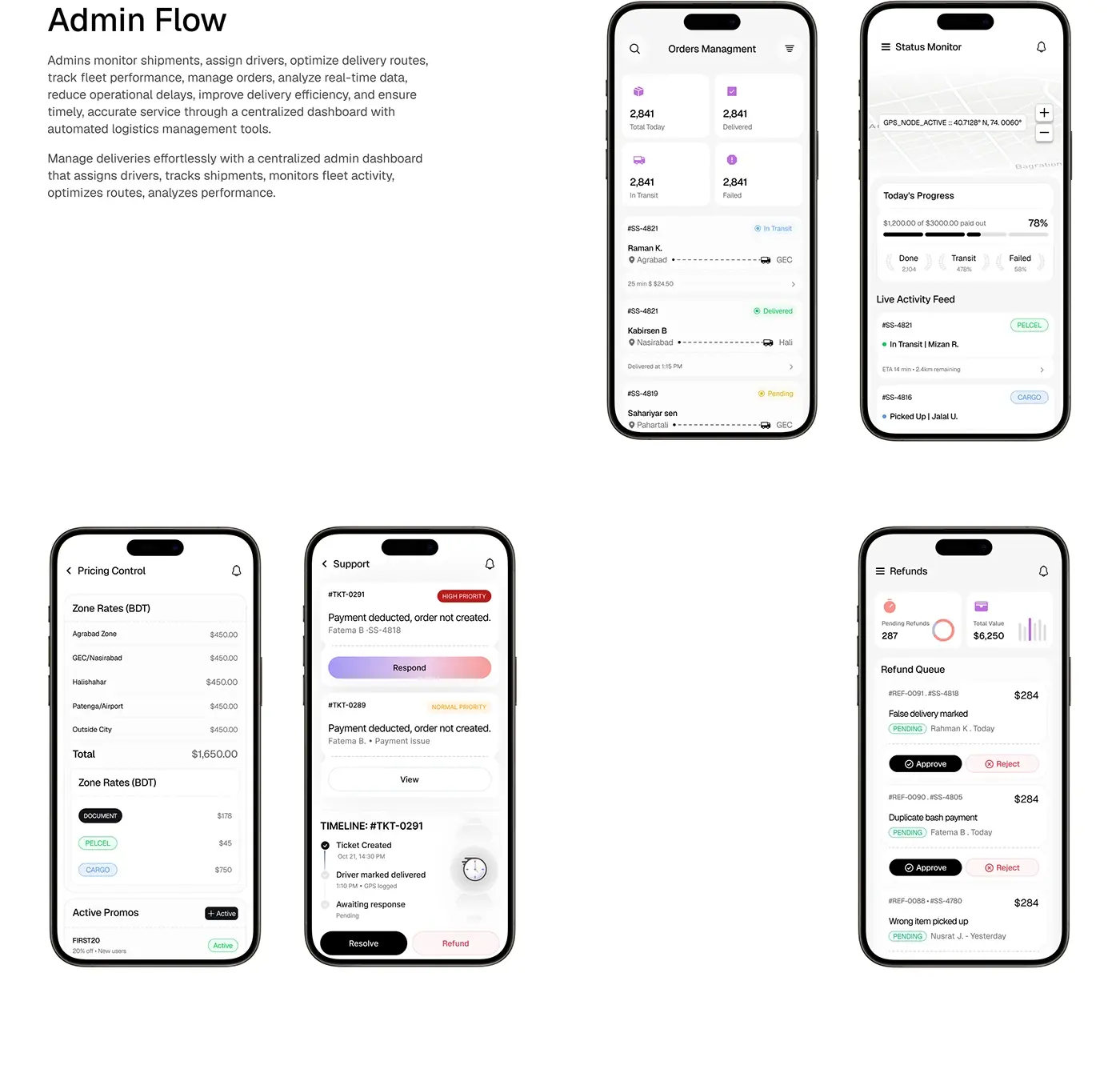
My team designed Shipora, a delivery app built around live tracking. The slide shows point 5 on the map: screens for the people running a service are a product of their own.
A quick sense check on any quote
Take a hypothetical quote for one designer over eight weeks: 320 hours. At Upwork's $20 to $40 median, that's $6,400 to $12,800. At Clutch's most common agency band of $25 to $49, it's $8,000 to $15,680. At the US agency average of $100 to $149, it's $32,000 to $47,680. Far below hours times any credible rate? Ask what's missing.
How to compare app design quotes
This is the order I'd follow if I were the one buying.
- Write the flows, not "an app". Use the screen map as a checklist: entry, core flow, account, any second role.
- Name the platforms and the order. iOS, Android or both, and whether one launches first.
- Say which languages launch, and when. If Arabic is coming in year one, say so now.
- List the deliverables. Research, flows, screens with states, prototype, testing rounds, design system, handoff, store assets.
- Ask for one fixed price for the whole defined scope, with assumptions and exclusions written down, and the named people who will do the work.
- Put every quote on one sheet: people, weeks, deliverables, what's excluded, who owns the files.
- Look at shipped apps, not mockups. Ask to see states and edge cases from their past work, not only hero screens.
Red flags I'd walk away from:
- No states in the scope, or "error states as needed".
- A total far below hours times rate, with no explanation.
- "Both platforms" with no word on what differs between them.
- Unlimited revisions, which usually means no clear process.
- No mention of who owns the Figma files and the design system after handoff.
Where I would start
I'd write the one-page flow list before speaking to anyone, me included. It takes an afternoon and makes every quote more honest. Then judge scope before the number: a higher quote with states, testing and a system can cost less than a low one that leaves them for change requests.
Here's how my own pricing works, so you can compare like for like. A project starts with a free 30 minute intro call. Then I write a scope and give one fixed quote for the whole project: no retainer, nothing billed by the hour. My team designs the app and can stay with it into production, building it in React Native or Flutter, or handing your developers a documented system. You can read who I am and how my team works, or see what's included in my app design work for founders.
Frequently asked questions
How much does it cost to design an app?
It depends on flows, states, platforms and user roles more than screens. Clutch says reviewed design projects typically cost $10,000 to $49,999, averaging $84,973 over about 10 months. Upwork's worldwide median for app designers is $20 to $40 an hour; most Clutch agencies charge $25 to $49. Get a written scope before trusting any total.
How much does a freelance app designer charge per hour?
Upwork's worldwide median is $20 to $40 an hour for app designers and $25 to $39 for UX designers, from past contracts. In the UK, Malt shows UX designers averaging €336 to €510 a day by experience, about $47 to $71 an hour. Upwork estimates $30 to $125 an hour for intermediate US-based interface work.
Does designing for iOS and Android cost twice as much?
No, but it costs more than one. Most layouts and the design system are shared, while navigation, back behaviour, sheets, pickers and type follow each platform's guidelines and are adapted for each. Launching on one platform first spreads the cost and lets you learn from real users before paying for the second.
What is the difference between app UI design cost and full app design cost?
An app UI design quote covers the visual layer: final screens, colour, type and components. A full quote adds research, flows, states, prototypes, testing, a design system and the handoff. UI-only work is cheaper and fits when your flows are already tested; without that, you may polish screens that still confuse people.
How much does an in-house app designer cost?
In the US, web and digital interface designers earned a median of $104,000 in May 2025, according to the BLS. Benefits add more: in professional jobs, wages were 69.2% of an employer's cost per hour in June 2026, so that median comes to roughly $150,000 a year to the employer, before recruiting, tools and management time.
Does adding Arabic make app design more expensive?
Yes. Arabic is right to left, so layouts mirror, directional icons flip, and custom components, charts and numbers need decisions. Every key screen needs checking in both directions. I haven't found a published figure for the extra cost, so I won't quote one. Ask each supplier to price Arabic as its own line and to list exactly what it includes.
Is it cheaper to hire an app designer in another country?
Often, by the hour. Clutch's country averages run from $100 to $149 an hour in the US, Canada and Australia to $25 to $49 in India, the Philippines, Ukraine and Mexico. The saving shrinks if the team is junior, shares few hours with you or hasn't shipped for your market. Check named people and past apps.
What should an app design quote include?
The flows and screens with their states, the platforms, the languages, the number of testing rounds, the design system, the handoff and store assets. It should give one price for the defined scope, list assumptions and exclusions, name the people doing the work, and say who owns the source files. If any of these is missing, ask before comparing totals.
Sources and method
Read on 10 October 2026. Annual pay is divided by 2,080 hours; Malt's daily rates by eight hours, converted at the ECB rate for 9 October 2026. Clutch's key findings list user research at $100 to $149 an hour while its own service table says $25 to $49, so I quote neither. Data is thin for the senior end of freelance rates and for what Arabic adds to a budget. The screen map and the worked scope are illustrative and carry no prices of mine.
- US Bureau of Labor Statistics, Occupational Outlook Handbook, web developers and digital designers (May 2025 pay, last modified 27 August 2026), date read 10 October 2026: bls.gov
- US Bureau of Labor Statistics, Employer Costs for Employee Compensation, Table 4, June 2026, date read 10 October 2026: bls.gov
- Upwork, hiring cost pages for app designers, UI designers, UX designers, UX researchers, usability testing specialists and translators, date read 10 October 2026: app designers, UI designers, UX designers, UX researchers, usability testing, translators
- Malt UK, average freelance rates for UX designers, 2026 rate grid, date read 10 October 2026: malt.com
- Clutch, UX Services Pricing Guide 2026 (updated 21 September 2026), date read 10 October 2026: clutch.co
- European Central Bank, USD reference rate, 9 October 2026, date read 10 October 2026: ecb.europa.eu
- Apple, App Review Guidelines (5.1.1, last updated 8 June 2026), Human Interface Guidelines and screenshot specifications, date read 10 October 2026: review guidelines, accessibility, right to left, screenshots
- Google, Play Console Help on preview assets, and Android Developers on accessible apps (updated 22 September 2026), date read 10 October 2026: support.google.com, developer.android.com
- W3C Web Accessibility Initiative, what's new in WCAG 2.2, date read 10 October 2026: w3.org
- AccessibleEU (European Commission), the European Accessibility Act enters into force, 27 June 2025, date read 10 October 2026: accessible-eu-centre.ec.europa.eu
- Nielsen Norman Group, Jakob Nielsen, why you only need to test with 5 users, 18 March 2000, date read 10 October 2026: nngroup.com