Design engineer, product designer or frontend developer: which to hire first
Design engineer vs product designer vs frontend developer: what each owns, where handoffs lose detail, and which one a startup should hire first.

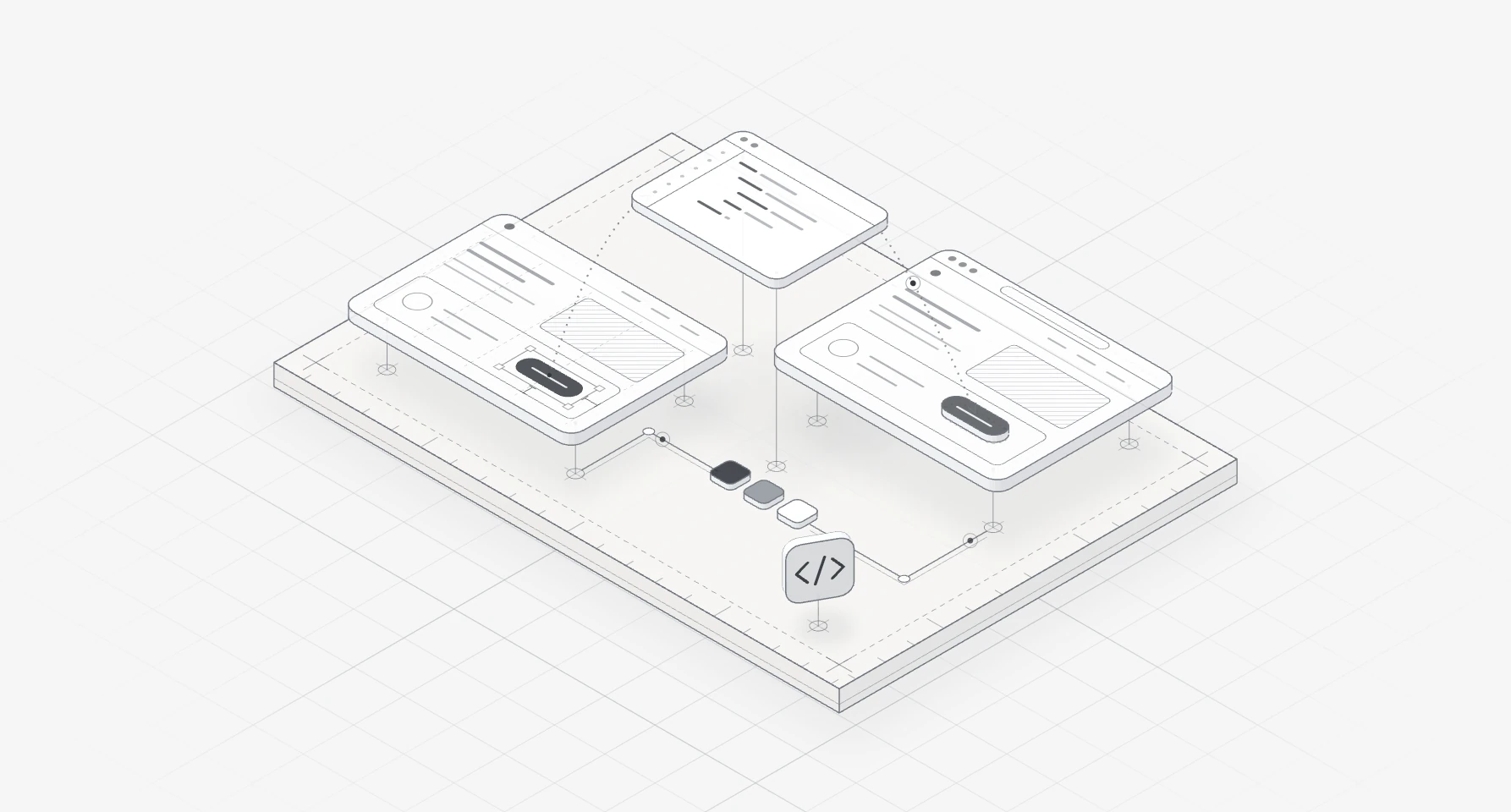
A product designer decides what the product should do and how it looks, and proves it with research, flows and a prototype. A frontend developer turns those decisions into working code. A design engineer does both for the interface, designing the screens and building them in production code, so nothing is lost between the Figma file and what ships.
That third role is my work: I'm a design engineer for startups and lead a senior team of designers and developers in Dhaka. So I'm biased, and I'll say where I'm the wrong first hire.
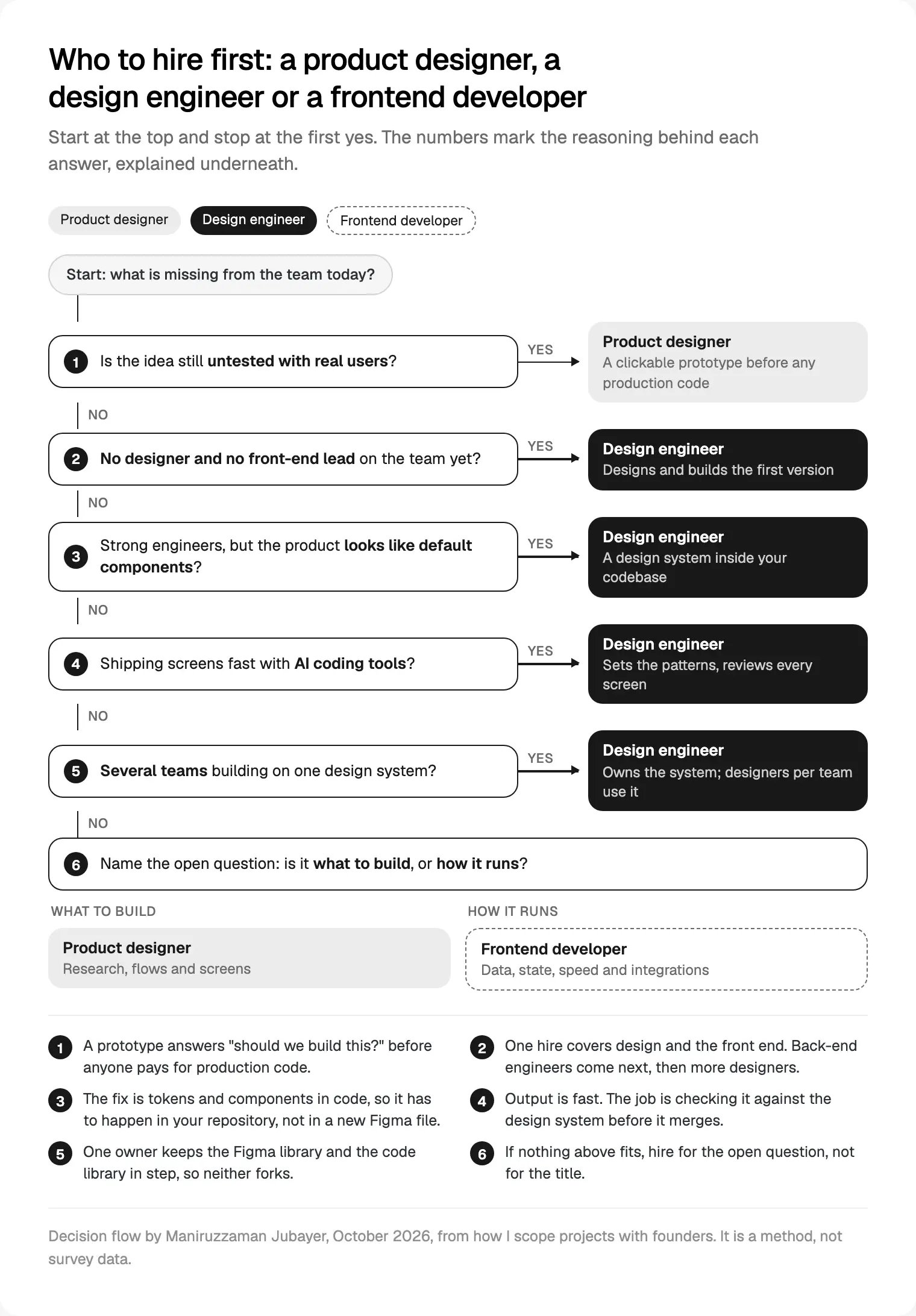
Who you hire first depends on what's missing: with no designer and no front-end lead, a design engineer covers the most ground in one hire. An untested idea needs a product designer and a clickable prototype. Strong engineers with a product built from default components need a design engineer, and hard problems in data, state and APIs need a frontend developer.
This is for founders and product leads choosing a first design or front-end hire. For the role on its own, read what a design engineer does and when to hire one; this post is the comparison and the decision.
Design engineer vs product designer vs frontend developer at a glance
Titles overlap more every year, so compare what each person owns. This is how I split the work when I scope a project.
| Product designer | Frontend developer | Design engineer | |
|---|---|---|---|
| Question they answer | What should we build, and does it work for people? | How does it run, fast and reliably? | Does what ships behave as designed? |
| Decisions they own | Problem, flows, hierarchy, visual design | State, data, routing, performance | Components, tokens, motion, states, accessibility in code |
| What they deliver | Research, flows, a prototype, Figma screens | Features, tests, pull requests, integrations | Coded components, one design system in Figma and code |
| Daily tools | Figma, research tools, AI prototyping | TypeScript, React, browser dev tools, CI | Figma beside the codebase, Storybook, AI coding tools |
| Where the work ends | A frame marked ready for development | A merged, deployed feature | The live screen, checked against the design |
| Usually doesn't own | Production code | Design decisions | The back end, long research programmes |
The last two rows matter most: in a small team, someone has to pick up whatever lies past each role's edge.
What a product designer owns, and where the work stops
A product designer's real output is decisions: which problem comes first, which flow is the core one, what a screen leaves out. The UK government's interaction designer role, the closest official description I know, frames it that way: designs built on evidence of user needs and organisational outcomes.
The role is moving closer to code. Vercel's Senior Product Designer, Growth posting asks for working prototypes in Figma, v0, Cursor and Claude Code, yet puts customer research, hypotheses and success measures at the centre of the job.
In most teams the work stops at a frame marked "ready for dev" in Figma's Dev Mode, the workspace where developers inspect designs and manage the handoff. Everything after that mark belongs to someone else, and that's where detail slips.
When the open question is "what should this product be?", hiring a product designer for SaaS comes before any code.
Design engineer vs frontend engineer: who owns the code
"Design engineer vs frontend developer" and "design engineer vs frontend engineer" are one question: frontend developer and frontend engineer are the same job under two titles.
Brad Frost's essay on front-of-the-front-end and back-of-the-front-end development (16 February 2021) draws the useful line. The front of the front end is semantic HTML, CSS, accessibility and the component library: how a button looks and responds. The back is business logic, state, routing, authentication and API calls: what happens after it's pressed.
A design engineer lives in the first half and also makes the design decisions. A frontend engineer usually owns the second half, or both without owning the design. The UK government's frontend developer role (updated 28 August 2026) centres on accessible code, standards, integration and web performance, working alongside researchers and designers.
Hand both a settings page with a save button. The frontend engineer asks what the API returns and what to cache. A good design engineer asks that too, then what the button says while it saves and where focus goes afterwards.
Hire a frontend developer first when the risk sits in the data (real-time updates, permissions, integrations) and the design is settled. My team does that build too, from MVP development in Next.js onwards.
What a design engineer owns that the other two don't
Vercel's team, writing on design engineering at Vercel in March 2024, describes designers sketching the start and iterating with a design engineer in Figma or code, instead of handing over finished screens. Vercel's current Design Engineer posting asks one person to own product design and frontend implementation in React and TypeScript, and quality after launch: accessibility, performance and edge cases.
In my work, that means owning three things nobody else does:
- The design system as code. Tokens and components are named the same in Figma and the repository. The W3C Design Tokens Community Group published its first stable tokens specification on 28 October 2025, a shared format for these decisions.
- States and motion, designed on purpose and built in the same sprint.
- The final check: the live screen compared with the design, by someone who can fix either.
That's how I run one feature from Figma to production each week, with no document passing between two teams.
Where the handoffs between them lose detail
Between a product designer and a frontend developer sits a handoff: a file, a spec, a ticket. Figma's Code Connect narrows it by showing your real component code in Dev Mode instead of generated snippets, on Organization and Enterprise plans. This is what goes missing most, in the order I check it:
- States. Designs show the happy path; production meets loading, empty, error and no permission.
- Real content. Long names, long translations, big numbers, no profile photo.
- Motion. Easing, timing, and what happens when someone's device asks for less motion.
- Accessibility. WCAG 2.2 asks at level AA for pointer targets of at least 24 by 24 CSS pixels (2.5.8) and for a focused control never to be entirely hidden, say behind a sticky footer (2.4.11). Both vanish when a component is rebuilt from a picture.
- Widths between the frames. The file shows a phone and a desktop; the code meets every width in between.
- Names. A colour called one thing in Figma and another in code, until nobody knows which is right.
Which to hire first: five situations
A founder with no designer and no front-end lead
Hire a design engineer, or a small team led by one: one accountable person for the first version, instead of two hires and a handoff from day one. The risk is research, so make sure they talk to users. Hire back-end engineers next, and a product designer when research outgrows one person. If the scope is still fuzzy, start with scoping an MVP before anyone codes.
An engineering-led team whose product looks like default components
Hire a design engineer who works inside your codebase and review process. A product designer drawing a new Figma file rarely fixes this, because the problem is the system your engineers build with: tokens, spacing, components and their states. Fix those in code and every new screen improves.
An AI product team shipping fast with AI coding tools
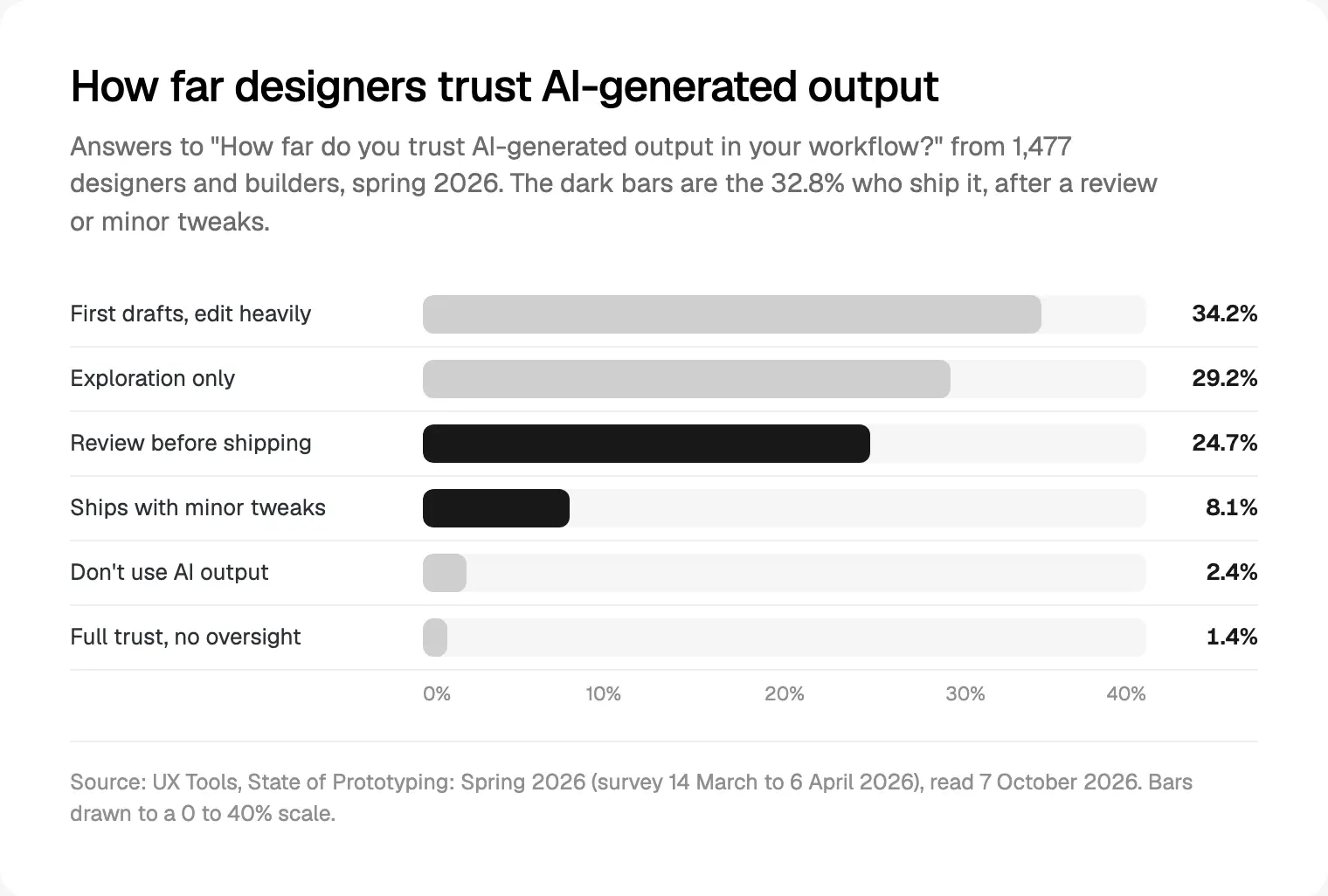
Here the bottleneck is review, not output. In UX Tools' State of Prototyping, Spring 2026 (1,478 responses, 14 March to 6 April 2026), 80.9% of design engineers spent half or more of their building time on AI-generated code, against 35% of individual-contributor designers. Only 32.8% of respondents trust that output enough to ship after a review, and 1.4% without oversight.
Developers agree. In the Stack Overflow 2025 Developer Survey, 84% of respondents used or planned to use AI tools, and 66% named "AI solutions that are almost right, but not quite" as their top frustration. Figma's MCP server can hand a coding agent your variables and components, but only a clean system and a reviewer make that pay off.
So hire a design engineer to set the patterns (streaming answers, sources, approvals, undo) and review generated screens before users see them. My patterns for AI features people trust are where I start.
A company with a growing design system
Hire a design engineer to own the tokens, components, documentation and the rules for adding to them, then product designers for each team who design with the system. Without an owner in code, the Figma library and the code library drift apart, and each team builds its own button.
A very early idea that only needs a prototype
Hire a product designer, or nobody yet. A clickable prototype tested with real users answers "should we build this?" long before production code can. Here I may be the wrong first hire, and I'll say so on the intro call.
What each pair of roles covers, and what it misses
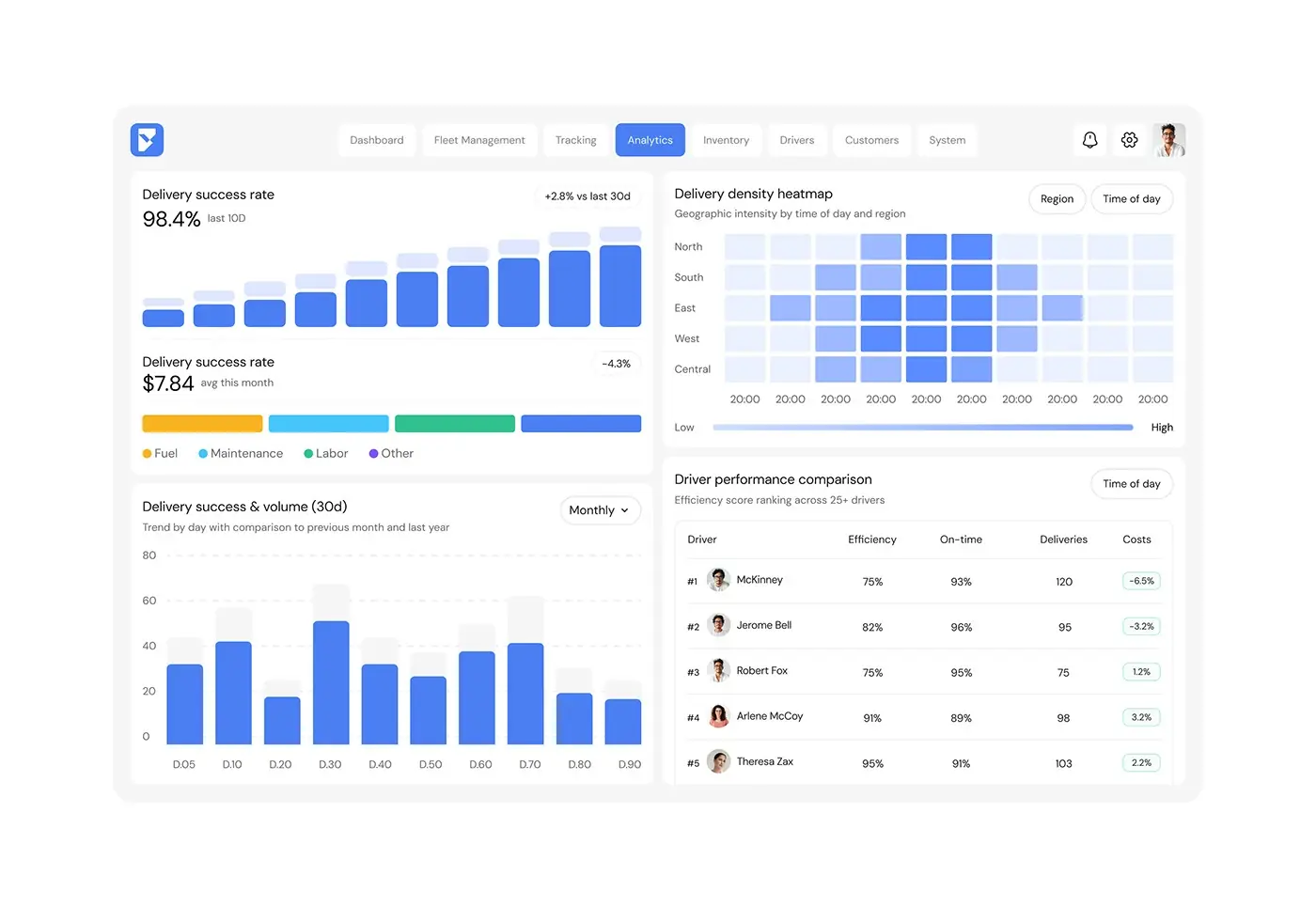
Most startups have two of these roles before all three, and each pair leaves a different gap.
| Pair | Covers | Misses | Works when |
|---|---|---|---|
| Product designer and frontend developer | Research, flows and a solid build | States, motion, accessibility details, drifting names | A design system exists that both read from |
| Product designer and design engineer | Research, plus an interface built as designed | Back-end depth: data, infrastructure, integrations | The back end is simple or bought in |
| Design engineer and frontend developer | Interface quality and a strong technical front end | Research and problem framing | You already know what to build |
| A design engineer alone | One owner from first frame to release | Research depth, and capacity as you grow | A first version with a tight scope |
The first pair is the classic set-up; until a shared design system exists, every screen is a translation. The second is closest to how my team works, with me owning the seam.
Product designer vs product engineer, and other titles you'll meet
Titles blur because the work has. Figma's 2026 AI report (24 June 2026, 8,403 survey responses over three years) found that designers taking part in development doubled to 41% in a year, and developers doing design work rose from 44% to 60%.
- Designer vs design engineer. A designer may prototype in code but isn't accountable for what goes live. A design engineer is.
- Product designer vs product engineer. A product engineer is an engineer first, building features end to end and caring whether people use them, but not deciding how a screen looks and behaves.
- UX engineer, UI engineer, creative developer. Overlapping jobs that mean different things at each company.
Write the job as decisions and deliverables, using the first table, and hire whoever has done that work.
How to tell them apart in an interview
One conversation about a shipped screen tells you more than a title. Vercel's design engineer posting sets a good bar: the work should show what the candidate personally identified, designed, built, shipped and learned after launch.
| Role | Ask | Strong answer | Portfolio signal |
|---|---|---|---|
| Product designer | "Show me a decision you changed after testing." | The evidence, the change, what they dropped | Problems and flows, not only final screens |
| Frontend developer | "How did you handle a slow or failing API?" | States, retries, caching, what the user sees | Code they can explain, tests, a performance fix |
| Design engineer | "Show me one screen in Figma and live. What changed, and who decided?" | Knows every difference and owns the trade-offs | One component in Figma and code, with states and motion |
For design engineers, I add two more:
- "Do your Figma components and code components share names and variants?"
- "What do you check in an AI-generated screen before it merges?"
Be wary of a design engineer portfolio of static shots, a front-end portfolio with no states, and a product designer who can't say what research changed.
Where I would start
Take the three columns from the first table and tick what your team owns. The empty column is your first hire. If it's design and the idea is untested, hire a product designer and prototype. If it's the seam (the states, the system, the live screen matching the design), that's my work, with a senior team building beside me.
It starts with a free 30 minute intro call. Bring the product, the Figma file or the repository, and I'll tell you honestly which of the three you need first. If we fit, a written scope and one fixed quote follow. Read more about my design engineering work with founders.
Frequently asked questions
What is the difference between a design engineer and a product designer?
A product designer decides what the product does and how it looks, through research, flows, prototypes and screens, then hands the design to developers. A design engineer designs the interface and builds it in production code, owning the design system, states, motion and accessibility details. The product designer's work usually ends at the handoff; the design engineer's ends at the live screen.
Is a design engineer the same as a frontend developer?
No, though they overlap. A frontend developer, or frontend engineer, turns designs into working software and often owns state, data, routing and performance. A design engineer works on the visual and interactive half of the front end and also makes the design decisions. Larger teams need both.
What is the difference between a product designer and a product engineer?
A product designer is a designer: research, flows, interaction and visual design. A product engineer is an engineer who builds features end to end and cares whether people adopt them. Both think about users, but only the designer owns how the product looks and behaves, so hiring a product engineer first still leaves the interface without an owner.
Should a startup hire a designer or a design engineer first?
Hire for what's missing. With an untested idea, a product designer and a clickable prototype come first. With no designer and no front-end lead, a design engineer covers the most ground in one hire. With strong engineers and a product that looks unfinished, a design engineer inside your codebase usually fixes more than new mockups.
Is a design engineer more expensive to hire than a product designer?
I found no official statistics for the title, only employers' postings. Vercel's, read 7 October 2026, list San Francisco base pay of $208,000 to $312,000 for a Design Engineer and $172,000 to $258,000 for a Senior Product Designer, Growth. That's one company, one city and two different levels. For a startup, compare one design engineer with two hires and the handoff between them. I compare the three ways to pay for the work in what a design engineer costs.
What should a design engineer's portfolio show?
Shipped work with both sides visible: the Figma file and the live product, ideally the same component in each. Look for loading, empty and error states, motion in a video or live link, and notes on what changed between design and code, and why. Static screenshots alone can't show the part of the job that matters most.
Sources and method
I read every source on 7 October 2026; job postings change, so treat them as a snapshot. Survey samples are self-selected: UX Tools spread its survey through its newsletter, social channels and sponsors, and Figma's figures span three years and ten markets. I found no government statistics for the design engineer title. The decision flow and the pairs table are my own method.
- Vercel, Design Engineering at Vercel (29 March 2024), read 7 October 2026: vercel.com
- Vercel, Design Engineer job posting, read 7 October 2026: vercel.com
- Vercel, Senior Product Designer, Growth job posting, read 7 October 2026: vercel.com
- Brad Frost, front-of-the-front-end and back-of-the-front-end web development (16 February 2021), read 7 October 2026: bradfrost.com
- UK Government Digital and Data, frontend developer role (updated 28 August 2026), read 7 October 2026: understand-digital-data-roles-skills.service.gov.uk
- UK Government Digital and Data, interaction designer role (updated 28 August 2026), read 7 October 2026: understand-digital-data-roles-skills.service.gov.uk
- Figma, 2026 AI report (24 June 2026), read 7 October 2026: figma.com
- UX Tools, State of Prototyping: Spring 2026, read 7 October 2026: uxtools.co
- Stack Overflow, 2025 Developer Survey, AI section, read 7 October 2026: survey.stackoverflow.co
- W3C, WCAG 2.2 Recommendation (12 December 2024), read 7 October 2026: w3.org
- W3C Design Tokens Community Group, first stable Design Tokens specification (28 October 2025), read 7 October 2026: w3.org
- Figma Help Center, Guide to Dev Mode, read 7 October 2026: help.figma.com
- Figma Help Center, Code Connect, read 7 October 2026: help.figma.com
- Figma Help Center, Guide to the Figma MCP server, read 7 October 2026: help.figma.com