

SaaS development cost comes from two bills: the build and the monthly cost of running it. Public data puts custom software projects on Clutch at an average of $132,480.29, with $10,000 to $49,999 the most common project band and an average hourly rate of $25 to $49. What moves a SaaS product up or down that range is less the screen count than the SaaS plumbing: accounts and teams (multi-tenancy), sign-in and SSO, subscription billing, roles, audit logs, integrations and AI features. After launch, hosting, auth, billing fees and AI tokens become a monthly bill that grows with your customers.
I'm a design engineer: I design SaaS products and build them in TypeScript, React and Next.js. This guide is for founders budgeting a full SaaS product, not only a first version. If you're pricing an MVP alone, my MVP development cost guide goes deeper on that. The build side of my work is on my development page.
What the public data says about SaaS development cost
Most pages ranking for this query quote cost bands without a source. These are the figures I could trace.
- Clutch. Its software development pricing guide, updated 21 September 2026, lists an average project cost of $132,480.29, an average monthly cost of $10,209.39, a typical timeline of about 13 months, a most common project band of $10,000 to $49,999 and an average hourly rate of $25 to $49. These come from reviewed projects of every kind, not SaaS alone, so read them as a market reference, not a SaaS price list.
- Salaries, if you hire. The US Bureau of Labor Statistics puts the median pay for software developers at $135,980 a year, from May 2025 data, in its Occupational Outlook Handbook.
I found no independent survey of SaaS build costs specifically, so the rest of this guide explains what moves the number, with official prices for the monthly services.
SaaS development cost by stage
A SaaS product is never finished, so price it in stages.
| Stage | What it usually includes | What drives the cost |
|---|---|---|
| MVP | One core workflow, sign-in, one plan, card payments, a basic admin view | How narrow the first workflow is |
| Version 1 | Teams and invites, roles, several plans, onboarding, settings, email notifications, two or three integrations | Billing rules, permissions, integration count |
| Scale | SSO and directory sync, audit logs, usage-based billing, an API for customers, compliance work, performance tuning | Enterprise buyers' requirements |
The jump from MVP to version 1 surprises most founders: the core workflow exists, and what's new is everything that lets a company, not one person, use the product. My guide on how long it takes to build an app covers timelines per phase.
The SaaS features that move the cost
Multi-tenancy
Multi-tenancy means many customer companies share one product while each sees only its own data. The common approach for an early SaaS is one database with a tenant ID on every row and rules that enforce it on every query. Separate databases per customer cost more to run and migrate. Decide this before the first table is built: adding tenants to a product designed for single users means touching nearly every query.
Sign-in, teams and SSO
Email and social sign-in are cheap to rent. Enterprise sign-in is where the bill starts. Clerk's pricing lists a free Hobby plan with a limit of 50,000 monthly retained users per app, a Pro plan at $25 a month ($20 billed annually) with one enterprise SSO connection included, and each extra connection at $75 a month. WorkOS pricing lists the first 1 million monthly active users of its AuthKit sign-in free, and SSO at $125 per connection for the first 15 connections, with Directory Sync priced the same way.
The design work matters as much: invites, switching workspaces, and what happens when someone leaves a company.
Subscription billing
Card fees and billing fees stack. Stripe's pricing lists 2.9% plus 30 cents per successful domestic card transaction in the US, plus 1.5% for international cards and 1% if currency conversion is needed. On top of that, Stripe Billing charges 0.7% of billing volume on its pay as you go plan.
The build cost sits in your rules: trials, mid-month upgrades, seats, usage pricing, failed payment retries, invoices and taxes. Every rule is a screen and a set of edge cases.
Roles, permissions and audit logs
"Admin and member" is enough for an MVP. Version 1 usually adds custom roles, per-feature permissions and approval limits. Business buyers then ask who changed what, and when, which means an audit log. WorkOS lists audit log streaming at $125 a month per SIEM connection, which tells you how seriously larger customers take it.
Integrations
Each integration (Slack, HubSpot, an ERP) is its own small project: authentication, field mapping, outages and sync. Two good integrations beat ten fragile ones.
AI features and token costs
AI features have a build cost and a per-use cost. Anthropic's API pricing lists Claude Sonnet 5.5 at $2 per million input tokens and $10 per million output tokens, Claude Haiku 5.5 at $0.10 and $0.50 for prompts up to 100,000 tokens, and Claude Opus 5.5 at $4 and $20. The same page lists a 50% discount for batch processing and much cheaper cache hits for repeated context. It also notes that newer models use a tokenizer that produces roughly 30% more tokens for the same text, so test with real prompts before you budget.
The cost lever is design: which model per task, how much context per request, caching and batching. My free LLM token counter gives exact counts for OpenAI's encodings and estimates for Claude, which is enough to size a prompt before you price a feature.
Compliance and SOC 2
Larger customers often ask for a SOC 2 report. The AICPA describes SOC 2 as a report on controls at a service organisation relevant to security, availability, processing integrity, confidentiality and privacy. The cost isn't only the audit: access controls, logging, backups and policies get built into the product. Your vendors matter too: Supabase's pricing lists SOC 2 on its Team plan, from $599 a month, not on Pro.
Running costs per month after launch
These are the published prices I read on 10 November 2026 for services a typical TypeScript SaaS uses.
| Service | Published price | What grows the bill |
|---|---|---|
| Vercel hosting | Pro $20 a month per developer seat, with a $20 usage credit | Traffic and compute beyond the credit |
| Cloudflare Workers | $5 a month minimum, 10 million requests and 30 million CPU milliseconds included | $0.30 per extra million requests |
| Supabase database | Pro from $25 a month, 100,000 monthly active users and 8 GB disk per project | Users, disk and compute |
| Clerk auth | Pro $25 a month, 50,000 retained users included | Users and extra SSO connections |
| Stripe payments and Billing | 2.9% plus 30 cents per US card payment, plus 0.7% for Billing | Revenue |
| Claude API | Per million tokens, by model | AI usage per customer |
Supabase also notes that free projects pause after a week of inactivity, which rules out the free tier for a live product.
A worked example, with made-up revenue. Take a small B2B SaaS on Vercel Pro with one seat ($20), Supabase Pro ($25) and Clerk Pro ($25): $70 a month before usage. Now assume $10,000 of monthly subscription revenue from 200 US card payments of $50. Stripe card fees come to $290 plus $60, and Billing adds $70, so $420 a month in payment fees. Payment fees then cost more than the whole stack, so model running costs per customer, not per month.
Build, no-code or a vibe-coded prototype?
No-code tools are a fair way to test demand, until you need tenants, custom roles or billing rules they don't support; moving off usually means a rebuild.
A vibe-coded prototype from an AI app builder shows the idea well, but tenant isolation, permissions, billing edge cases and security tend to be missing. I wrote a separate guide on taking a vibe-coded app to production, including when to harden it and when to rebuild.
A custom build costs more up front, and you own the code and the data model. For the stack itself, see my pick of the best tech stack for SaaS.
How to cut SaaS development cost without hurting quality
- Rent the commodity parts. Auth, billing, email and hosting are solved problems. Your custom code belongs in the workflow customers pay for.
- Design before you build. Changing a Figma screen takes minutes; changing a shipped data model takes days.
- Decide tenancy and roles early, even if version 1 has two roles. Retrofitting either is one of the most expensive changes in SaaS.
- Launch with one or two plans. Every pricing rule adds billing screens and edge cases.
- Add SSO when a buyer asks, but pick an auth provider that supports it, so it's a setting rather than a rebuild.
- Put AI where it saves a person time, with the cheapest model that does the job, and measure tokens per customer from day one.
- Keep one design system with components named the same in Figma and in code, so every new screen costs less than the last.
Case studies: what the invisible SaaS features look like
Founders budget for the main dashboard and forget the screens around it. Two SaaS products I designed show them.
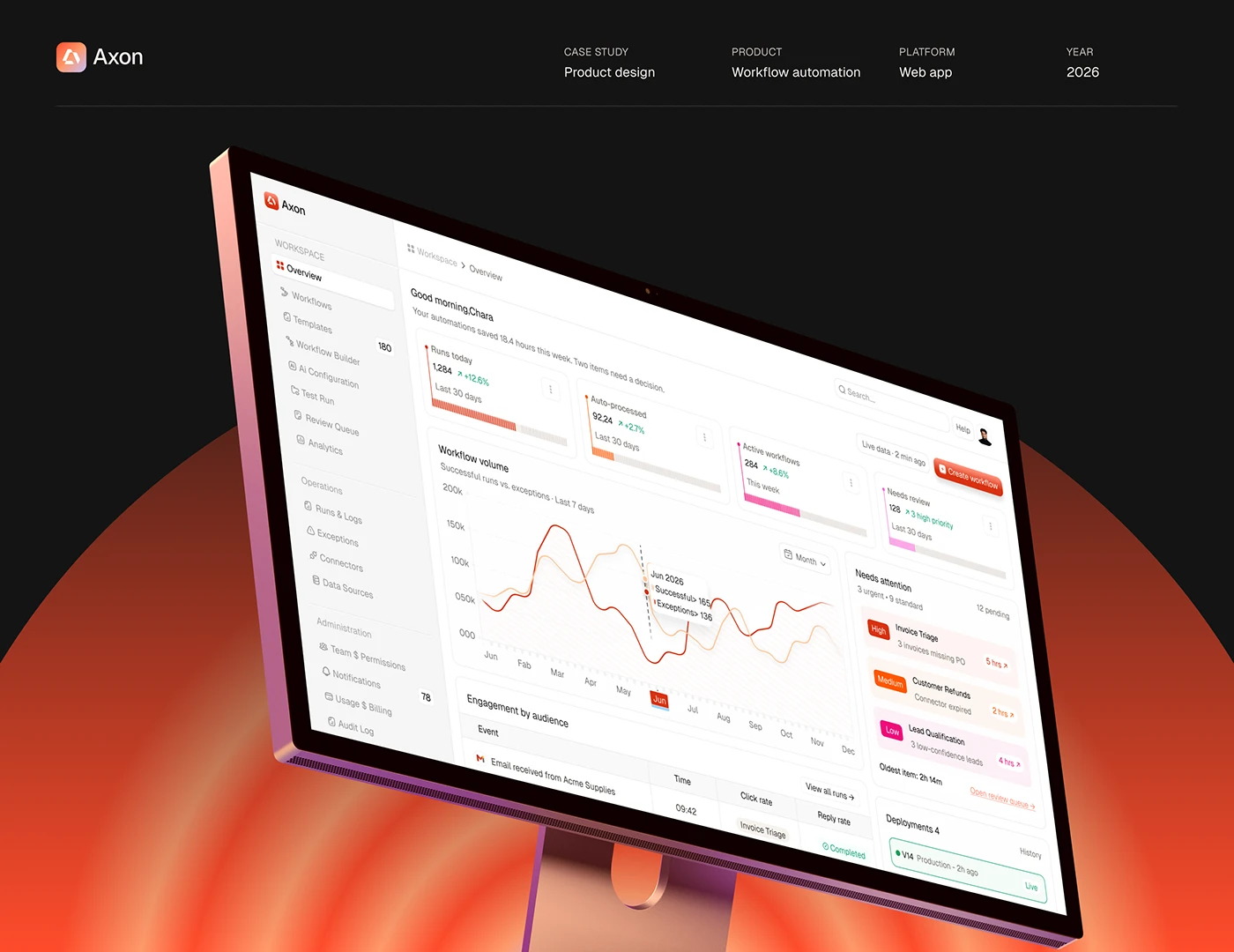
Axon is an AI workflow automation web app where every AI step carries a confidence score and uncertain runs pause for a person in a Review Queue. I designed 17 pages and 82 interaction states. Beyond the main screens, it has Team & Permissions with a role, a team and an approval limit on each member row, System Settings for single sign-on and sessions, a change plan dialog and an audit event drawer that records who changed what, and from where.
OpsLoop is a two-sided micro-task platform: teams post, assign and approve work, and workers find tasks, submit them and get paid. I designed every screen on both sides, including a payment dashboard with credits, top-up by card or bank transfer, spending by category and paid invoices.
How to get one fixed quote for your SaaS
A fixed quote needs a fixed scope. Before the intro call, write down:
- Who signs up: one person, a team, or a company with an admin.
- The roles, and what each one can see and do.
- Your plans, and how you charge: per seat, per use or flat.
- Integrations at launch, and which can wait.
- AI features, with what each one reads and produces.
- Who you sell to: if it's larger companies, list their likely security asks now.
On the call I ask about each of these, then send a written scope and one fixed quote for the whole project. No retainer, nothing billed by the hour.
Frequently asked questions
How much does SaaS development cost?
Clutch's pricing guide, updated 21 September 2026, lists an average software project cost of $132,480.29 and a most common band of $10,000 to $49,999, across all project types. Your cost depends on tenants, roles, billing, integrations and AI features. You get one fixed quote after a free intro call.
How much does it cost to run a SaaS each month?
At launch, a few services at their entry paid plans, such as Vercel Pro at $20, Supabase Pro at $25 and Clerk Pro at $25. Then payment fees, users and AI tokens grow with your customers.
Is SaaS development cost different from web app development cost?
An internal web app skips tenants, self-serve sign-up and subscription billing. A SaaS product needs all three, then SSO and audit logs.
What is the most expensive part of building a SaaS?
Usually the rules, not the screens: billing, permissions and integrations, each with many edge cases. AI features add a running cost per use on top.
Can you design and build my SaaS product?
Yes. I design the product and build it in TypeScript, React and Next.js, with a design system so the code matches the design.
Sources and method
I searched "saas development cost" on 10 November 2026 and read the top results; most quoted cost bands without sources, so I used only figures I could trace to the publisher. I read every source below on 10 November 2026. Prices change often, so check them before you budget. The worked example uses made-up revenue to show the arithmetic.
- Clutch, software development pricing guide (updated 21 September 2026), checked 10 November 2026: clutch.co
- US Bureau of Labor Statistics, Occupational Outlook Handbook, Software Developers (May 2025 pay), checked 10 November 2026: bls.gov
- Clerk, pricing, checked 10 November 2026: clerk.com
- WorkOS, pricing, checked 10 November 2026: workos.com
- Stripe, pricing, checked 10 November 2026: stripe.com
- Stripe, Billing pricing, checked 10 November 2026: stripe.com
- Anthropic, Claude API pricing, checked 10 November 2026: platform.claude.com
- AICPA and CIMA, SOC 2, checked 10 November 2026: aicpa-cima.com
- Supabase, pricing, checked 10 November 2026: supabase.com
- Vercel, pricing, checked 10 November 2026: vercel.com
- Cloudflare, Workers pricing, checked 10 November 2026: developers.cloudflare.com
If you're budgeting a SaaS product and want it designed and built as one piece of work, book a free 30 minute intro call. After it, you get a written scope and one fixed quote.
Tags: SaaS development cost, SaaS, Web app development cost, Custom software development cost, Development