


Bolt vs Lovable comes down to who's building and what comes next. Lovable suits a non-technical founder who wants a web app with a built-in backend, server-rendered pages on new projects and two-way Git sync to GitHub, GitLab or Bitbucket. Bolt suits someone who wants mobile apps through Expo, to import an existing GitHub repository, or to publish to Netlify instead of the builder's own hosting. Both list a Pro plan at $25 a month (checked 10 November 2026), but Lovable meters credits by task while Bolt meters tokens, and Bolt's token use grows with the size of the project. If your team already ships Next.js on Vercel, v0 is the third option worth comparing.
I'm a design engineer: I design products and build them in TypeScript, React and Next.js. An honest note first: I haven't built a product in Bolt, Lovable or v0, so everything below comes from their own docs and pricing pages, read on 10 November 2026, not from my own tests. What I add is the step after: what a generated app needs before paying customers use it, which is my development work.
Bolt vs Lovable vs v0 at a glance
| Lovable | Bolt | v0 | |
|---|---|---|---|
| Builds | Websites and web apps | Websites, web apps and mobile apps (Expo) | Full-stack web apps |
| Stack | TanStack Start for new projects; older projects React and Vite | "A wide range of JavaScript-based web frameworks", run in the browser | Next.js, React, TypeScript, Tailwind CSS and shadcn/ui |
| Backend | Lovable Cloud (built on Supabase), or your own Supabase | Bolt database, or Supabase on Pro and Teams | Marketplace integrations: Supabase, Neon, Upstash, Vercel Blob |
| Git | Two-way sync, one branch, no import | Two-way sync with GitHub on main, can import a repository | Working branches and pull requests, can import a repository |
| Hosting | lovable.app, custom domains on paid plans | bolt.host or Netlify, custom domains on Pro | Vercel; code can be exported and deployed elsewhere |
| Metered by | Credits by task complexity | Tokens, growing with project size | Credits, priced per model |
| First paid plan | Pro $25 a month | Pro $25 a month | Plus $30 per user a month |
What each one generates
Lovable. Its upgrade guide says TanStack Start became the default for new projects on 13 May 2026. Older projects run on React and Vite, which render pages in the browser; upgrading usually costs 10 to 35 credits. That matters for public pages you want found in search.
Bolt. Bolt's introduction says it builds websites, web apps and mobile apps from a prompt, with "a wide range of JavaScript-based web frameworks", running in WebContainers in your browser. Mobile apps go through its Expo integration.
v0. Vercel's full-stack guide says v0 defaults to Next.js because it gives the most reliable results, uses React Server Components and creates backend endpoints with App Router conventions.
Backend, database and sign-in
Lovable turns on its built-in backend, Lovable Cloud, by default. Its Supabase page says the built-in backend uses Supabase's open-source foundation, and that you can connect your own Supabase project instead if you want your own billing and full dashboard access. The catch is in its own words: Lovable doesn't move a project between the two in one step, in either direction, and some features (managed backups, the in-editor database and users views, Lovable-sent auth emails) need the built-in backend. Choose before you build.
Bolt creates a database automatically when the app needs one, per its database page. Sign-in isn't always added for you; you prompt for it, with settings for email confirmation, password reset and Google sign-in. Pro and Teams users can pick Supabase when they create a project; switching later "requires extra steps", and an existing Bolt database can be claimed into Supabase on those plans.
v0 connects to Supabase, Neon, Upstash and Vercel Blob through Vercel Marketplace integrations, so the database sits in that provider's account from the start.
Code export and GitHub
Lovable's Git sync works with GitHub, GitLab and Bitbucket, both ways: edits in Lovable become commits, and commits on the synced branch come back. It syncs one branch at a time and only exports, so you can't bring an existing repository in. The repository never contains your database's data, and syncing doesn't deploy changed edge functions or run new migrations. Downloading the code needs a paid plan, per its subscription plans.
Bolt's GitHub integration commits every change that doesn't break the project and checks GitHub every 30 seconds for outside changes. Its help page says a project links to the repository's main branch. You can also start a Bolt project from an existing repository.
v0 works on chat-specific branches and opens pull requests against a base branch you choose, per its GitHub docs, and its FAQ says you can import a GitHub repository or a zip.
Hosting and going live
Lovable hosts the published app on a lovable.app address, with HTTPS included. Custom domains need a paid plan. Its publish page mentions wrapping the published app in a native shell with Capacitor for the app stores.
Bolt gives every project a bolt.host address, per its hosting page. Custom domains need Pro. When a plan's hosting usage runs out, the site stops showing publicly until the next billing cycle. You can publish to Netlify instead.
v0 publishes to Vercel with preview and production deployments. Its FAQ says you can export the code and deploy elsewhere, though environment variables and previews work best with a connected Vercel project.
Plans, credits and limits, checked 10 November 2026
All prices in US dollars before tax. Plans change often, so check before you budget.
| Lovable | Bolt | v0 | |
|---|---|---|---|
| Free | 5 build credits a day, up to 30 a month | 1M tokens a month, 300K a day; Made in Bolt badge | 7 messages a day |
| First paid plan | Pro $25 a month for 100 credits, or $21 a month billed annually | Pro $25 a month from 10M tokens, no daily limit | Plus $30 per user a month, with $30 of monthly credits and $2 of daily credits |
| Team plan | Business $50 a month for 100 credits, adds SSO | Teams $30 per member a month | Business $100 per user a month, training opt-out by default |
| Rollover | Monthly plan credits expire two months after issue | Paid tokens roll over for up to two months | Not stated on the pricing page |
Sources: Lovable plans, Lovable credits, Bolt pricing, v0 pricing.
How the meters behave. Lovable's pricing page gives examples: "Make the button gray" costs 0.50 credits and adding authentication 1.20. Bolt's token guide says most token use comes from reading and syncing your project files, so larger projects use more tokens per message, and direct edits in code view use none. On both, changes cost more as the app grows.
Output quality: what I can and can't tell you
I found no independent benchmark comparing the code these tools produce, and the comparison pages ranking for this query mostly rest on one small test build or are written by one of the vendors. So instead of a score, here's what I'd check in whatever you generate, in any of the three:
- Access rules. Sign in as two different users and try to read each other's data.
- States. Empty lists, slow loading, failed payments, expired sessions. Generated apps tend to cover the happy path.
- Rendering. View the page source of a public page. If the text isn't there, search engines may not see it either.
- Accounts. Which database, hosting and payment accounts does the app use, and are they in your company's name?
My vibe coding to production checklist goes through each of these, with the row level security test I run.
v0 vs Lovable
These answer different questions. Lovable gives a founder without an engineer a whole app: screens, a backend and hosting in one place. v0 produces Next.js code that lands as pull requests on a repository and deploys to Vercel, which suits a team that already has an engineer and wants generated work reviewed like any other change. If nobody on your side reads code, pick the tool you can check.
Which one to pick
- You're not technical and want a web app this week: Lovable, choosing the built-in backend or your own Supabase before you start.
- You need a mobile app, or want to start from an existing repository: Bolt.
- Your team ships Next.js on Vercel: v0.
- None of these fits, or you're already leaving one: my Lovable alternatives post compares Replit and Claude Code as well.
When to bring in a design engineer
A generated app is a fast way to test an idea. It needs a person once customers pay: when a fix breaks something two screens away, a customer asks where their data is, or the screens need the empty, loading and error states nobody prompted for. That's design and code fixed together, which is my design engineering work.
How I take a Bolt, Lovable or v0 app further:
- A free 30 minute intro call. What the app does, who uses it, where it breaks and which accounts it runs on.
- A read of the repository and database before any screen: tables, ownership, access rules and secrets. I decide keep, fix or rebuild area by area.
- A written scope and one fixed quote. No retainer, nothing billed by the hour.
- The design pass, in weekly Figma sprints with a written update in Slack every 48 hours and a review call each week.
- The build in TypeScript, React and Next.js, with every account in your company's name. I use AI coding tools where they save time, and I review every change.
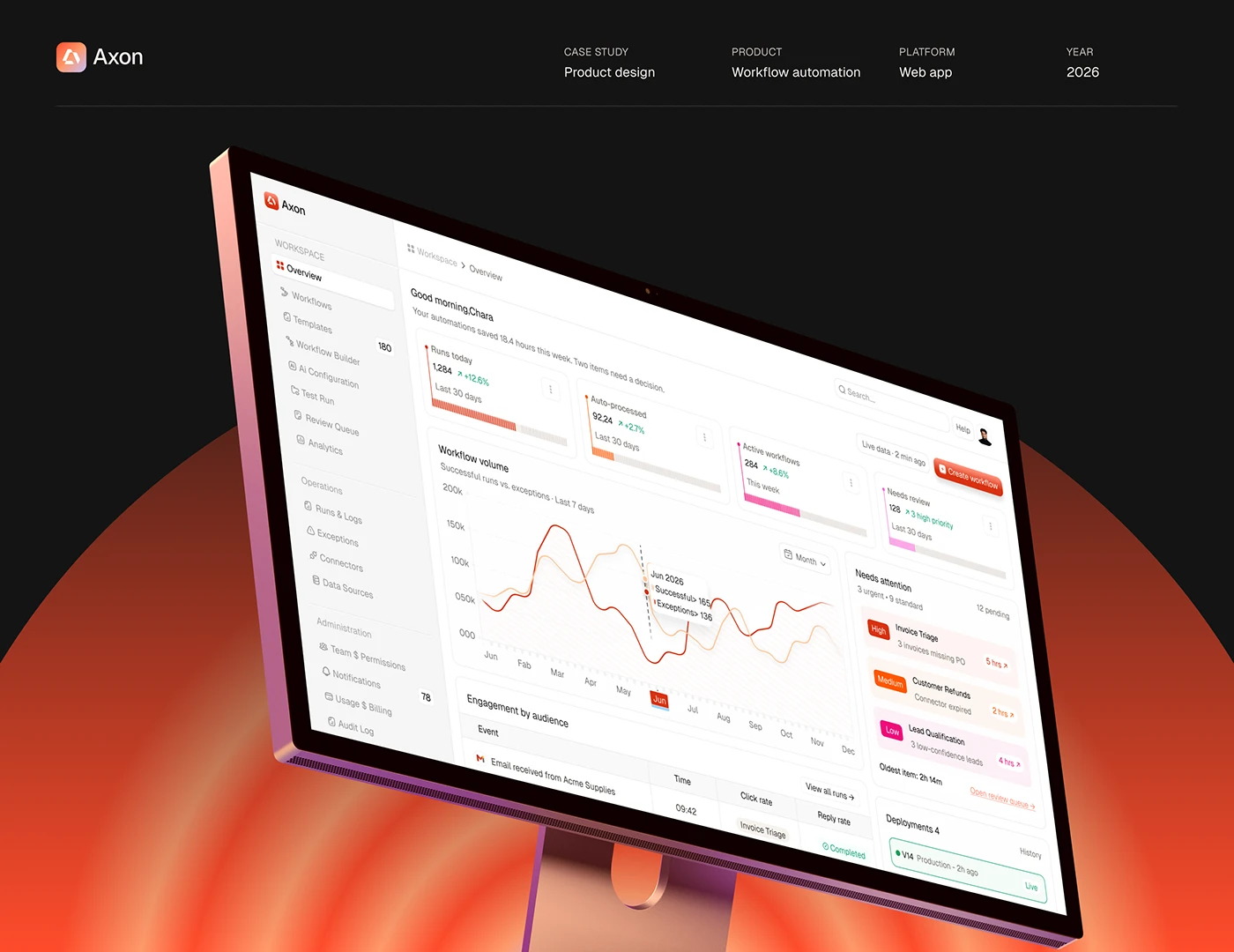
The design pass is where most generated apps fall short. On Axon, an AI workflow automation web app, I designed 17 pages and 82 interaction states, plus the marketing website: the states a prompt rarely asks for are most of the work.
Frequently asked questions
Is Bolt or Lovable better?
Neither in general. Per their docs, Lovable suits web apps with a managed Supabase-based backend and two-way Git sync; Bolt adds mobile through Expo, GitHub import and Netlify publishing. Both list Pro at $25 a month on 10 November 2026.
Is Bolt cheaper than Lovable?
The Pro plans cost the same, $25 a month. They meter differently: Lovable charges credits by task complexity, Bolt charges tokens that grow with project size. Your real cost depends on how big the app gets and how often you change it.
Can I export my code from Bolt and Lovable?
Yes. Lovable syncs with GitHub, GitLab or Bitbucket, and downloading code needs a paid plan. Bolt syncs with GitHub on the main branch. Your database data isn't in the repository on either and moves separately.
Do Bolt and Lovable use Supabase?
Lovable's built-in backend uses Supabase's open-source foundation, and you can connect your own Supabase project instead. Bolt has its own database, with Supabase as an option on Pro and Teams.
Can I take a Bolt or Lovable app to production?
Yes, with work: test access rules with two accounts, add the missing states, set up backups and move every account into your company's name.
Sources and method
I read every source on 10 November 2026. I haven't used Bolt, Lovable or v0 on a product, so every claim about them comes from their own docs and pricing pages. I studied the pages ranking for "bolt vs lovable" and "v0 vs lovable"; I found no independent data on output quality, so I don't score the tools. Prices and plans change often.
- Lovable, pricing page, date read 10 November 2026: lovable.dev
- Lovable, subscription plans and plans and credits, date read 10 November 2026: docs.lovable.dev, docs.lovable.dev
- Lovable, upgrade to TanStack Start, Supabase, Git sync and publish docs, date read 10 November 2026: docs.lovable.dev, docs.lovable.dev, docs.lovable.dev, docs.lovable.dev
- Bolt, pricing, date read 10 November 2026: bolt.new
- Bolt, help centre: intro, database, GitHub, hosting and tokens, date read 10 November 2026: support.bolt.new, support.bolt.new, support.bolt.new, support.bolt.new, support.bolt.new
- Vercel, v0 pricing, full-stack apps, GitHub and FAQs, date read 10 November 2026: v0.app, v0.app, v0.app, v0.app
If you've built an app in Bolt, Lovable or v0 and it now needs to hold up for paying customers, book a free 30 minute intro call. Bring the repository. After it, you get a written scope and one fixed quote.
Tags: Bolt vs Lovable, v0 vs Lovable, AI app builders, Vibe coding, Development