



Saudi e-commerce law website requirements come in layers. The E-Commerce Law (Royal Decree M/126, in force since 20 October 2019) asks a store to show who it is, how to reach it and its commercial registration (CR) number, and to set out terms, total price and delivery before the buyer orders. As a website designer in Riyadh, these are the first items I draw.
Its Implementing Regulations add a privacy policy covering cookies, a complaints procedure, the VAT number and an order button that says it commits you to pay. On top sit the Ministry of Commerce's guidance (store verification moved from Maroof to the Business Platform in 2023, a 20-point checklist, discount rules) and ZATCA's rule that consumer prices include VAT.
This guide is for founders and e-commerce leads building or redesigning a store for Saudi buyers, in Riyadh or abroad. I work remotely, and I'm a designer, not a lawyer: this is design guidance, and your counsel confirms how each rule applies to you.
Which texts set Saudi e-commerce law website requirements
I read the Arabic texts the Ministry of Commerce publishes on its E-Commerce Council page, because that is where it points stores. Translations are mine.
| Text | What it covers on your site |
|---|---|
| E-Commerce Law, Royal Decree M/126 of 7/11/1440H | Identity (Art. 6), terms (Art. 7), invoice (Art. 8), licences (Art. 9), adverts (Arts. 10 to 12), cancellation (Arts. 13, 14), penalties (Art. 18) |
| Implementing Regulations | Privacy, complaints and VAT number (Art. 6), price detail and order button (Art. 7), invoice fields (Art. 8), verification (Art. 13) |
| Self-assessment list for e-stores, January 2022 | 20 points the ministry checks |
| ZATCA's e-commerce VAT guideline, Issue 2, May 2026 | VAT-inclusive prices, VAT certificate on the store |
The law took effect 90 days after publication in Umm Al-Qura, as the ministry announced on 14 October 2019. I found no later amendment on the ministry's pages, but couldn't reach the Bureau of Experts' portal to confirm, so ask counsel.
Who you are: the identity block in the footer
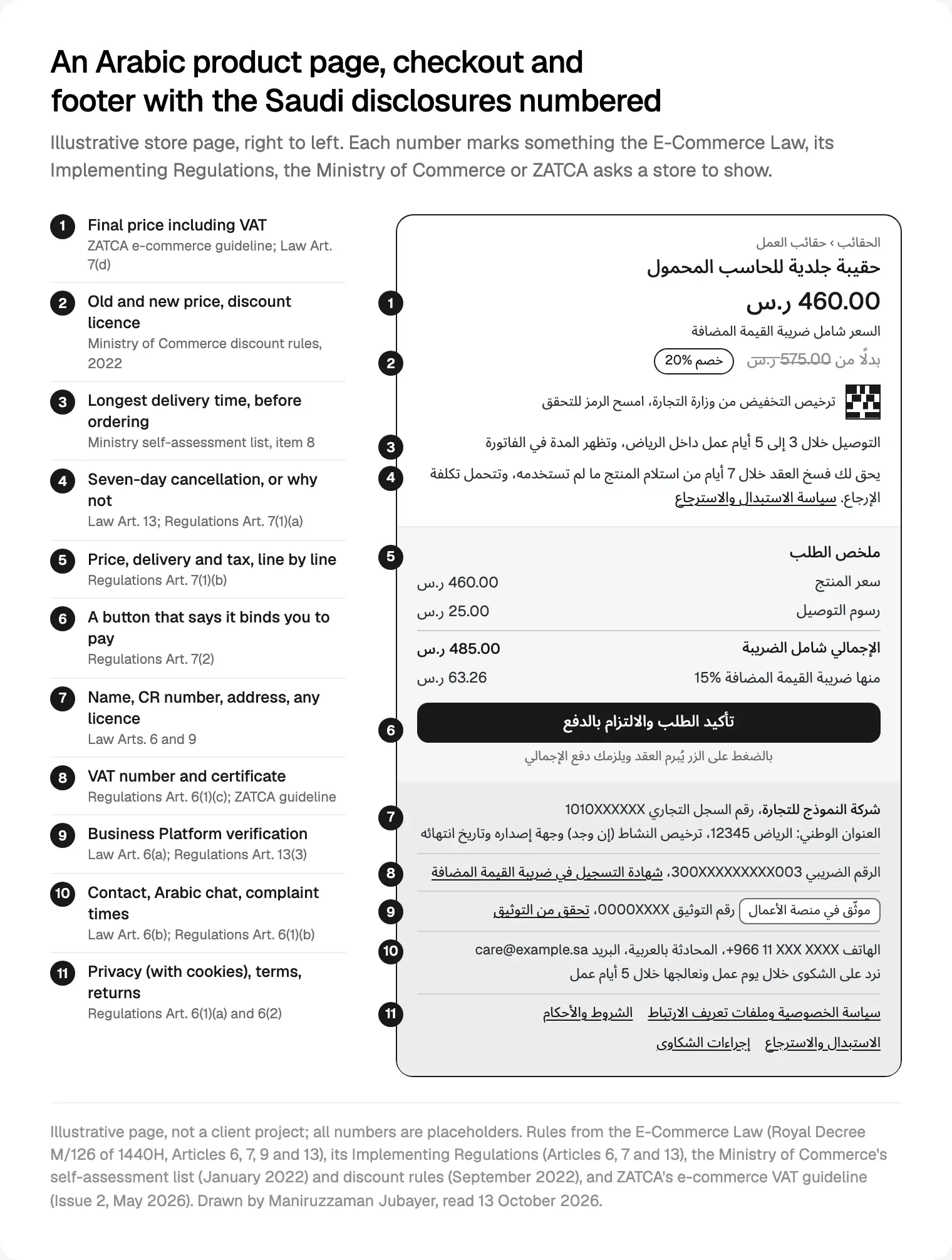
Article 6 of the law sets the minimum: your name or another distinctive identifier, your address, how to contact you, and the name and number of any register you are entered in. The regulations add a privacy policy, the complaints procedure and your tax number, all reachable by a link, with any change made clear.
The footer is on every page, so that is where they go:
- Legal name and CR number as text, labelled رقم السجل التجاري, never inside an image, so screen readers and search engines can read it.
- The national address. Article 3 of the regulations says a person trading without premises uses the home address registered under the national address system.
- Licences. Article 9 asks anyone in a licensed profession to show the licence number, its expiry date and who issued it; the ministry's list names cosmetics and food.
- Contact routes that work on a phone: a Saudi number, email and chat, with complaint response times beside them.
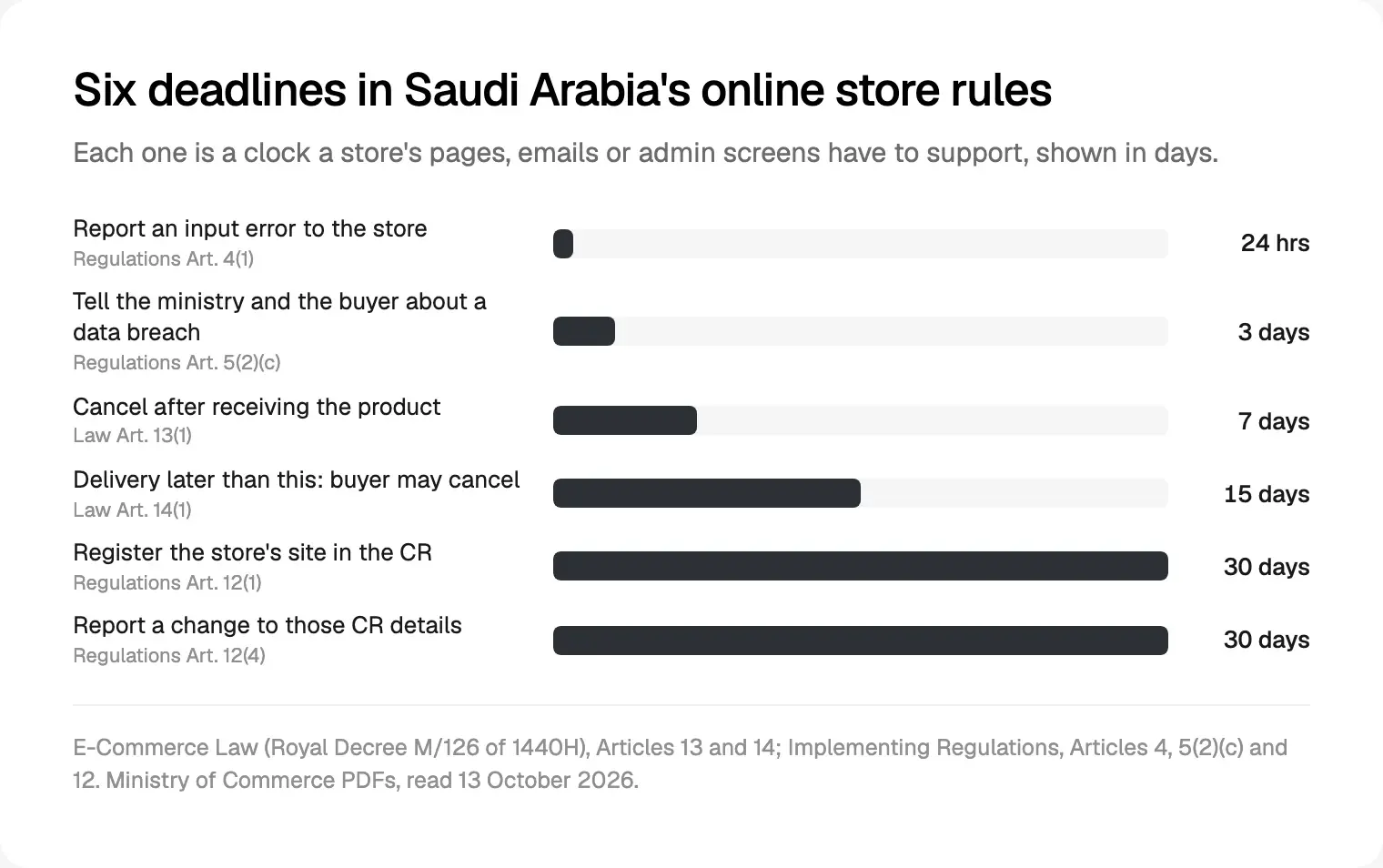
Behind the footer, Article 12 of the regulations requires a merchant to enter the main store's address in the commercial register within 30 days of creating it, and to report changes within 30 days. A new domain makes that a launch-week task. It is the same block I plan in disclosure footers for Riyadh company sites, where SAMA or REGA licence numbers sit.
Maroof is gone: verification on the Business Platform
On 29 March 2023 the ministry asked store owners to register on the Business Platform, run by the Saudi Business Center at business.sa, instead of Maroof. Verification needs a CR or a valid professional (freelance) document and a business bank account linked to the store.
On 3 September 2023 the Business Platform became the only authorised platform for e-commerce verification; the ministry's complaints app and 1900 line began acting on reports about verified stores, and buyers were pointed to a "Verified Store Inquiry" service. Its spokesperson repeated the advice to check stores there on 13 November 2025.
Is verification compulsory? Article 6 lets a verified store leave out its address, and Article 13(3) of the regulations limits that to bodies linked to the ministry's site. My reading: verification is an option with a reward. I'd verify anyway, because the ministry sends shoppers to that lookup.
On the page, a text line, "موثّق في منصة الأعمال", with the verification number and a link to the lookup, beside the CR number. I couldn't open business.sa from my location, so check its current badge wording first.
Prices, VAT and discounts on the product page
Article 7 of the law requires the total price "including all fees, taxes or additional amounts for delivery" before the contract, and the regulations spell out the parts: original price, delivery, taxes and any later costs, with how they are calculated.
ZATCA's guideline says final prices announced to consumers on websites, platforms, social media stores and apps must include VAT, at 15%. Article 8 of the VAT Implementing Regulations asks a registered business to display its certificate publicly, and the guideline extends that to electronic stores. So I design:
- One price, VAT included, with "السعر شامل ضريبة القيمة المضافة" under it, and no "+ VAT" a consumer can see.
- An order summary that adds up: product, delivery, total with tax, then "of which VAT 15%". On 485 riyals that is 63.26, using ZATCA's 15/115 method.
- The VAT number in the footer, linked to the certificate.
Discounts have their own rules. On 26 September 2022 the ministry published nine rules for sales in shops and e-stores: get a permit before announcing a discount, display it so customers can scan its code, show the percentage and both prices, and state the return policy during the sale. A code is hard to scan off the phone you're holding, so I also make it a tap-through link. That is my reading, not the ministry's.
On Salla or Zid, check how much of this the theme lets you change; I compared that in Salla, Zid or a custom store.
Terms, cancellation and returns before the order button
Article 7 of the law asks for the terms before the buyer commits: how the contract is made, who the seller is, the product's main features, total price, payment and delivery arrangements, and any warranty. The regulations add two things designers often miss.
First, cancellation. Article 13 gives the consumer 7 days from receiving the product to cancel if they haven't used it, at their own cost unless agreed otherwise. The statement must mention that right and what to do, or say plainly why it doesn't apply. Exceptions include custom-made goods, used software and media, books and newspapers, hotel and travel bookings, perishables, items that can't be resold for health reasons, auctions, and goods like gold whose price moves with the market.
Second, the button. Article 7(2) asks the store to make clear that clicking it concludes the contract and commits the buyer to pay. "Buy now" doesn't say that. I write "تأكيد الطلب والالتزام بالدفع", with a short line under it.
After the click, Article 4 lets the buyer correct an input error by telling you within 24 hours. A visible "something wrong with this order?" link on the confirmation page honours that.
Delivery times, the invoice and the confirmation page
Point 8 of the ministry's list asks for the maximum delivery time before the order is completed. Article 14 of the law explains why: if delivery is more than 15 days late, unless you agreed another period, the buyer may cancel for a refund, and you must warn them of expected delays. So I write delivery as a range with its longest day ("خلال 3 إلى 5 أيام عمل"), never "fast delivery".
Article 8 of the regulations lists the invoice the buyer keeps: your name, the product, the contract date, total price and taxes, shipping, your VAT number, delivery date, carrier and tracking details, a summary of return rules, and how payment was made.
The tax invoice itself is ZATCA's territory. Articles 53 and 66 of the VAT regulations require it in Arabic, with any other language as a translation; the build is in my guide to ZATCA e-invoicing integration, screen by screen. For the store, the confirmation email and order page should carry the invoice's fields in the same order, so a buyer never reconciles two documents.
Arabic content: what the texts say, and what I do
Neither the law nor its regulations names a language. The ministry's expectations are clearer: on 13 April 2022 the E-Commerce Council listed 13 reliability standards for stores run under a registration certificate, including Arabic as an option for complaints, Arabic in chat, products displayed in Arabic, and the exact delivery time before purchase.
Two older rules point the same way. The Implementing Regulations of the Commercial Data Law say commercial data on goods must be written clearly in Arabic, and ZATCA's invoices are Arabic first.
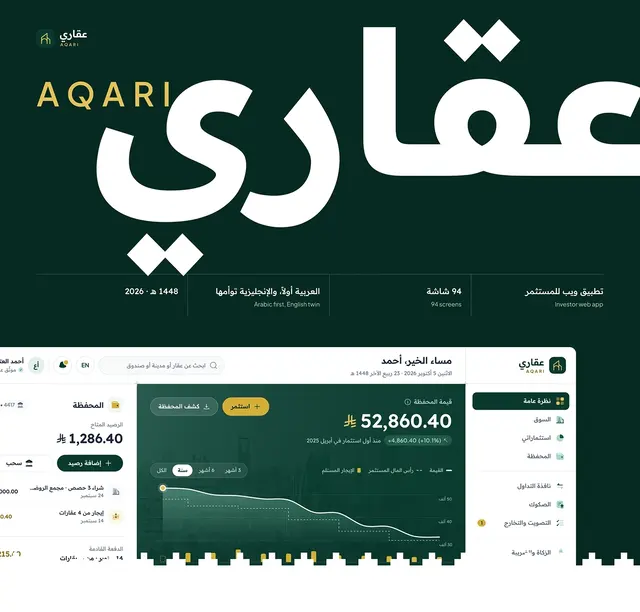
So the Arabic store is the main store and English is its twin. Product names, delivery text, the cancellation statement, legal pages and error messages are written in Arabic first, approved by a native speaker, then mirrored, with numbers kept left to right inside Arabic sentences.
Advertising rules from the Ministry of Commerce
Articles 10 to 12 of the law treat an electronic advert as part of the contract. It must name the product and the seller (a verified seller may skip the name) and give a contact route; the regulations add that it must say clearly it is an advert. Article 11 bans false offers, misleading wording and logos you have no right to use, and Article 12 lets the ministry order a breaching advert removed within one day of notice.
With the discount permit rules on top, every banner and email campaign needs an owner and a check before it goes live. I make sure the banner's offer matches the cart price, both prices and the percentage appear, and the end date is stated.
A pre-launch check against the ministry's 20-point list
The ministry's own list is the best final test. I run it in both languages on a phone:
- Identity: store, product and service details, CR number, VAT number, licences (points 1, 16 to 18).
- Contact and complaints: a channel and the handling steps (points 2, 3).
- Returns: a disclosed policy that follows the law (points 4, 5).
- Account and adverts: closing the account, stopping adverts (points 6, 7).
- Delivery: the longest time, before ordering (point 8).
- Invoice: total, base price, tax, extra fees such as cash on delivery, shipping, delivery date, carrier and tracking (points 9 to 15).
- Registration and privacy: the store's link in the CR, the privacy policy published (points 19, 20).
Article 18 allows a warning, a fine of up to SAR 1 million, suspension, or blocking the store, and Article 17 lets the minister block urgently. On 20 August 2025 the ministry blocked a store based outside the Kingdom selling counterfeit gold bars, citing the law. Selling from abroad is no shelter.
My take
Treat the law as a page list from the first wireframe. The footer block, VAT-inclusive price, cancellation statement, order button and delivery range are each one component, designed once in Arabic and English. Retrofitting them later touches every template, email and campaign at once.
That is how my website design service handles Saudi stores: Arabic designed first, legal pages laid out for counsel to fill, and a launch check against the ministry's list. It starts with a free 30 minute intro call, then a written scope and one fixed quote, with no retainer; more is on my about page. If you're planning a store for Saudi buyers, start with my Arabic-first website work for Riyadh companies.
Frequently asked questions
What must an online store in Saudi Arabia show on its website?
Under Article 6 of the E-Commerce Law: your name or distinctive identifier, address, contact details, and CR name and number if registered. The Implementing Regulations add a privacy policy covering cookies, the complaints procedure and your VAT number, reachable by a link. Before ordering, the buyer also needs the terms, total price, delivery and cancellation rights.
Is Maroof still used to verify online stores in Saudi Arabia?
No. In March 2023 the Ministry of Commerce asked stores to register on the Saudi Business Center's Business Platform instead of Maroof, and in September 2023 it called the Business Platform the only authorised platform for e-commerce verification. You need a CR or a valid professional document and a business bank account linked to the store.
Do prices on a Saudi website have to include VAT?
Yes, for consumers. ZATCA's e-commerce VAT guideline (Issue 2, May 2026) says final prices announced to end consumers on websites, platforms, social media stores and apps must include VAT, currently 15%. The E-Commerce Law also asks for the total price, including taxes and delivery, before the contract.
How long does a customer have to cancel an online order in Saudi Arabia?
Seven days from receiving the product, under Article 13 of the E-Commerce Law, if they haven't used it; the buyer pays the costs unless you agree otherwise. Custom-made goods, perishables, used software, books, travel bookings and gold are among the exceptions. If delivery is more than 15 days late, the buyer may cancel for a refund.
Does a Saudi e-commerce website have to be in Arabic?
The E-Commerce Law and its regulations name no language. But the ministry's 2022 reliability standards expect products in Arabic, Arabic chat and Arabic complaints, the Commercial Data rules want product data in Arabic, and tax invoices must be in Arabic. In practice, design the Arabic store first and give English its own twin.
Do I need a permit to advertise a discount on my online store?
Yes. The Ministry of Commerce's rules of 26 September 2022 require a business or online retailer to get a permit before announcing price reductions and to display it so customers can scan its code. The discount percentage, original and discounted prices, and the return policy must also be shown during the sale.
Sources and method
I read every source on 13 October 2026; translations of the Arabic texts are mine. The Bureau of Experts' portal, business.sa and SDAIA's site refused connections from my location, so I could not confirm later amendments to the law, the Business Platform's current badge, or PDPL details; the platform's history rests on the ministry's releases. Applying the 13 standards, addressed to stores under a registration certificate, to every store is my reading. The 63.26 riyal VAT line is my worked example.
- Ministry of Commerce, E-Commerce Law, Royal Decree M/126 (Arabic), read 13 October 2026: mc.gov.sa
- Ministry of Commerce, Implementing Regulations of the E-Commerce Law (Arabic), 1441H, read 13 October 2026: mc.gov.sa
- Ministry of Commerce, e-store self-assessment list (Arabic), January 2022, read 13 October 2026: mc.gov.sa
- Ministry of Commerce, law in force from 20 October 2019, 14 October 2019, read 13 October 2026: mc.gov.sa
- Ministry of Commerce, 13 reliability standards, 13 April 2022, read 13 October 2026: mc.gov.sa
- Ministry of Commerce, nine discount rules, 26 September 2022, read 13 October 2026: mc.gov.sa
- Ministry of Commerce, Business Platform instead of Maroof, 29 March 2023, read 13 October 2026: mc.gov.sa
- Ministry of Commerce, the only authorised verification platform, 3 September 2023, read 13 October 2026: mc.gov.sa
- Ministry of Commerce, foreign e-store blocked, 20 August 2025, read 13 October 2026: mc.gov.sa
- Ministry of Commerce, checking stores via the Saudi Business Center, 13 November 2025, read 13 October 2026: mc.gov.sa
- ZATCA, Guideline on Electronic Commerce under VAT Provisions, Issue 2, May 2026, read 13 October 2026: zatca.gov.sa
- ZATCA, VAT Implementing Regulations, English translation, read 13 October 2026: zatca.gov.sa
- WIPO Lex, Implementing Regulations of the Law on Commercial Data, Saudi Arabia, consolidated to 2006, read 13 October 2026: wipo.int
Tags: Saudi Arabia, Riyadh, E-commerce, Compliance, Arabic, VAT