

A design engineer's cost per hour depends on how you buy the work. Hired in the US, five companies recruiting for the title publish base salaries from $157,300 to $440,000 a year across levels, about $76 to $212 an hour before benefits. Through a marketplace, the median rates Upwork publishes for front-end developers, React developers and UX designers sit between $15 and $40 an hour, and Malt's UK page puts experienced front-end freelancers at €471 a day. A team on a fixed-scope project has no hourly rate at all: you pay one price for a written scope, and the scope sets it.
I work as a design engineer for startups, so this guide is about the software and product role: the person who designs an interface and builds it in production code. Search "design engineer hourly rate" and most results are about mechanical design engineers instead.
I don't bill by the hour, so there's no rate of mine here: just the market's numbers with sources, and what drives a fixed-scope price. It's for founders and product leads deciding whether to hire, contract or commission the work.
Design engineer cost per hour at a glance
Every figure below is published and dated. Annual pay becomes an hourly figure by dividing by 2,080 hours, the full-time year the BLS uses for its wage estimates.
| Way of buying the work | Published figure | Per hour |
|---|---|---|
| Employee, five US design engineer postings | $157,300 to $440,000 base a year | about $76 to $212 |
| Employee, one London posting | £100,000 to £130,000 base a year | about £48 to £63 |
| Employee, closest US occupations, median | $92,650 to $135,980 a year | $44.54 to $65.38 |
| Freelancer on Upwork, median ranges | $15 to $40 an hour | $15 to $40 |
| Freelancer on Malt UK, experienced average | €445 to €518 a day | about €56 to €65 on an eight-hour day |
| Team on a fixed-scope project | One price for a written scope | no hourly rate |
The spread is huge because these are different products: a salary buys a person's time for years, a marketplace rate buys hours you direct, and a fixed quote buys an outcome you've written down.
What the title pays in-house: published salary ranges
There's no official job category called "design engineer" for software, so the best direct evidence is employers' own postings that publish a pay range. These were all open when I checked on 7 and 9 October 2026:
| Employer, role and location | Base salary range | Experience asked for |
|---|---|---|
| Stripe, Design Engineer, Expansion, remote US | $157,300 to $235,900 | 6+ years |
| Ramp, Design Engineer, New York | $172,000 to $440,000, estimated | Not stated |
| Perplexity, Design Engineer, Growth and Marketing, San Francisco | $180,000 to $300,000, estimated | 3+ years |
| Replit, Design Engineer (posting since closed), Foster City, CA | $180,000 to $290,000 | 8+ years |
| Vercel, Design Engineer, San Francisco range | $208,000 to $312,000 | No required path |
| Granola, Design Engineer, London | £100,000 to £130,000 | Not stated |
All six mention equity on top, so base salary understates the package. Not everyone publishes a number: Linear's Design Engineer posting offers "competitive salary and equity" with no range.
The BLS has no design engineer category, so I use its three closest occupations. Its handbook entry for web developers and digital designers and its page for software developers give the national medians below; the top tenth earned more than $162,290 (web developers), $201,550 (designers) and $214,670 (software developers). Location changes everything:
| May 2025 median | United States | San Francisco metro | New York metro |
|---|---|---|---|
| Web developers | $92,650 ($44.54 an hour) | $152,450 ($73.29) | $104,820 ($50.39) |
| Web and digital interface designers | $104,000 ($50.00) | $163,810 ($78.76) | $119,190 ($57.30) |
| Software developers | $135,980 ($65.38) | $186,640 ($89.73) | $166,830 ($80.21) |
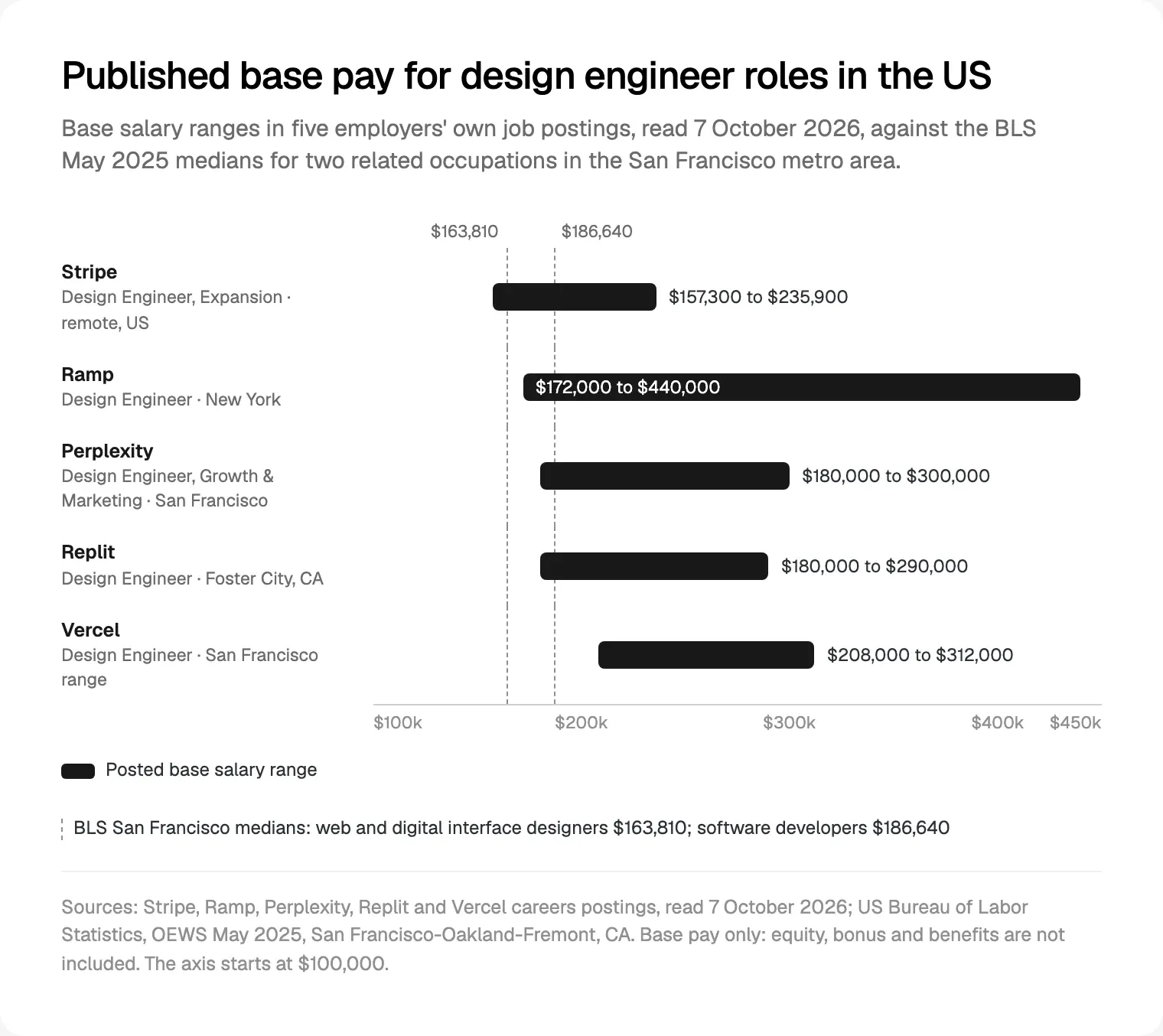
My reading: the postings start near the San Francisco median for designers and run well past the one for software developers, because companies are paying for one person who covers both. My notes on what a design engineer does each week explain that combination.
What an employee really costs beyond base pay
Salary is the number in the offer letter, not the number on your books. The BLS Employer Costs for Employee Compensation table for June 2026 shows that for professional jobs in US private industry, an hour of work cost the employer $73.69, and only $50.98 of it (69.2%) was wages. The other $22.71 was benefits: $6.78 paid leave, $5.47 insurance, $4.81 legally required benefits such as Social Security, $2.90 supplemental pay and $2.75 retirement.
That's about 45 cents of benefits per dollar of wages, or roughly $70,000 a year on the bottom of Stripe's range, $157,300. Treat it as a rough guide: it mixes every pay level, and health cover usually costs the same whatever the salary.
In the UK the legal minimums are easier to work out. GOV.UK's rates and thresholds for employers, 2026 to 2027 set employer National Insurance at 15% above £5,000 a year: £14,250 to £18,750 on Granola's range. The workplace pension minimum adds 3% of earnings between £6,240 and £50,270, about £1,321. So the minimum cost is roughly £115,571 to £150,071 before health cover, equity or a laptop, less any Employment Allowance (£10,500 for 2026 to 2027) an eligible employer claims.
The time to hire is a cost too
I found no official statistic for how long hiring a design engineer takes, so here is one company's published process. Linear's post on why and how it runs work trials (December 2023) describes a recruiter call, a hiring manager interview, skills assessments, three to five panellists voting, then a paid work trial of two to five days, with senior roles usually taking all five.
Count the people in that list. Every stage takes hours from your team, the trial is paid, and the person you choose still has notice to serve and a codebase to learn. None of it shows in a salary figure.
Contract and freelance design engineer hourly rates
Neither Upwork nor Malt publishes a rate page for design engineers that I could find, so you're combining two categories: a front-end developer's rate and a designer's. Upwork's figures are median ranges from historical contracts worldwide; Malt's are averages for experienced freelancers active in the last three months.
| Marketplace category | Published rate |
|---|---|
| Upwork, front-end developers | $15 to $35 an hour |
| Upwork, React.js developers | $20 to $38 an hour, with rates from $15 to $150 |
| Upwork, UX designers | $25 to $39 an hour |
| Upwork, UI designers | $20 to $40 an hour |
| Malt UK, front-end developers | €471 a day; €337 at 0 to 2 years, €480 at 15+; ReactJS developers €518 |
| Malt UK, UX designers | €445 a day; €336 at 0 to 2 years, €511 at 15+ |
Upwork's own front-end page shows what averages hide: for North American freelancers with over 1,000 hours and a 90% success rate, it lists $15 for basic front-end work, $35 for intermediate to advanced and $55 or more for full stack. A worldwide median isn't what a senior person who designs and builds charges. Upwork's pricing for clients then adds a 5% service fee on Basic or 10% on Business Plus, plus a contract initiation fee.
Three caveats before you budget from these:
- You may be hiring two people. If the freelancer designs but doesn't build, you pay both rates and own the handoff between them.
- Hours aren't a scope. An hourly contract moves the overrun to you; a cheap rate on a vague brief can cost more than a dear rate on a clear one.
- Your time isn't free. Someone on your side writes tickets, answers questions and reviews the work against the design.
A contract design engineer works best on a defined task inside a team that has a design system and someone to review code.
What drives the cost of a fixed-scope design engineering project
A fixed quote isn't a rate multiplied by a guess. It's the price of a written scope, and these are the lines I count, in this order, when a founder asks what a project will cost.
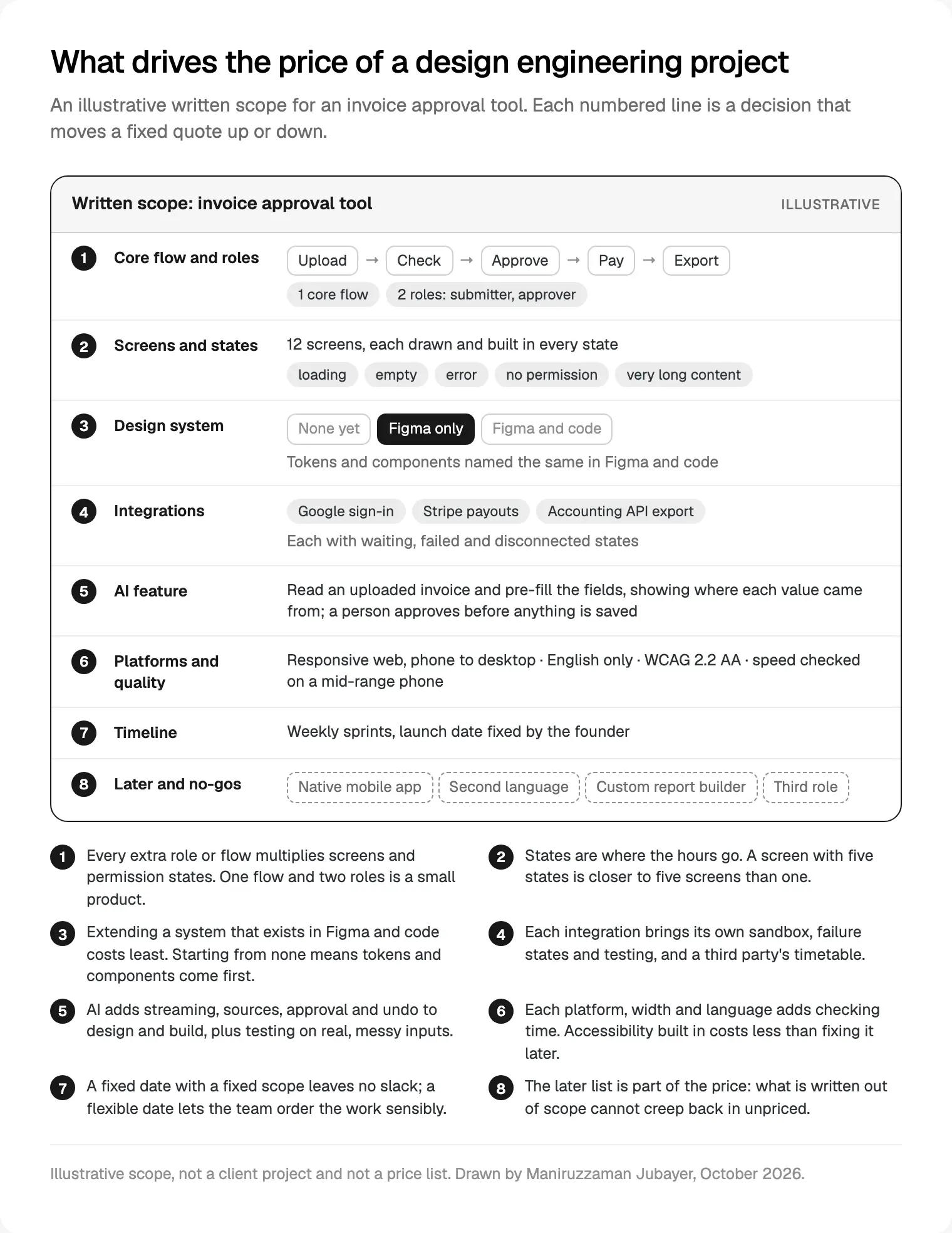
- Flows and roles. Each extra role adds permission states to every screen it touches.
- Screens and their states. Most of the work hides here: loading, empty, error, no permission and very long content, each designed and built.
- The design system. Extending one that exists in Figma and code costs least; having none means tokens and components come first.
- Integrations. Payments, sign-in or accounting each bring a sandbox, failure states and someone else's timetable.
- AI features. Streaming, a visible source, approval before anything changes and an undo, plus testing on real, messy inputs.
- Platforms, languages and quality. Each adds checking time. Accessibility to WCAG 2.2 level AA costs least when it's built in from the first sprint.
- The timeline. A fixed date with a fixed scope leaves little slack.
- What's written out. The later list belongs in the scope, so nothing creeps back in unpriced.
A worked scope, and what would change its price
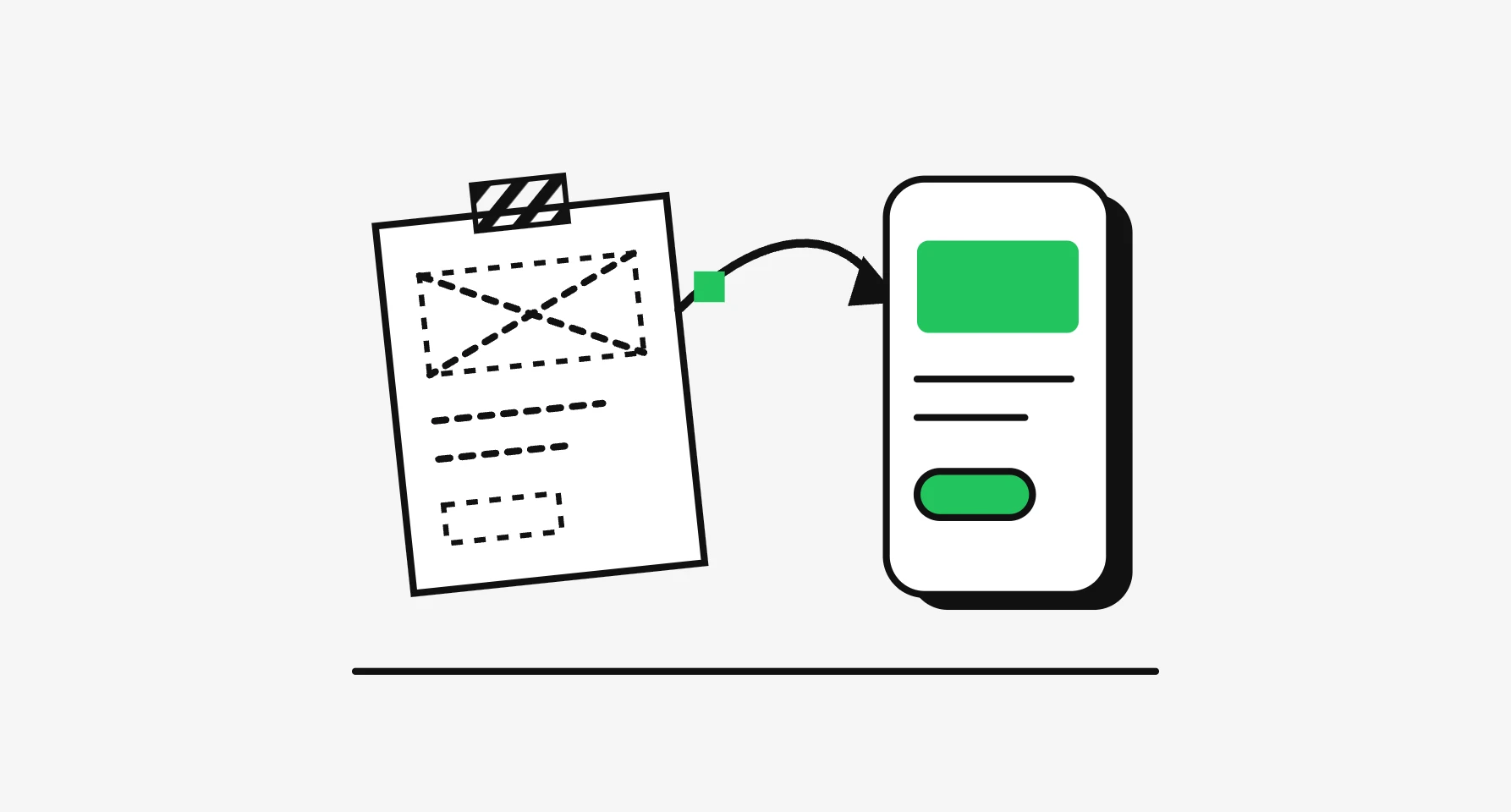
This example is illustrative, not a client project: the invoice approval tool from the diagram. I've left prices out on purpose, because what matters is which way each decision pushes the quote.
| Scope line | In this scope | Would raise the quote | Would lower it |
|---|---|---|---|
| Flow and roles | Upload, check, approve, pay, export; submitter and approver | A third role, or multi-step approvals | One approver at first |
| Screens and states | 12 screens, five states each | Dashboards, a custom report builder | One table pattern for every list |
| Design system | In Figma, not yet in code | No system and a new visual language | Components already in code |
| Integrations | Google sign-in, Stripe payouts, accounting export | Two-way accounting sync, bank feeds | A CSV export first |
| AI feature | Pre-fill from an uploaded invoice, sources shown, a person approves | AI that approves on its own | Pre-fill only the fields people type most |
| Platforms and quality | Responsive web, English, WCAG 2.2 AA | Native apps, a second language | Nothing: I don't cut accessibility |
| Timeline | Weekly sprints to a fixed launch date | A date that forces parallel work | A few weeks of slack |
Founders underestimate the AI line most, because the happy path demos well and the failures need their own screens. The design system line pays back most: every later screen is built from it.
Once agreed, the table becomes the written scope (flows, screens with states, components, integrations by name, stack, order of work and the later list), and that document gets one fixed quote for the whole project. My guide to how I scope an MVP before quoting shows how I cut a feature list down to it.
In-house, freelance or a fixed-scope team, compared
| Hire in-house | Contract or freelance | A fixed-scope team | |
|---|---|---|---|
| How you pay | Salary and benefits, monthly | Hourly or day rate, plus fees | One price for a written scope |
| Published figures | $157,300 to $440,000 base, five US postings | $15 to $40 an hour on Upwork; €445 to €518 a day on Malt UK | None; the scope sets it |
| Costs beyond the work | Benefits, hiring stages, a trial, management | Your time directing and reviewing; 5% or 10% on Upwork | The scoping work before the quote |
| Who carries an overrun | You | You: the hours keep running | The team, within the scope |
| Who keeps the design system | The employee, while they stay | Often nobody once the contract ends | Documented, handed over, in your accounts |
| Best when | The work fills someone's week for years | A defined task you can direct | A product or phase with a scope and a date |
One line I add on intro calls: commission a team when you need a product delivered before you know what the permanent role should be. If you're weighing the first hire itself, my comparison of a design engineer or product designer first covers which gap to fill.
The costs that never appear on a rate card
Total cost of ownership is where cheap options get expensive. These depend on your team, so I give reasoning, not numbers.
- The handoff. When one person designs and another builds, whatever the spec doesn't carry (an easing, a disabled state, focus after a dialog closes) gets guessed, found in review and fixed. You pay for that screen twice.
- Rework found late. A missing empty state costs minutes in Figma and far more once built and shipped. Accessibility fixed after launch means changing components that dozens of screens use.
- Management time. If the founder writes the tickets and reviews the work, the cheapest rate is paid for with the company's most expensive hours.
- Ramp-up and idle time. Every new freelancer learns your codebase on your clock; an employee costs the same in a quiet month.
- Knowledge that leaves. When the person who understood the design system goes, the next one rebuilds it. That's why the repository, Figma file and component library sit in my clients' accounts from day one.
This is the case for one owner across design and code, which is how I run design and build as one project: no handoff document between two teams, and a person who knows the design reviewing every change, including AI-written code.
How to compare design engineering quotes
- Send every supplier the same written scope, including the later list. Different briefs produce quotes you can't compare.
- Ask what each quote assumes: screens and states, components, integrations, AI behaviour, devices and accessibility level.
- Ask who designs and who builds, by name, and who reviews code before it merges.
- Ask what you keep: the Figma file, component library, documentation and repository, in your accounts.
- Normalise to a total. Hourly: multiply by an honest hours estimate and add fees. A hire: add benefits and hiring stages. Fixed: read the exclusions.
- Look at shipped work in a browser, including its empty, loading and error states.
| Question | A good answer | A warning sign |
|---|---|---|
| What's not included? | A written list: content, translation, hosting, support | "Everything's included" |
| Who reviews AI-generated code? | A named person who knows the design | "The tools handle it" |
| What happens when scope changes? | The item is sized and agreed in writing first | "We'll sort it out at the end" |
| Where do the code and files live? | Your accounts from day one | "We transfer them on final payment" |
Where I would start
Write down the one flow your product can't launch without, list every screen on it, and count the states each needs. That page tells you more about cost than any hourly rate, and every supplier should quote against it.
If you'd like that page turned into a product by one accountable person, see my design engineering service for founders, and read who I am first. I'm on UTC+6, working Sunday to Thursday, with evening calls for the Americas.
Frequently asked questions
How much does a design engineer cost per hour?
Five US design engineer postings read on 7 October 2026 had base ranges of $157,300 to $440,000 a year, about $76 to $212 an hour before benefits. The closest BLS occupations had May 2025 medians of $44.54 to $65.38 an hour. Upwork's worldwide freelance medians for front-end and UX work are $15 to $40 an hour.
What is a contract design engineer's hourly rate in software?
No marketplace I checked publishes one, so price the two halves. Upwork's median ranges are $20 to $38 an hour for React developers and $25 to $39 for UX designers, worldwide. Malt's UK page shows experienced front-end freelancers at €471 a day and UX designers at €445. Senior people who do both usually sit above those averages.
How much does a design engineer earn?
It depends on city and level. The US base ranges I read run from $157,300 (the bottom of Stripe's remote range) to $440,000 (the top of Ramp's New York range), plus equity. In London, Granola posted £100,000 to £130,000. The BLS has no design engineer category; its closest occupations had national medians of $92,650 to $135,980 in May 2025.
What does design engineering cost for a startup's first product?
It depends on scope, not a rate. The biggest drivers are the flows and roles, the screens and the states each needs, whether a design system exists in Figma and code, the integrations, any AI features, the platforms and languages, and how fixed the launch date is. Write those down and ask for one price against them.
Is it cheaper to hire a freelancer or a design engineering team?
Per hour, a freelancer usually looks cheaper. Per finished product, not always: with hourly work you carry the overrun, the management time and any handoff between a designer and a developer. A team on a fixed quote carries the overrun within the agreed scope. Compare totals on the same written scope, not hourly rates.
Why do design engineers earn more than frontend developers?
In the postings I read, base pay starts around the San Francisco medians for web developers ($152,450 in May 2025) and designers ($163,810) and runs well past the one for software developers ($186,640). Employers are paying for one person who makes design decisions and writes production code, saving a second hire and a handoff.
Do you charge by the hour?
No. A project with me starts with a free 30 minute intro call. Then I write a scope and give one fixed quote for the whole project, with no retainer and nothing billed by the hour. If the scope changes, the change is sized and agreed in writing before anyone starts on it.
Sources and method
I read every source on 7 October 2026 and checked on 9 October that each posting was still listed. Postings are a snapshot of a few companies, mostly in San Francisco and New York, and cover base salary only. Hourly figures divide annual pay by 2,080 hours, as the BLS does; Malt's hourly equivalents assume an eight-hour day. The BLS has no occupation for software design engineers, so its figures are for the closest occupations. I found no official data on time to hire. The worked scope and the diagram are illustrative and contain no prices.
- Stripe, Ramp, Perplexity, Replit, Vercel, Granola and Linear, design engineer job postings, date read 7 October 2026: Stripe, Ramp, Perplexity, Replit (posting since closed), Vercel, Granola, Linear
- Linear, Why and how we do work trials at Linear (13 December 2023), date read 7 October 2026: linear.app
- US Bureau of Labor Statistics, Occupational Outlook Handbook pages for web developers and digital designers and for software developers (updated 27 August 2026), OEWS May 2025 metro tables and OEWS questions and answers, date read 7 October 2026: web developers, software developers, San Francisco, New York, 2,080-hour year
- US Bureau of Labor Statistics, Employer Costs for Employee Compensation, June 2026, Table 4 (released 9 September 2026), date read 7 October 2026: bls.gov
- GOV.UK, employer rates and thresholds 2026 to 2027 (updated 1 September 2026) and workplace pension contributions, date read 7 October 2026: rates, pensions
- Upwork, hiring cost pages and pricing for clients, date read 7 October 2026: front-end, React.js, UX, UI, client pricing
- Malt, UK average freelance rates, date read 7 October 2026: front-end developers, UX designers
- W3C, Web Content Accessibility Guidelines (WCAG) 2.2, date read 7 October 2026: w3.org
Tags: Design engineering, Costs, Hiring, Startups, Freelance