

I checked the home pages of 64 UAE companies listed on the Dubai Financial Market and the Abu Dhabi Securities Exchange on 27 October 2026. 39 of them (60.9%) link to an Arabic version a crawler can follow, 5 more (7.8%) have an Arabic switch that only works in JavaScript, and 20 (31.3%) show no sign of Arabic at all. Only 27 of the 64 (42.2%) serve an Arabic page that is tagged as Arabic, set right to left and written mostly in Arabic, and only 17 (26.6%) also pair it with the English page through hreflang. Every one of the 64 home pages opens in English.
I design and build bilingual websites for companies in the Gulf, the work behind my website design in Dubai, and the same few Arabic mistakes come up in almost every audit I do. I wanted real numbers instead of my impression, so I wrote a small script and pointed it at the companies on the UAE's two main exchanges.
The results at a glance
| What I measured | Sites | Share |
|---|---|---|
| Home pages measured | 64 | 100% |
| Crawlable link to an Arabic version | 39 | 60.9% |
| Arabic switch in JavaScript only, no link | 5 | 7.8% |
| No sign of Arabic | 20 | 31.3% |
| Arabic page with lang="ar" (of 39) | 31 | 79.5% |
| Arabic page with dir="rtl" (of 39) | 30 | 76.9% |
| Arabic page with both (of 39) | 29 | 74.4% |
| Arabic page that is at least 80% Arabic text (of 38 with enough text) | 34 | 89.5% |
| Arabic page that passes all three checks | 27 | 42.2% of 64 |
| English and Arabic paired by hreflang both ways (of 39) | 22 | 56.4% |
| All three checks plus two-way hreflang | 17 | 26.6% of 64 |
| HTTPS | 64 | 100% |
| Mobile viewport meta tag | 64 | 100% |
| Home page html lang says Arabic | 0 | 0% |
The split by exchange was close: 19 of 31 measured DFM companies (61.3%) and 20 of 33 measured ADX companies (60.6%) link to an Arabic version.
Six in ten link to Arabic, three in ten show none
For a company listed in the UAE, Arabic isn't a nice extra. It's the country's official language, and the DFM's own site switches to Arabic from its header. Still, 20 of the 64 home pages had no Arabic signal the script could find: no lang or hreflang for Arabic, no link to an /ar path or an ar. subdomain, and no link labelled عربي, العربية or Arabic.
The script reads the HTML the server sends, so a switcher drawn later by JavaScript would be invisible to it. To test that, I opened 7 of those 20 home pages in a normal browser and let the scripts run. None of the 7 showed an Arabic link.
A further 5 sites do have an Arabic switch, but it's a button or a "#" link that changes the page in JavaScript. A visitor can use it. A search engine that follows links can't, and a person can't share or bookmark the Arabic page from it. If the Arabic version has no address of its own, it can't rank on its own.
A quarter of the Arabic pages don't say they're Arabic
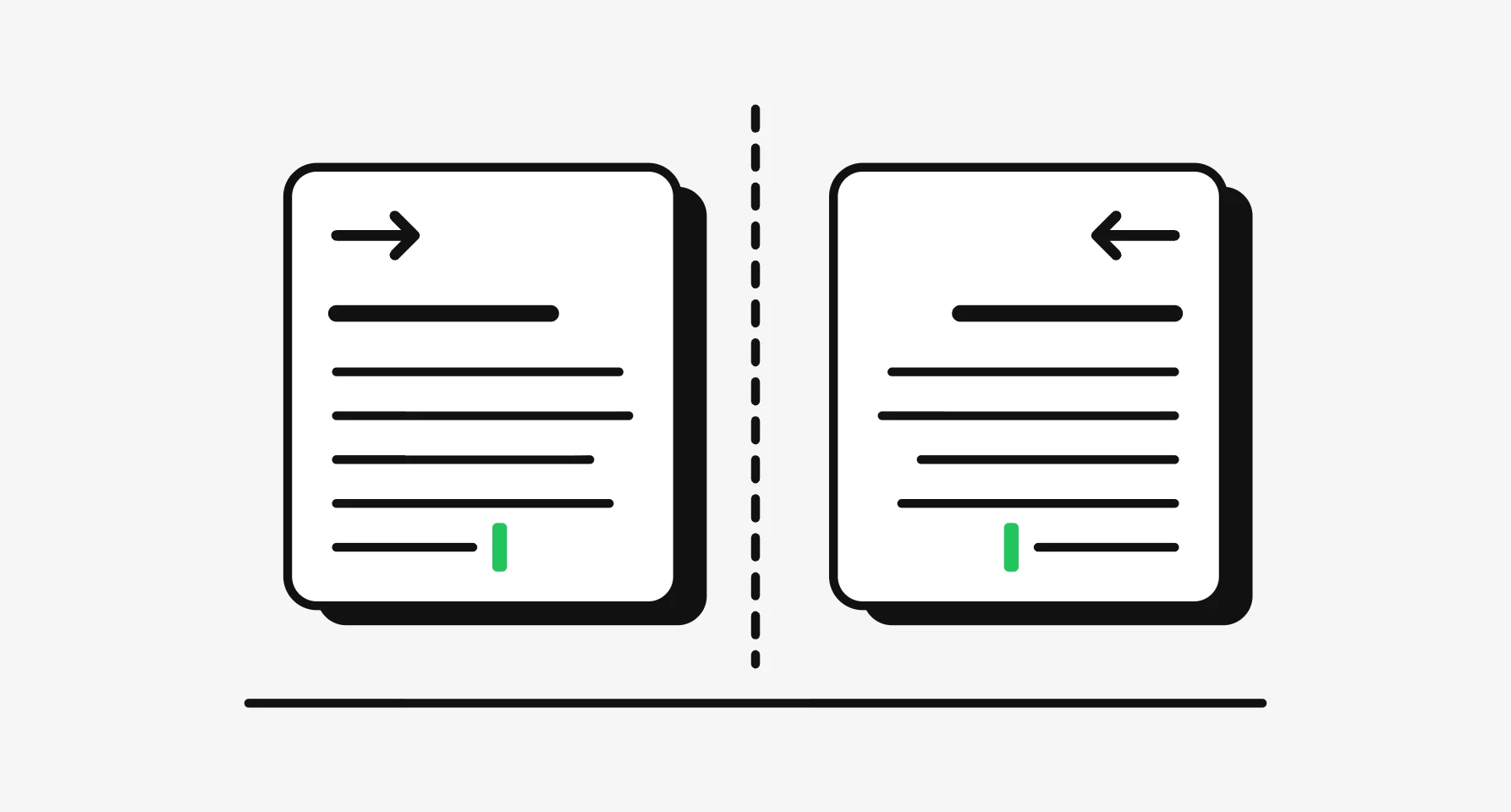
Two attributes tell a browser how to treat an Arabic page: lang="ar" on the html element names the language, and dir="rtl" sets the reading direction. The W3C's guidance on declaring language in HTML and on right-to-left text in HTML puts both on the html element.
Of the 39 Arabic pages:
- 31 (79.5%) set lang to ar (or ar-AE, ar-SA); 6 still said en and 2 had no lang at all.
- 30 (76.9%) set dir="rtl" on html or body.
- 7 did neither, so they are Arabic words inside a page that tells the browser it's English and left to right.
Missing lang changes how screen readers pronounce the text and which font a browser falls back to. Missing dir is the reason punctuation lands on the wrong side and numbers jump around inside sentences.
The Arabic is real Arabic
The good news: the translation is done. I counted Arabic and Latin letters in the visible text of each Arabic page. 38 pages sent enough text in the HTML to measure (one sent 7 letters and builds the rest in the browser). The median page was 95.9% Arabic letters, 34 of the 38 (89.5%) were above 80%, 4 were between 50% and 80%, and none was below half.
On those 4 pages Latin letters made up 20% to 50% of the text, which can be brand names and product terms rather than untranslated copy; the script can't tell which.
Where the Arabic slips is the title tag. 10 of the 39 Arabic pages (25.6%) kept a fully English title, and 8 more mixed the two scripts. The title is usually the blue link Google shows, so an Arabic page with an English title asks an Arabic searcher to click on English.
hreflang is where bilingual sites stop
hreflang tells Google which pages are language versions of each other. Google's documentation on localised versions of your pages asks for each version to list itself and every other version, and says tags that don't point back to each other may be ignored.
26 of the 64 home pages (40.6%) had any hreflang, and 23 (35.9%) listed an Arabic version. Where a site used hreflang, it nearly always did it properly: 22 of those 23 Arabic pages pointed back to the exact English page. The gap is the other group. Of the 16 Arabic versions I found only through a switcher link, just 1 home page had any hreflang tag at all.
So 22 of the 39 Arabic versions (56.4%) are paired with the English home page in both directions, and 17 sites out of 64 get everything in this study right.
HTTPS and mobile are done; page weight varies a lot
Every measured home page used HTTPS and declared a mobile viewport, so those basics are settled across the sample. 59 of 64 (92.2%) set an html lang, all of them English variants.
The HTML of the home page itself, before images, scripts or fonts, had a median of 167.7 KB. A quarter were under 59.4 KB and a quarter over 353.5 KB, 6 were over 500 KB and 3 over 1 MB, with the largest at 1,762.6 KB. These are uncompressed sizes. In the sites I audit, HTML that heavy usually means the whole menu, every slide or a data blob inlined into the page, and on a phone that delays the first paint.
What good looks like
None of this needs a rebuild. On a bilingual site I build, I set these from the first template, because they're cheap to add early and painful to retrofit:
- One address per language: /en/ and /ar/ (or the same path on an ar. subdomain), with a plain link between them, not only a JavaScript switch.
- On every Arabic page,
<html lang="ar" dir="rtl">, so the markup says what the design shows. - An Arabic title tag and meta description written for Arabic searches, not left in English.
- hreflang on both versions, each listing itself, its partner and an x-default, with the exact URLs that return a 200.
- Arabic text in the HTML the server sends, so the page can be read before scripts run.
- Logical CSS properties (margin-inline-start rather than margin-left) so the layout mirrors from dir, not from a second stylesheet.
I go deeper on layout, numerals, icons and forms in designing Arabic RTL interfaces for the UAE, and the same checklist applies to sites I build for Abu Dhabi and Dubai companies.
How I ran the study
Sample. On 27 October 2026 I took every symbol in two public lists: the 72 symbols in the price feed that loads on the DFM listed securities page, and the 86 symbols in the price ticker on the ADX all equities page. That's 158 symbols. I removed 34 that are not UAE operating companies: ETFs, funds, sukuk, warrants, a second share line, a company sharing its parent's website, and companies based outside the UAE. That left 124 companies.
Websites. The exchanges' company profile pages didn't load for an automated reader on the day (the DFM listing data timed out and the ADX profile data needs a session token), so I looked up each official website myself and kept it only if the home page names the company. 26 companies were skipped because I couldn't tie the symbol to a company or confirm a site. That left 98 websites.
Measured. 64 of the 98 home pages loaded and could be measured (31 DFM, 33 ADX). The other 34: 22 answered with a bot check, an error page or a maintenance page; 9 didn't connect, including 3 with certificate errors; and 3 sent an empty page that is built entirely in the browser.
The script. A Node script with no extra libraries fetched one page at a time with a normal desktop browser User-Agent, 1.5 seconds between requests, a 20 second timeout and one retry. For each home page it recorded the final URL, HTTPS, the viewport meta tag, the size of the HTML, the html lang, the title language and any hreflang tags. It looked for an Arabic version in this order: the home page itself in Arabic, an hreflang="ar" link, then a same-site link marked as Arabic (lang or hreflang on the link, an ar. subdomain, an /ar path, a lang=ar parameter, or link text عربي, العربية or Arabic). If it found one, it fetched that one Arabic page and recorded its lang, dir on html or body, the share of Arabic letters among all Arabic and Latin letters in the visible text, its title language, and whether its hreflang pointed back to the English page.
Thresholds. "Mostly Arabic" means at least 80% Arabic letters, counted only on pages with at least 200 letters of text in the HTML. "Two-way hreflang" means the home page lists the Arabic URL and the Arabic page lists the home URL, compared without www, trailing slashes or protocol.
Limits
- Home pages only. One English page and one Arabic page per company. A site can get the home page wrong and the rest right, or the reverse.
- HTML as sent, not as rendered. The script doesn't run JavaScript. Sites that build their language switch or their text in the browser can look worse than they are. I checked 7 of the 20 "no Arabic" home pages in a browser and none had an Arabic link, but I didn't check all 20.
- Bot protection shapes the sample. The 22 sites that answered with a bot check aren't in the numbers, and they may differ from the 64 that are.
- The exchange lists are what they showed that day. The ADX ticker doesn't carry every listed company, and the URL for each company is my own lookup, confirmed against the company's home page.
- One day. Sites change. These are the results of one run on 27 October 2026.
- A text count isn't a quality check. The script can tell Arabic letters from Latin ones. It can't tell good Arabic from a weak translation.
Use this data
If you write about Arabic on the web, websites in the Gulf or bilingual SEO, you're welcome to use these numbers. Please cite this page by name and link to it. I'm keeping the per-company rows private on purpose: the point is the pattern across the market, not any one company.
Tags: UAE, Arabic, RTL, Research, SEO, Website design