

Arabic SEO in the UAE works when the Arabic site is treated as a second site to rank, not a translation to tick off. That means one language per URL, hreflang that pairs every page with its partner, Arabic titles written from Arabic searches, a slug rule, and Arabic fonts that don't slow the page down.
Most of it is decisions made once, before design: hreflang codes, slug script, which Arabic, fonts, and who writes it. Get them wrong and you're fixing hundreds of pages after launch.
This is for marketing leads and founders at UAE companies planning or rebuilding a bilingual site, and it's how I work as a website designer in Dubai, remotely. I've written about layout elsewhere, so this post stays on search: what Google reads, what Arabic searchers type, and what slows Arabic pages.
What Arabic SEO means for a UAE company
Search in the UAE is Google's to lose. Statcounter put Google at 93.47% of UAE search in September 2026, Bing at 3.96%, and mobile at 60.04% of web traffic. DataReportal's Digital 2026 UAE report counted 11.3 million internet users in October 2025, 99% of the population (its cap).
What I couldn't find is a reliable figure for how many UAE searches are in Arabic. Arabic is the official language and signs carry Arabic and English, but there's no official split of search by language. So I size the Arabic site from the client's own data: Arabic enquiries and WhatsApp messages, and Arabic queries in Search Console.
Your Arabic page competes on its own in Arabic results. It doesn't inherit the English page's rankings.
URLs and slugs for an Arabic and English site
Google's guide to multi-regional and multilingual sites gives four structures:
| Structure | Example | What Google says | My view for a UAE company |
|---|---|---|---|
| Country domain | example.ae | Clear geotargeting, one country only | Fine if the business is UAE only |
| Subdomain | ar.example.com | Easy; users may not read "ar" | Rarely worth a second property |
| Subfolder | example.com/ar/ | Easy, low maintenance | My default |
| URL parameter | example.com?lang=ar | Not recommended | Never |
I put both languages in folders, /en/ and /ar/, rather than English at the root, so sitemaps, analytics filters and redirects are symmetrical. It's how I plan bilingual company sites for Dubai: one page list, one URL scheme, both languages from the first sketch.
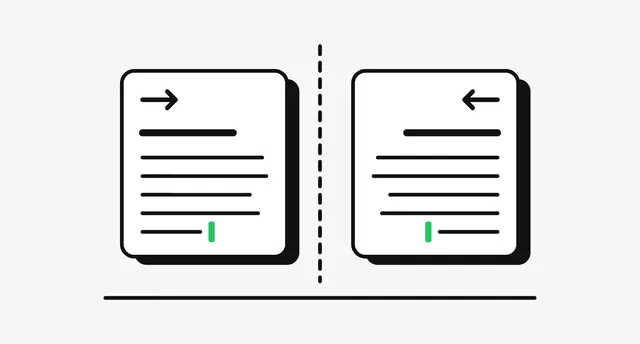
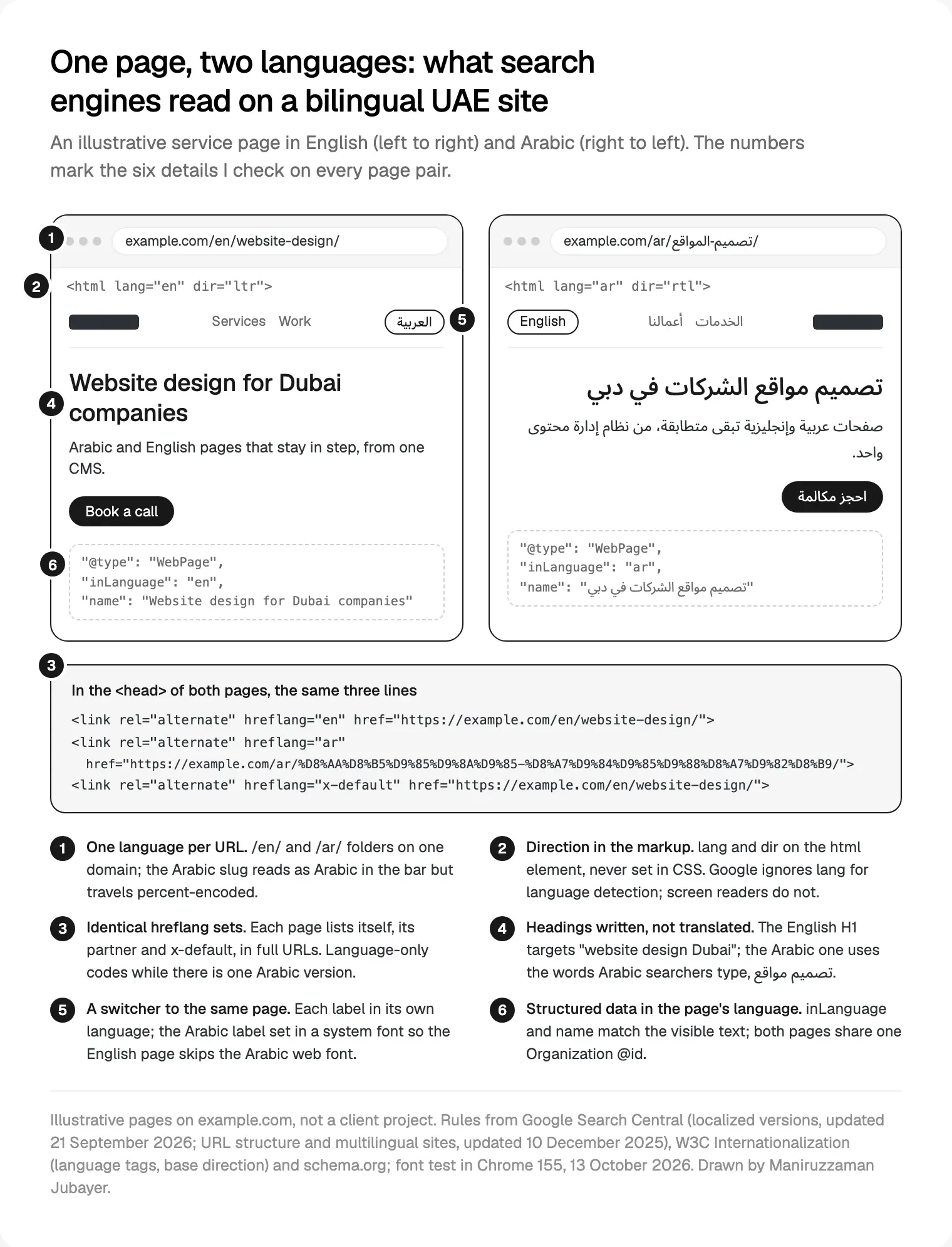
Google also asks for one language per page, since it detects language from visible content, and no redirects that guess a visitor's language; a switcher opening the same page in the other language does that job. Google ignoring the lang attribute doesn't make it optional: screen readers use it, and the W3C's guidance on right to left text puts dir="rtl" on the html element, in markup rather than CSS.
Arabic or Latin slugs
Google's URL structure guidelines use an Arabic word as their example: percent-encode non-ASCII characters in links, and use words in your audience's language "and, if applicable, transliterated words". Both scripts are acceptable.
Their cost is length outside the address bar. In Node.js 24, تصميم-مواقع-دبي ("website design Dubai") was 15 characters in the browser and 80 encoded, as it lands in an email or a CRM. My rule:
- Arabic slugs for pages shared in Arabic: services, locations, articles.
- Latin slugs for legal, careers and campaign URLs.
- One spelling. الإمارات and الامارات (with and without hamza) encode to different URLs, so the CMS guide fixes hamza and taa marbuta once.
- No changes after launch without a 301 redirect.
hreflang for ar, en, ar-AE and x-default
From Google's page on localized versions, the rules that break most:
- Return links. If page X lists Y, Y must list X, or Google ignores the tags.
- One identical set on every version, each page listing itself, in full URLs.
- Language first: ISO 639-1, optionally followed by an ISO 3166-1 region. A region alone is invalid.
That last rule has a UAE trap. AE is the Emirates' country code, but ae as a language is Avestan, an ancient Iranian language, in the Library of Congress ISO 639 list. I check every audit for hreflang="ae" because it looks so plausible.
Language-only codes or ar-AE?
Much UAE advice defaults to ar-AE and en-AE. Google defines x-default as the page used "when no other language/region matches the user's browser setting". So with ar-AE, en-AE and an English x-default, an Arabic speaker in Riyadh matches neither tag, and the annotations point them to English. That's my reading of Google's wording, and why I avoid region codes on a site's only Arabic version.
Google's fix is in the same page: when you have regional versions of a language, add "a catchall URL for geographically unspecified users of that language". The W3C's advice on language tags agrees: keep tags as short as possible.
| Your site | hreflang set | x-default |
|---|---|---|
| One Arabic and one English version | ar, en | English, or a language chooser |
| Separate UAE and Saudi Arabic versions | ar-AE, ar-SA, ar on one of them, en | A chooser |
| One Arabic version; English for UAE residents and for buyers abroad | ar, en-AE, en | International English |
On large sites I put hreflang in the XML sitemap, one file to check; Google treats the methods as equivalent.
Translated or written for Arabic
Google treats localized pages as duplicates only when the main content stays untranslated, so translation isn't penalised. It just isn't written for anyone: Arabic searchers phrase things their own way, and a translated title often uses words nobody types. I split content in two:
- Written natively in Arabic: title tags, H1s, meta descriptions, the opening paragraph of each service page, FAQs and calls to action. These rank and get read in results.
- Translated, then reviewed: policies, biographies, case study detail. A professional translator, then a native reviewer on staging.
Your team owns the Arabic words; I plan the space and structure. If you're still choosing a two-language CMS, my comparison of Framer, Webflow or Next.js covers who can edit what.
Arabic keyword research: dialect, Modern Standard Arabic and Arabizi
Written Arabic online is mostly Modern Standard Arabic (فصحى). Spoken Arabic in Dubai is Gulf, and queries typed on phones drift between the two. Some people type Arabizi: Kareem Darwish's 2014 paper on Arabizi describes it as Arabic in Latin characters, used for both standard Arabic and dialects, often mixed with English, with digits such as 3 for ع.
These are illustrations of how queries are shaped, not search volumes:
| Intent | Modern Standard Arabic | Gulf phrasing | Arabizi |
|---|---|---|---|
| Wants a website | أريد تصميم موقع | أبي أسوي موقع | abi asawi mawqe3 |
| Asks the price | كم تكلفة تصميم موقع | بكم تصميم موقع | bkam tasmeem mawqe3 |
| Looks for a firm | شركة تصميم مواقع في دبي | شركة تسوي مواقع في دبي | sharikat tasmeem mawaqe3 |
How I use this: titles, H1s and body copy stay in Modern Standard Arabic, which reads as professional and is the form Google named when it launched AI Mode in Arabic. Gulf phrasing goes where people speak: FAQ questions, WhatsApp buttons, testimonials. Arabizi stays off the page; if a brand gets typed in Latin letters, the English page catches it.
Spelling variants are separate strings to software: دبي and دبى, شركة and شركه. I don't claim to know how Google weighs each pair, so I check Search Console's Arabic queries and write the correct form.
My research order: Keyword Planner set to Arabic and the UAE, Google's suggestions typed in Arabic on a phone, Search Console queries, then the questions the sales team gets on WhatsApp, often the best source.
RTL layout, Arabic fonts and Core Web Vitals
Google's Core Web Vitals ask for Largest Contentful Paint within 2.5 seconds, Interaction to Next Paint of 200 milliseconds or less and Cumulative Layout Shift of 0.1 or less, at the 75th percentile. Arabic pages carry an extra weight: the font, since Arabic letters take several forms each.
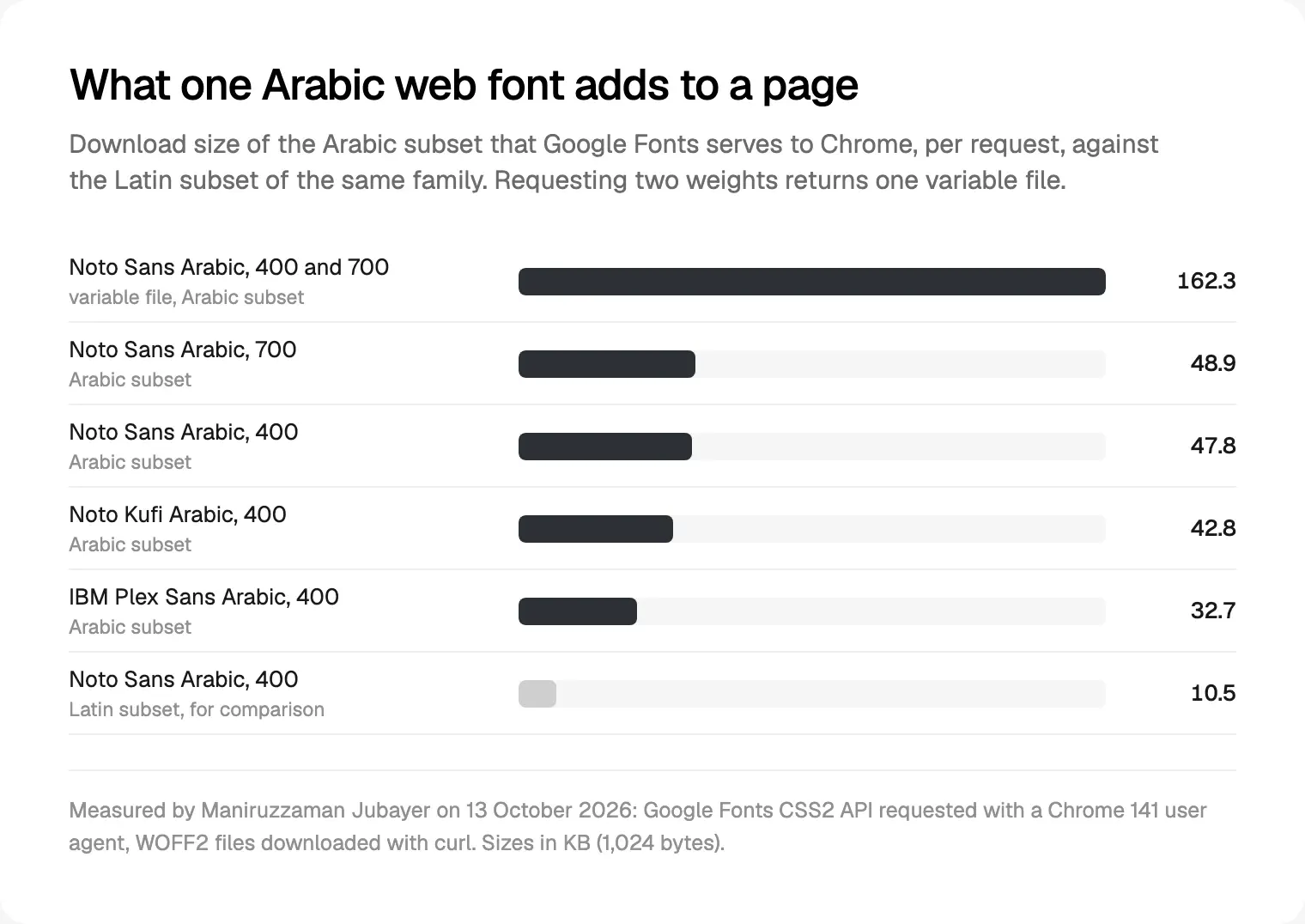
One weight of Noto Sans Arabic cost 47.8 KB for the Arabic subset (48.9 KB in bold). Asking for 400 and 700 together returned one variable file of 162.3 KB, more than the two static files combined. Noto Kufi Arabic was 42.8 KB and IBM Plex Sans Arabic 32.7 KB, against 10.5 KB for a Latin subset. So a variable Arabic font has to earn its size.
Two more tests, in headless Chrome 155:
- The switcher loads the font. Google Fonts splits families by unicode-range, so an English page skipped the Arabic file until I added a switcher labelled العربية. That word pulled the 47.8 KB file in; a system font on the label stopped it. The web.dev font guide adds that preload ignores unicode-range, so preload Arabic on Arabic pages only.
- The swap moves the page. A 16px Arabic paragraph in a 360px column was 84px tall in the macOS fallback, Geeza Pro, and 170px in Noto Sans Arabic, with line height left at normal. Fixed at 1.7, it was 109px against 136px. A late swap pushes everything below by that gap. I set line height per language, use font-display: optional or a size-adjusted fallback, and never fade in the Arabic hero heading.
Mirroring and digits are in my Arabic RTL design rules for UAE products.
Structured data in both languages
Google's structured data guidelines say markup "must be a true representation of the page content". So one English JSON-LD block in a shared template is wrong on Arabic pages:
- WebPage with inLanguage set to ar or en, and a name matching the visible title.
- Organization, defined once with a stable @id that both languages reference. Google's Organization guide recommends name, alternateName, legalName, address, url and sameAs. On Arabic pages I lead with the Arabic name and give the English as alternateName, and the reverse on English pages. That pairing is my approach, not Google's.
- WebSite on the root home page only. Google's site names documentation doesn't support site names at subdirectory level, so /ar/ gets no site name of its own; put the Arabic name in alternateName.
- Breadcrumbs and FAQs in the page's language.
Before launch I crawl both folders and compare the language of each H1 with its JSON-LD name. Any mismatch is a template bug.
Google Business Profile for a Dubai company
For a company with a Dubai office, the Business Profile has its own rules. Google's guidelines for representing your business forbid repeating the business name in several scripts or languages, even if your signage does. So the profile carries one name, not "Name / الاسم".
Three more rules matter in the UAE:
- Address: P.O. boxes at remote locations aren't acceptable, and much UAE mail goes to PO boxes. Use the street address.
- Website: link the page for that location, in the language most of its customers use; hreflang handles the other.
- Description: no links, promotions or prices.
The location page and the profile should agree on name, address and phone. I build the site side; the profile stays with you.
AI search in Arabic
Google brought AI Overviews to MENA on 20 May 2025, available in Arabic globally. On 8 October 2025 it began rolling out AI Mode in 38 new languages, naming "Modern Standard Arabic (Fush'a)". AI Mode uses query fan-out: one question split into subtopics, searched together.
Confirmed, from Google's page on AI features and your website: no extra requirements or special markup. A page must be indexed and eligible to show with a snippet, and structured data should match the visible text.
My reading: fan-out favours pages that answer a topic's sub-questions plainly. In Arabic that means an answer in the first paragraph of each service page, FAQ answers that stand alone, and checkable facts (licence, emirate, languages, hours) as text, never inside images.
Where I would start
If your Arabic site exists, start with a crawl: hreflang return links, any hreflang="ae", the x-default target, and each page's JSON-LD language against its H1. None of those fixes needs a redesign.
If you're building new, decide in this order: URLs and hreflang set, slug rule, which pages get native Arabic, fonts and weights, then design. My website design for company sites starts from that list, and my guide to an Arabic-first website set-up for Qatar covers CMS statuses that keep both languages in step.
I work two hours ahead of Dubai. To have the whole site handled, from scope to launch in both languages, see my website design work for Dubai companies.
Frequently asked questions
Should I use ar-AE or ar in hreflang for a UAE website?
Use ar and en while you have one Arabic and one English version. A tag of ar-AE matches Arabic speakers in the UAE only, so Arabic searchers elsewhere can fall through to your x-default page, often English. Add ar-AE when you also run another country's Arabic version, such as ar-SA, and keep a plain ar tag on one of them as the catch-all Google recommends.
Is Arabic SEO different from English SEO in the UAE?
The technical rules are the same: crawlable pages, one language per URL, hreflang and speed. Research and writing change. Arabic queries mix Modern Standard Arabic, Gulf phrasing and spelling variants that translated English keywords miss, and Arabic fonts make pages heavier. Treat the Arabic site as a second site to rank.
Should Arabic URLs use Arabic or English letters?
Either works for Google, which recommends words in your audience's language, percent-encoded in links, or transliterated words. Arabic slugs read naturally in the address bar but grow long when pasted: 15 characters became 80 in my test. I use Arabic slugs for Arabic service pages and articles and Latin ones for legal and campaign URLs, with one spelling rule.
Can Google translate my English site instead of me building an Arabic one?
Google's translated results may show an English page's title and snippet in Arabic and open a machine translation on click. That isn't an Arabic site: you don't control the wording, forms and legal text stay English, and it won't rank for Arabic queries like a written page. If you sell to Arabic speakers, build the Arabic pages.
Do I need separate structured data for the Arabic pages?
Yes. Google says structured data must represent the visible content, so an English JSON-LD block on an Arabic page is wrong. Give each page markup in its own language with inLanguage set, and reference one Organization with the same @id from both. WebSite markup for your site name goes on the root home page only.
Do I need to do anything special for AI Overviews in Arabic?
Google says no special markup or files are needed: a page must be indexed and eligible to show with a snippet. The habits that help ordinary search help here: answer the question in the first paragraph, write FAQ answers that stand alone, keep key facts as text and match structured data to the page. Google named Modern Standard Arabic for AI Mode.
Sources and method
I read every source and ran every test on 13 October 2026: font sizes via the Google Fonts CSS2 API and curl, font loading and heights in headless Chrome 155 on macOS, slug lengths in Node.js 24.14.1. I found no official figure for the share of UAE searches made in Arabic. The keyword table's queries are illustrations, not volumes.
- Google Search Central, localized versions (updated 21 September 2026), multilingual sites and URL structure (both updated 10 December 2025), read 13 October 2026: developers.google.com, developers.google.com, developers.google.com
- Google Search Central, structured data guidelines (10 July 2026), Organization markup (8 September 2026) and site names (10 December 2025), read 13 October 2026: developers.google.com, developers.google.com, developers.google.com
- Google Search Central, AI features and translated results (both 10 December 2025), read 13 October 2026: developers.google.com, developers.google.com
- Google MENA Blog, AI Overviews in MENA and Arabic (20 May 2025) and AI Mode in Arabic (8 October 2025), read 13 October 2026: blog.google, blog.google
- Google Business Profile Help, guidelines for representing your business, read 13 October 2026: support.google.com
- W3C Internationalization, language tags and right to left text in HTML, read 13 October 2026: w3.org, w3.org
- Library of Congress, ISO 639-2 code list (ae: Avestan; ar: Arabic), read 13 October 2026: loc.gov
- schema.org, inLanguage, read 13 October 2026: schema.org
- web.dev, Web Vitals (31 October 2024) and font best practices (4 October 2022), read 13 October 2026: web.dev, web.dev
- Statcounter Global Stats, UAE search engine and platform share, September 2026, read 13 October 2026: gs.statcounter.com, gs.statcounter.com
- DataReportal, Digital 2026: The United Arab Emirates, 5 November 2025, read 13 October 2026: datareportal.com
- Kareem Darwish, Arabizi Detection and Conversion to Arabic, EMNLP 2014 Arabic NLP workshop, 25 October 2014, read 13 October 2026: aclanthology.org
Tags: Arabic, SEO, UAE, Bilingual, Website design