



Web development cost in Estonia runs at about €45 to €88 an hour from a Tallinn agency, roughly €40 to €60 an hour from an experienced contractor, or about €3,000 to €6,500 a month per employed developer, once the employer's 33.8% in payroll taxes is added. Built into projects with the arithmetic below, a marketing site comes to around €5,400 to €17,500, an MVP web app €27,000 to €70,000 and a SaaS product with sign-in and payments €54,000 to €140,000, all before 24% VAT.
The official anchor is Statistics Estonia: software developers earned a median of €4,718 a month gross in Q2 2026, up 4.3% in a year. Estonian IT company leaders expect €60 to €80 an hour for development.
This guide is for founders budgeting in euros, including e-residents running an Estonian company from abroad. It covers salaries, employer cost, contractor and agency rates, project budgets, VAT, running costs, quotes and where my price sits.
Web development cost in Estonia at a glance
| Option | Typical cost in 2026 | Basis | Confidence |
|---|---|---|---|
| Junior developer, employed | €2,263 gross, about €3,030 a month to the employer | Glassdoor Tallinn, 37 salaries | Fair |
| Mid-level developer, employed | €3,688 gross, about €4,935 a month | Glassdoor Tallinn, 901 salaries | Good |
| Senior developer, employed | €4,875 gross, about €6,525 a month | Glassdoor Tallinn, 406 salaries | Good |
| Contractor | about €40 to €60 an hour | Lemon.io, Freelancermap | Weak |
| Tallinn agency, most common band | USD 50 to 99 an hour (about €45 to €88) | 186 firms on Clutch | Good |
| Estonian IT company benchmark | €60 to €80 an hour | Survey of IT leaders | Fair |
| VAT on services | 24% | Estonian Tax and Customs Board | Certain |
Dollars are converted at the ECB rate of 1 EUR = 1.1225 USD (2 October 2026).
What developers earn in Estonia, by level
Statistics Estonia's salary application, built from the employment register and employers' tax returns, shows full-time equivalent gross pay by workplace county.
| Group, Q2 2026 | Median gross a month | Average gross a month | Median a year earlier |
|---|---|---|---|
| Software developers, Estonia | €4,718 | €4,973 | €4,522 |
| Software developers, Harju county (Tallinn) | €4,821 | €5,076 | €4,619 |
| Web and multimedia developers, Estonia | €2,750 | €3,052 | €2,500 |
| All employees, Estonia | €1,840 | €2,243 | €1,734 |
The web and multimedia group mixes site builders and multimedia roles with front-end engineers, so for product work use the software developer figures. There is no seniority split; by age, software developers under 25 had a median of €2,767 and those aged 35 to 44 €5,123.
Glassdoor's job titles map better to how founders hire. Base pay in Tallinn, October 2026:
| Title | Median base a month | Middle half (25th to 75th percentile) | Salaries |
|---|---|---|---|
| Junior software engineer | €2,263 | €1,926 to €2,688 | 37 |
| Front-end developer | €3,167 | €2,221 to €3,998 | 96 |
| Software engineer | €3,688 | €3,046 to €4,533 | 901 |
| Senior software engineer | €4,875 | €3,925 to €5,650 | 406 |
I use the general software engineer median as the mid-level figure. The top tenth of seniors reported €6,840 or more. Levels.fyi, counting bonuses and equity, shows a median of €69,102 a year (about €5,760 a month) for senior engineers in Estonia, from 59 submissions.
What employing a developer really costs
On top of gross pay, an Estonian employer pays 33% social tax and 0.8% unemployment insurance, according to the Estonian Tax and Customs Board (EMTA). The employee's 1.6% unemployment insurance, 2% funded pension and 22% income tax come out of gross pay, not on top.
| Level | Gross a month | Social tax 33% | Unemployment insurance 0.8% | Employer cost a month | A year | Per working hour |
|---|---|---|---|---|---|---|
| Junior | €2,263 | €746.79 | €18.10 | €3,028 | €36,335 | €19 |
| Mid-level | €3,688 | €1,217.04 | €29.50 | €4,935 | €59,215 | €31 |
| Senior | €4,875 | €1,608.75 | €39.00 | €6,523 | €78,273 | €41 |
| Official median | €4,718 | €1,556.94 | €37.74 | €6,313 | €75,752 | €39 |
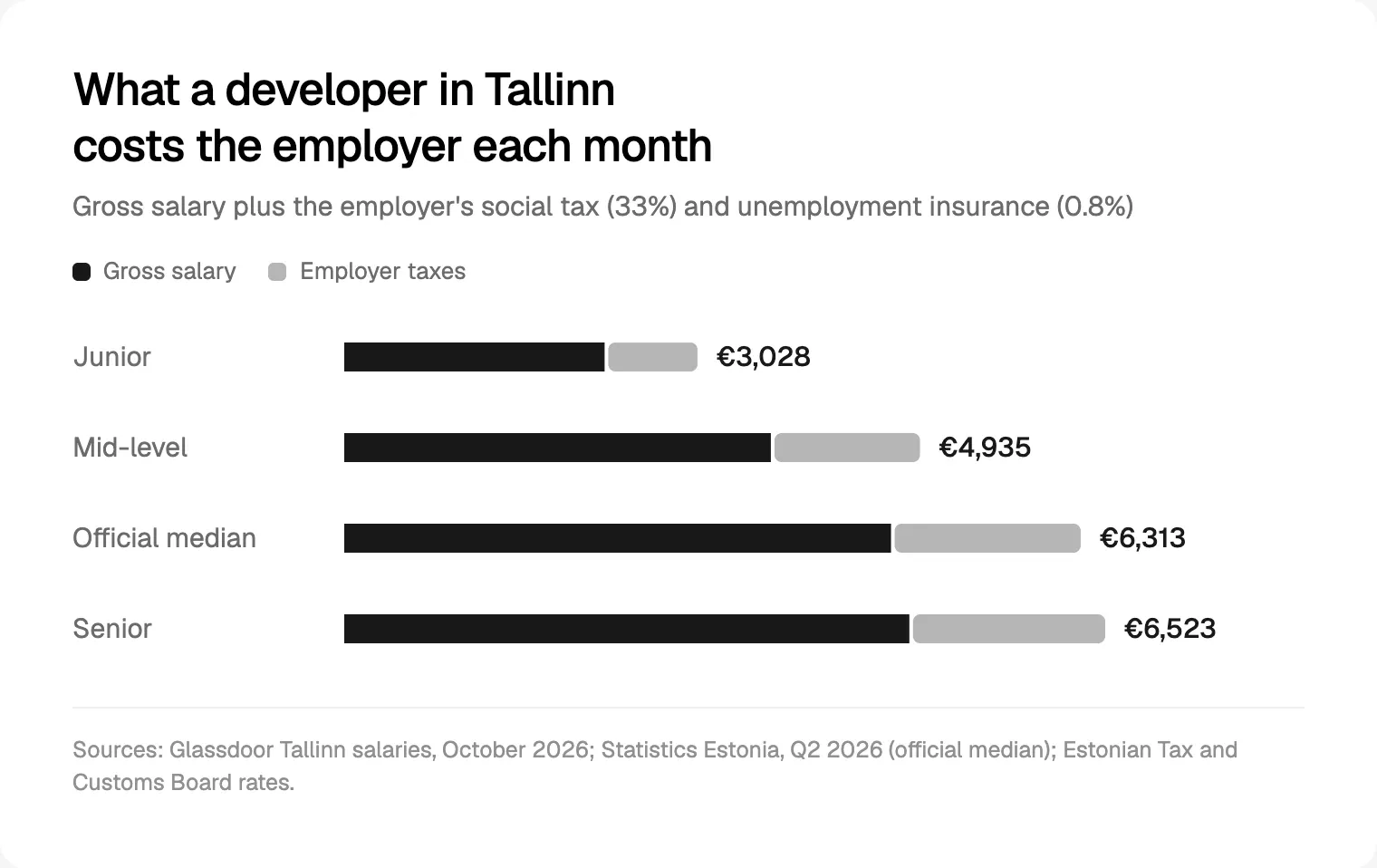
The hourly column divides the annual cost by 1,920 hours: full-time work is 40 hours a week and annual leave at least 28 calendar days, so 48 weeks of 40 hours is the ceiling, before public holidays and sick days. Social tax is also charged on at least €886 a month in 2026, a minimum of €292.38 per employee.
So an agency at €60 to €80 is less expensive than it looks next to a €41 employee: it carries idle time and hiring risk. The employee is cheaper only with steady work all year.
Freelancer and agency rates in Tallinn
Contractors
I found no independent survey of contractor rates, so treat these as indicative. Lemon.io, from 34 active contracts in Estonia in Q3 2026, reports medians of USD 27 an hour (about €24) for mid-level and USD 45 (about €40) for senior developers, what the developer receives rather than the client price. Freelancermap lists 113 freelancers in Tallinn, averaging €60 an hour across all categories.
A fair reading is €40 to €60 an hour, or €320 to €480 a day. VAT registration is compulsory once taxable sales pass €40,000 a year, and a contractor billing 1,600 hours (my assumption) at €50 invoices €80,000, so a full-time contractor usually adds 24%.
Agencies
Clutch listed 210 web development firms for Tallinn on 2 October 2026. Of the 186 that publish a rate:
| Hourly rate | Firms | Share | About in EUR |
|---|---|---|---|
| Under USD 25 | 7 | 4% | under €22 |
| USD 25 to 49 | 76 | 41% | €22 to €44 |
| USD 50 to 99 | 87 | 47% | €45 to €88 |
| USD 100 to 149 | 15 | 8% | €89 to €133 |
| USD 150 to 199 | 1 | under 1% | €134 to €177 |
Of the 183 firms that publish a minimum project size, 44% start at USD 5,000 (about €4,450). Clutch lists firms that say they serve Tallinn, not only local ones, so the lower bands partly reflect international teams.
For the local view, Äritehnoloogia surveyed Estonian software company leaders in September 2026: for three years running, most expected about €60 to €80 an hour. The article is paywalled and the respondent count is not visible.
Outsourcing software development to Estonia or elsewhere: rates compared
I counted every firm on each city's Clutch web developer list on 2 October 2026, using those that publish a rate.
| Option | City | Firms with a rate | Under USD 50 | USD 50 to 99 | USD 100 or more | Time from Tallinn |
|---|---|---|---|---|---|---|
| Local | Tallinn | 186 | 45% | 47% | 9% | same |
| Nordic neighbour | Helsinki | 69 | 22% | 32% | 46% | same |
| Baltic nearshore | Riga | 110 | 34% | 49% | 17% | same |
| Baltic nearshore | Vilnius | 107 | 42% | 48% | 10% | same |
| Central Europe | Warsaw | 516 | 47% | 49% | 5% | 1 hour behind |
| Western Europe | Berlin | 227 | 30% | 29% | 41% | 1 hour behind |
| Offshore | Dhaka | 562 | 77% | 14% | 10% | 3 hours ahead, 4 in winter |
Tallinn, Riga, Vilnius and Warsaw price much alike; Helsinki and Berlin cost more. Dhaka is mostly under USD 50, though about half its listed firms publish no rate. For design rather than code, my guide to design rates and salaries in Dhaka covers that market. Clutch's country table agrees: the most common band is USD 50 to 99 in Poland, USD 25 to 49 in Ukraine and under USD 25 in India.
Tallinn is on UTC+2 in winter and UTC+3 in summer (clocks go back on 25 October 2026). A team a few hours ahead can share your morning, but calls need a fixed slot.
Budgets by project type, with the arithmetic
The hours are my planning estimates for a competent team working from finished designs, not survey data. €45 is the bottom of the most common Tallinn band (USD 50) and €70 the middle of the €60 to €80 local benchmark. All figures exclude VAT and design.
| Project | Typical scope | Hours (estimate) | At €45 an hour | At €70 an hour |
|---|---|---|---|---|
| Marketing site | 5 to 10 pages, CMS, two languages, forms | 120 to 250 | €5,400 to €11,250 | €8,400 to €17,500 |
| MVP web app | Sign-in, 5 to 8 core screens, admin, one integration | 600 to 1,000 | €27,000 to €45,000 | €42,000 to €70,000 |
| SaaS with auth and payments | Roles, subscriptions, invoices, emails, audit log | 1,200 to 2,000 | €54,000 to €90,000 | €84,000 to €140,000 |
| Smart-ID and Mobile-ID login | Both services, every state, testing, go-live | 40 to 80 | €1,800 to €3,600 | €2,800 to €5,600 |
| Smart-ID and Mobile-ID signing | Signing flow, containers or a broker | 40 to 120 | €1,800 to €5,400 | €2,800 to €8,400 |
SK ID Solutions says Smart-ID authentication usually takes one to two days, and signing up to a week if ID-card signing exists. My higher figure covers the work around the API: waiting, cancelled and expired states, error copy, certificate pinning, demo testing and going live, as my guide to Smart-ID and Mobile-ID integration explains.
A worked example
Say an e-resident with a non-VAT-registered OÜ builds an MVP with Smart-ID and Mobile-ID login through a Tallinn agency at €70 an hour:
- MVP: 800 hours at €70 is €56,000.
- Login with both services: 60 hours at €70 is €4,200.
- Subtotal €60,200, plus 24% VAT (€14,448): €74,648, not reclaimable.
- Running costs: Vercel Pro, Supabase Pro, Smart-ID and Mobile-ID minimums, about €133 a month.
- Maintenance: 12 hours a month at €70 (my estimate), €840 a month.
One contractor at €40 to €60 would charge €32,000 to €48,000 but need about five months. A senior and a mid-level employee for six months cost €68,748, about €36 per available hour, and the salaries continue after launch.
What moves the number
- Languages. In the 2021 census, 67% of residents had Estonian as their mother tongue and 29% Russian. Plan internationalisation and native copy from the start. For published figures on what each extra language adds, see my Malaysia website cost guide.
- Accessibility. Online shops, ticketing and banking services placed on the EU market after 28 June 2025 must be accessible, unless the business has fewer than 10 employees and under €2 million turnover.
- Design readiness. A front end built from a documented design system is faster to build and cheaper to change. For a marketing site, compare Framer, Webflow and Next.js.
VAT and e-Residency: what changes the final bill
Estonia's standard VAT rate has been 24% since 1 July 2025, up from 22%, applied by the time of supply. A VAT-registered company with taxable sales can usually deduct it on a local invoice. A company that is not registered cannot: €30,000 plus 24% is €37,200.
Hiring abroad does not make VAT disappear. Business services are taxed where the customer is, so a foreign supplier charges no Estonian VAT and a registered company applies the reverse charge itself. If your company is not registered, EMTA says receiving listed services (consultants, engineers, data processing, electronically supplied services) from an unregistered foreign business means registering as a "taxable person with limited liability" within three working days and paying Estonian VAT. Ask your accountant how your contract is classified.
e-Residency costs and hiring remotely
Estonia had more than 144,000 e-residents and 44,000 companies founded by them on 22 September 2026. Setup costs are small next to a build:
- e-Residency state fee: €150, no annual fee, card valid for five years; a flat €165 from 1 January 2027.
- Registering an OÜ online: €265.
- Contact person: about €200 to €400 a year.
- Accounting: from €50 a month. The programme puts the first year at about €600 if you do it yourself, or €1,300 with accounting support.
Contracting a company or freelancer abroad is simple; employing someone abroad brings that country's rules. EMTA also warns that a company managed from abroad probably has a permanent establishment there, with tax due in that country. Whoever you hire, the contract should give your company the code, keep repositories and cloud accounts in your name, and include a data processing agreement if they handle personal data.
Hosting, payments and maintenance after launch
| Item | Published price, October 2026 | Note |
|---|---|---|
| Vercel Pro hosting | USD 20 a seat a month (about €18) | Hobby plan is non-commercial only |
| Supabase Pro | from USD 25 a month (about €22) | Includes USD 10 compute credit |
| Smart-ID | €0.109 a transaction, €60 monthly minimum, ex VAT | Minimum covers 550 transactions |
| Mobile-ID | €0.109 a transaction, €33 monthly minimum, ex VAT | Minimum covers 300 transactions |
| Stripe cards | 1.5% + €0.25 standard EEA cards, 3.15% + €0.25 international | Stripe Billing adds 0.7% |
| Montonio | from €11.99 a month; bank payments €0.05 to €0.20 each | EU cards from 1.29% + €0.20, ex VAT |
As a planning estimate, allow 8 to 20 hours of maintenance a month for a live product (updates, security patches, small fixes): €560 to €1,400 at €70 an hour. Ask every supplier what support covers.
How to brief developers and compare quotes
- Write a one-page brief: users, the three to five jobs the product must do, integrations, languages, deadline and budget range.
- Say what design exists. Nothing changes quotes more.
- Ask for an estimate by feature, with hours and rate, and VAT status in writing.
- Normalise every quote: convert dollars at the ECB rate, add VAT you cannot reclaim, add 12 months of running costs.
- Ask who writes the code and whether they stay for the whole project.
- Agree how changes are priced before you start.
- Check real work before the big contract: code samples, a reference call or a small paid pilot in your own repository.
| Question | A good answer | A warning sign |
|---|---|---|
| Who owns the code? | Your company, in your repository from day one | "We transfer it at the end" |
| How is Smart-ID handled? | Demo environment, every state designed, contract in your name | "It takes an afternoon" |
| What is not included? | A written list: content, translation, hosting, support | Nothing listed |
Red flags and mistakes to avoid
- Comparing gross salary with an agency rate. Multiply by 1.338 and divide by real working hours first.
- A fixed price on a vague scope. It hides a buffer or leads to change requests.
- An hourly rate with no estimate. You cannot budget a rate.
- Treating Smart-ID as a one-day job. The API is quick; the states and go-live are not.
- Choosing the cheapest rate band. A team at €45 that needs twice the hours costs more than one at €70.
- Code in the supplier's accounts. Whoever holds the repository holds your product.
A decision framework: who should build it
| Your situation | Best fit | Why |
|---|---|---|
| Marketing site under €15,000 | Freelancer, small studio or site builder | Small scope, easy to replace |
| MVP, no technical co-founder | Agency or senior remote team, fixed-scope phases | A working team without hiring |
| Funded, long roadmap | Senior in-house hire, outside help for peaks | Knowledge stays in the company |
| Smart-ID, three languages, regulated sector | A team that can show Baltic identity work | Fewer surprises at go-live |
| Tight budget, flexible timeline | Nearshore or offshore team with real overlap | Lower rates, if progress is visible |
Where my price sits
I work remotely with founders abroad, sharing part of their working day: Tallinn is three hours behind me in summer and four in winter.
Senior work like mine is priced above typical offshore freelancer rates. I do not compete on being cheapest, and I do not publish an hourly rate: every project gets its own fixed price.
It suits founders who want senior design and a React and Next.js front end from one accountable person, not those who need a Tallinn office or the lowest rate. My development service explains how it works.
Frequently asked questions
How much does a website cost in Estonia?
A marketing site of 5 to 10 pages with a CMS and two languages comes to about €5,400 to €17,500 ex VAT, on my estimate of 120 to 250 hours at €45 to €70 an hour, within the most common Tallinn agency band. Design, copy and translation are extra, and 24% VAT applies if your supplier is registered.
What is the average salary of a software developer in Estonia?
Statistics Estonia reports a median gross salary of €4,718 a month and an average of €4,973 for software developers in Q2 2026, with a median of €4,821 in Harju county, which includes Tallinn. The employer adds 33.8% on top. Senior software engineers in Tallinn report a median base of €4,875 on Glassdoor.
What hourly rate do web developers charge in Tallinn?
On Clutch, 47% of Tallinn web development firms that publish a rate charge USD 50 to 99 an hour (about €45 to €88) and 41% charge USD 25 to 49. Estonian software company leaders expect about €60 to €80. Experienced contractors charge roughly €40 to €60, though that data is thin.
Is VAT charged on web development in Estonia?
Yes. The standard rate has been 24% since 1 July 2025, and VAT-registered suppliers add it to every invoice. A registered company with taxable sales can usually deduct it. If yours is not registered, it is a real cost, and buying certain services from an unregistered foreign business can still oblige you to register and pay it.
Can an e-resident company hire developers abroad?
Yes. An e-resident's OÜ can contract a company or freelancer anywhere. Check three things first: how VAT applies to the foreign service, whether managing the company from abroad creates a permanent establishment where you live, and that the contract gives your company the code and the accounts.
How much does Smart-ID integration cost?
SK ID Solutions says authentication usually takes one to two days; with every state, testing and go-live, I estimate 40 to 80 hours for Smart-ID and Mobile-ID login, about €2,800 to €5,600 at €70 an hour. Running costs start at €60 a month for Smart-ID and €33 for Mobile-ID, ex VAT.
Is it cheaper to outsource development than to hire in Estonia?
Per hour, not always. A senior employee costs about €41 per available hour, against €45 to €88 for most Tallinn agencies. Outsourcing wins when work is uneven, you need several skills or you cannot wait to hire. Hiring wins when the product is the business and the roadmap runs for years.
My recommendation
Budget from employer cost or the agency band, never gross salary, and add 24% VAT unless you can reclaim it. For most first builds, a fixed-scope MVP from a senior team is the safest money, with a senior hire once you know what the product must become.
Whoever you choose, get a written scope and one fixed quote for the whole project, and know who will write the code before you sign. If you are building for Estonian users and want Smart-ID, three languages and a clean front end done properly, see how I approach development for Estonian startups.
Sources and method
I collected all figures on 2 October 2026, counting Clutch listings from each city page that day. Dollars are converted at 1 EUR = 1.1225 USD (ECB, 2 October 2026). Project hours, maintenance hours and the contractor's 1,600 billed hours are my own labelled estimates. Contractor data is thin and the Äritehnoloogia survey is paywalled.
- Statistics Estonia, salary application, Q2 2026, 2 October 2026: software developers median, average, by age, by county; web and multimedia developers median, average; method
- Statistics Estonia, average wages in Q2 2026, 3 September 2026: stat.ee
- Statistics Estonia, 2021 census, mother tongues (14 March 2023) and foreign languages (16 November 2022): stat.ee, stat.ee
- Estonian Tax and Customs Board, 2 October 2026: tax rates, social tax, standard VAT rate, place of supply of services, limited liability VAT registration (updated 4 February 2026), e-resident companies
- EY Estonia, tax changes in 2025 and 2026 (previous VAT rate), 8 July 2025: ey.com
- Labour Inspectorate, working time, and Social Insurance Board, annual holiday, 2 October 2026: tooelu.ee, eesti.ee
- Glassdoor, Tallinn base pay, October 2026: junior software engineer, front-end developer, software engineer, senior software engineer
- Levels.fyi, senior software engineers in Estonia, 2 October 2026: levels.fyi
- Lemon.io, developer rates in Estonia, Q3 2026: lemon.io; Freelancermap, Tallinn, 2 October 2026: freelancermap.com
- Clutch, web developer lists, 2 October 2026: Tallinn, Helsinki, Riga, Vilnius, Warsaw, Berlin, Dhaka; pricing guide, updated 21 September 2026: clutch.co
- Äritehnoloogia (Äripäev), survey of IT development hourly prices, 14 September 2026: aritehnoloogia.ee
- e-Residency, costs and fees, the 2027 fee change and the dashboard (updated 22 September 2026): learn.e-resident.gov.ee, e-resident.gov.ee, e-resident.gov.ee
- SK ID Solutions, price list from 1 June 2026 and Smart-ID FAQ, 2 October 2026: skidsolutions.eu, sk-eid.github.io
- Your Europe, accessibility requirements, 2 October 2026: europa.eu
- Published prices, 2 October 2026: Vercel, Supabase, Stripe Estonia, Montonio
- timeanddate.com, Tallinn time zone, 2 October 2026: timeanddate.com; European Central Bank, USD reference rate: ecb.europa.eu
I will refresh these numbers every six months.
Tags: Estonia, Tallinn, Pricing, Development, e-Residency