

Good SaaS onboarding design gets a new user from sign-up to the first moment of real value in as few steps as the product allows. I start by naming that moment as one event in your analytics, the activation event, then design backwards from it: a short sign-up form, a first-run screen that asks for one action, empty states that teach, and invites or integrations asked for where the work needs them.
Tours, checklists and emails come last, in small doses. Nielsen Norman Group found that tutorials interrupt people and are quickly forgotten, so I'd rather fix the screen than explain it. Activation rate and time to value then tell you whether it works.
This is for founders and product leads whose trials sign up and go quiet, and for teams about to hire a product designer for SaaS to fix that first session.
SaaS onboarding design starts with the activation event
Most onboarding briefs start with screens: a welcome modal, a tour, a checklist. I start earlier, with a sentence: "[this kind of user] has [done the core job once, with real data] within [this many days]." That's the activation event, and every screen either moves someone towards it or gets cut.
PostHog's documentation on measuring activation calls it a threshold after which someone is likely to keep coming back; signing up doesn't count, and it can be one event, a count or a mix. To pick it, I use Google's HEART framework paper (CHI 2010): goal, then signals, then metric. It says not every product needs all five categories; for onboarding I use adoption and task success.
On the intro call I ask what your best accounts did in their first week that the ones who left didn't. The answers usually sort like this:
| Signal | What it tells you | How I use it |
|---|---|---|
| Signed up, logged in | Interest, nothing more | The top of the funnel |
| Created a workspace | Setup has started | A step, not activation |
| Loaded sample data | Curiosity | Never counts towards activation |
| Imported or connected real data | A real attempt | Often the step before activation |
| Did the core job once, with real data | First value | Usually the activation event |
Once cohorts exist, I check that accounts reaching the event stay longer; if not, the event is wrong. It's the first thing I map when redesigning a SaaS product's first session.
A SaaS onboarding flow from sign-up to value
The flow I start from has eight steps. Products skip some and reorder the middle, but the end never moves.
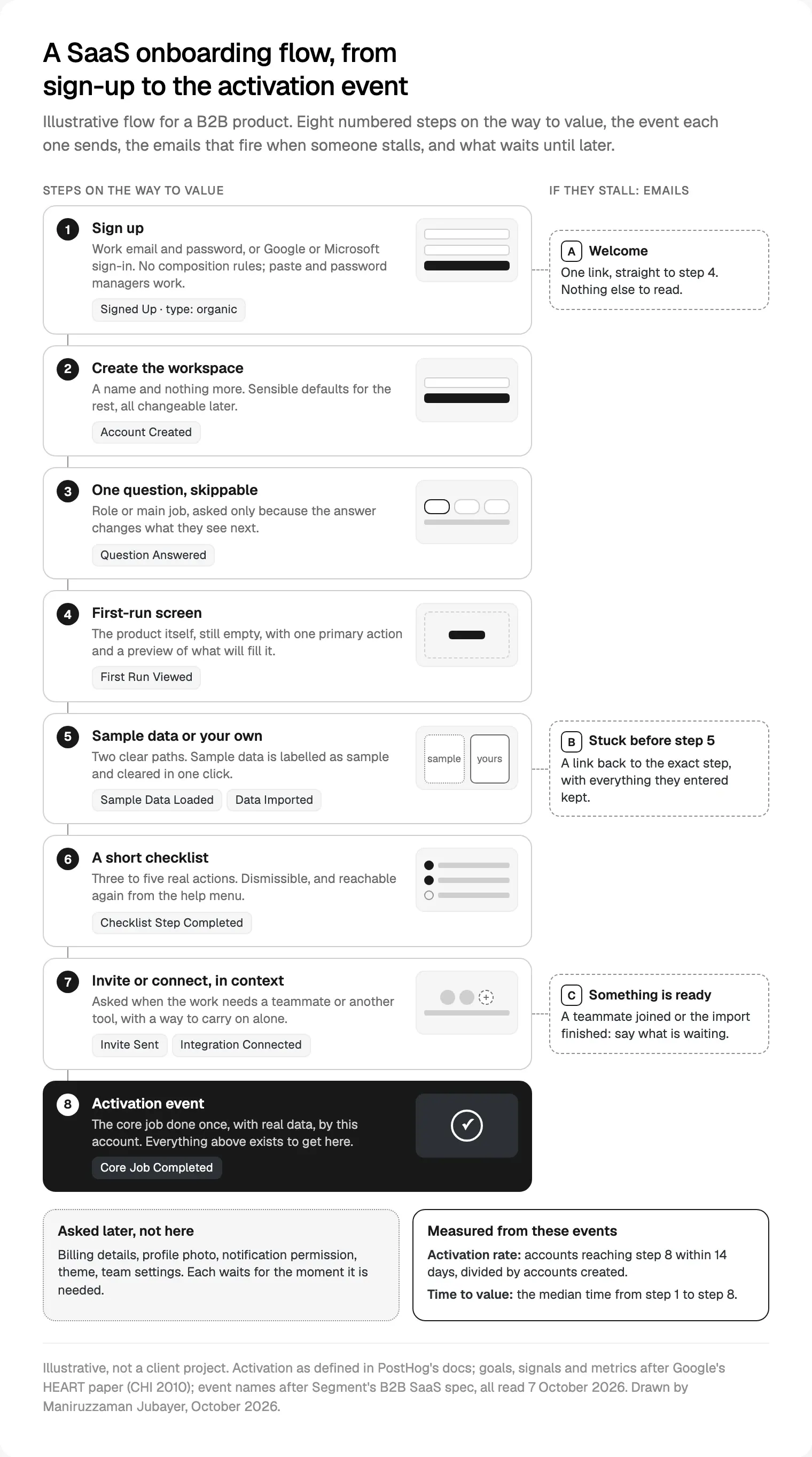
Steps 1 to 3 are a toll booth, so they stay short; steps 4 to 7 happen inside the product, not in a wizard. Emails fire on behaviour, and the bottom-left box lists what I move out of onboarding. For phone apps, see mobile app onboarding examples by pattern.
Events, states and emails all live in code, where onboarding most often drifts from its design; that's why I design and ship it myself.
Cut the sign-up form to what the first session needs
Google's web.dev guide to sign-up form best practices (updated December 2020) asks whether you need an account yet, advises asking for as little as possible, and says not to double up inputs such as "confirm email"; send a confirmation code instead.
Baymard Institute studies e-commerce checkout, not SaaS, but the lesson carries over. Its 2024 checkout form research found the number of fields matters more than the number of steps: most sites need only 8 fields, yet the average was 11.3. People also think of their name as one thing, so I use one name field.
My sign-up form keeps three things:
- Work email, marked
autocomplete="email". - A password marked
autocomplete="new-password"with a show button, or Google and Microsoft sign-in instead. - Nothing else. Company name becomes the workspace name in step 2, role becomes the skippable question in step 3, and company size waits or goes.
NIST's SP 800-63B-4 (July 2025) targets US federal systems, but its password rules travel: no composition rules such as mixing character types, password managers and autofill must work, and paste should. Baymard's password research (November 2022) found 82% of the sites it benchmarks impose unnecessarily complex rules, which hurt people most when they sign in again.
The first-run screen and empty states that teach
The paradox of the active user, from Carroll and Rosson's IBM studies, is why I distrust welcome carousels: people start using software at once and skip setup and learning. Apple's onboarding guidelines (updated June 2024) agree: teach through interactivity, postpone nonessential setup, ship reasonable defaults.
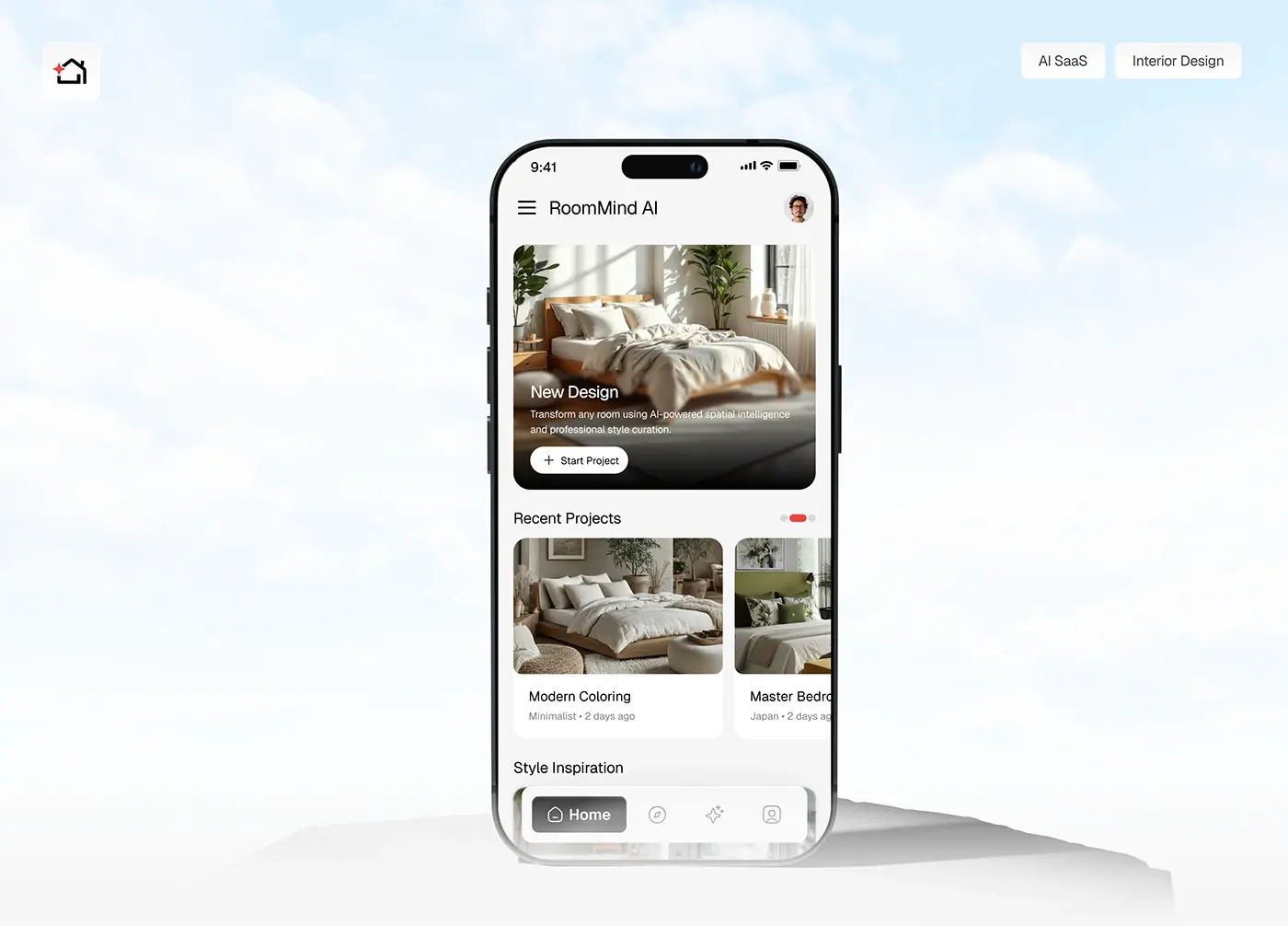
So my first-run screen is the product itself, empty, with one primary action and a preview of what will fill it. NN/g's analysis of mobile-app onboarding (June 2020) draws the line: content customisation can belong in onboarding, a colour theme doesn't, and people should be able to skip.
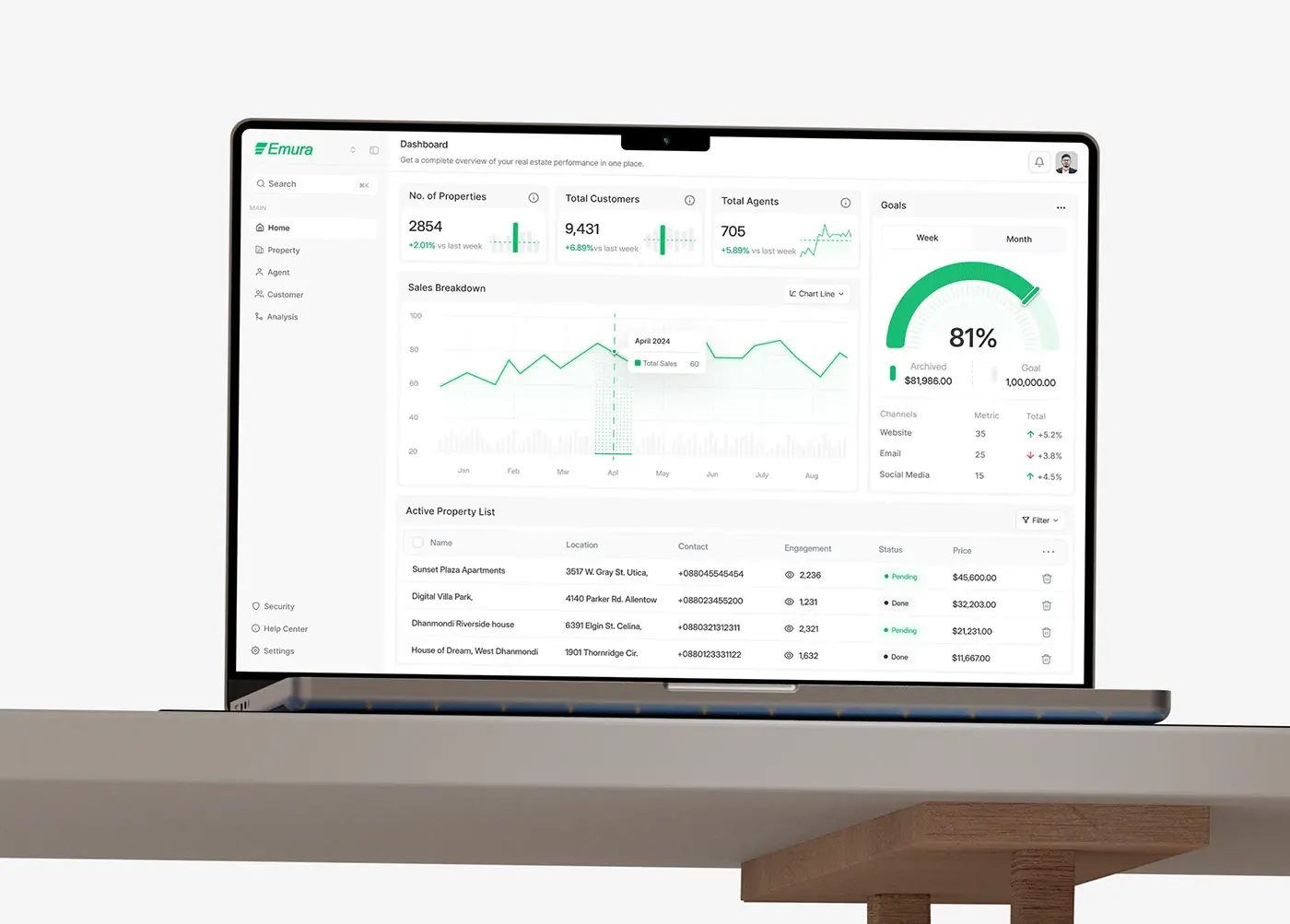
Empty states do most of the teaching. I cover the basics in my guide to empty, loading and error states on dashboards; the onboarding twist is that the first-use state names the next action in the product's own words and shows what will appear once it's done.
Sample data or a blank start
NN/g's article on empty states in complex applications (September 2021) shows a tool offering two paths from an empty account: connect real data, or load demo data to explore safely. When a product only makes sense full, I offer both.
| Start | When it fits | What to watch |
|---|---|---|
| Sample data | Analytics, dashboards, CRMs | Label it, clear it in one click, keep it out of billing and activation |
| Blank start, one action | The first item is quick to make | The empty state must teach |
| Template | People repeat a known structure | A big gallery is a new decision |
| Import or connect | The value is in data held elsewhere | Show progress; offer sample data meanwhile |
Sample actions carry is_sample: true, so demo clicks never inflate activation.
Checklists, tours and tooltips, used sparingly
Nunes and Drèze's paper on the endowed progress effect (2006) found that framing an eight-step task as ten steps with two already done made people likelier to finish, and faster, and that the reason given for the head start mattered. So I tick off steps people have really done, such as creating the account, and never invent progress.
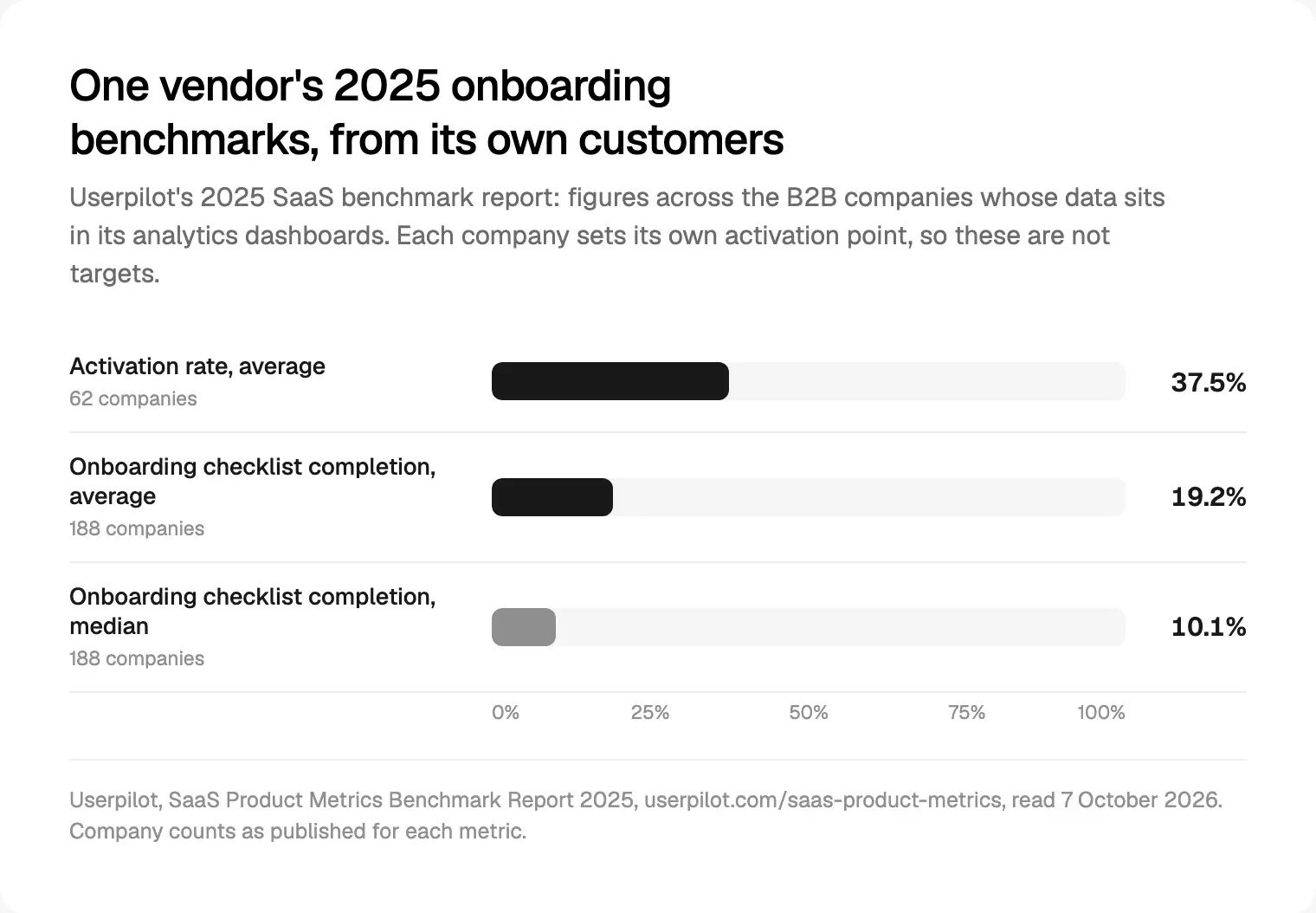
Few people finish checklists, though. Userpilot, which sells onboarding software, published a 2025 benchmark from its customers' dashboards: across 188 companies, checklist completion averaged 19.2%, with a median of 10.1%. That's its own customers, measured its way, but it's reason enough not to make the checklist the only route to activation.
My checklist has three to five real actions in order. It can be dismissed, it comes back from the help menu, and its progress is announced to screen readers.
NN/g's Onboarding Tutorials vs. Contextual Help (February 2023) separates push revelations, shown out of context, from pull revelations, triggered when the person would benefit. It found tutorials interrupt, don't necessarily improve task performance, are quickly forgotten and often skipped. My rare tours cover a genuinely new interaction, start when the user asks, run three steps or fewer and end with the person doing the action.
NN/g's tooltip guidelines (updated January 2024) add: never hide information vital to the task in a tooltip, and make tooltips work from the keyboard.
Invitations, integrations and permissions as steps
In B2B products, value often needs a second person or another tool's data. Each request is a step, asked when the work needs it, with a way to carry on alone.
- Invites go where collaboration happens: assigning a task, sharing a report.
- Invited people get their own flow. They land in a workspace with data, so I skip setup questions and show who invited them and what's waiting. Segment's B2B SaaS spec gives Signed Up a type (invited or organic) and Invite Sent the invitee's role, so both groups can be measured apart.
- Integrations ask for the narrowest access at the moment of need. Google's OAuth 2.0 guide for web server apps recommends requesting scopes in context, through incremental authorisation. I add one line on what the product will read and write, and a "skip for now" path.
- Device permissions, such as notifications, wait for the feature. Apple's guidelines say to ask when people first use the function that needs it.
Emails that bring people back
I use three triggered emails: a welcome with one link to the first action, a nudge when someone stalls before the step that matters (linking straight back, work kept), and a note when a teammate joins or an import finishes. Timing comes from your data; each email has one job.
The FTC's CAN-SPAM compliance guide judges an email by its primary purpose and reads the transactional category narrowly, so an email promoting a feature needs an opt-out, honoured within 10 business days. Since 1 February 2024, Google's email sender guidelines require anyone sending over 5,000 messages a day to Gmail to offer one-click unsubscribe on marketing messages and keep spam rates below 0.3%.
How to measure SaaS onboarding: activation rate and time to value
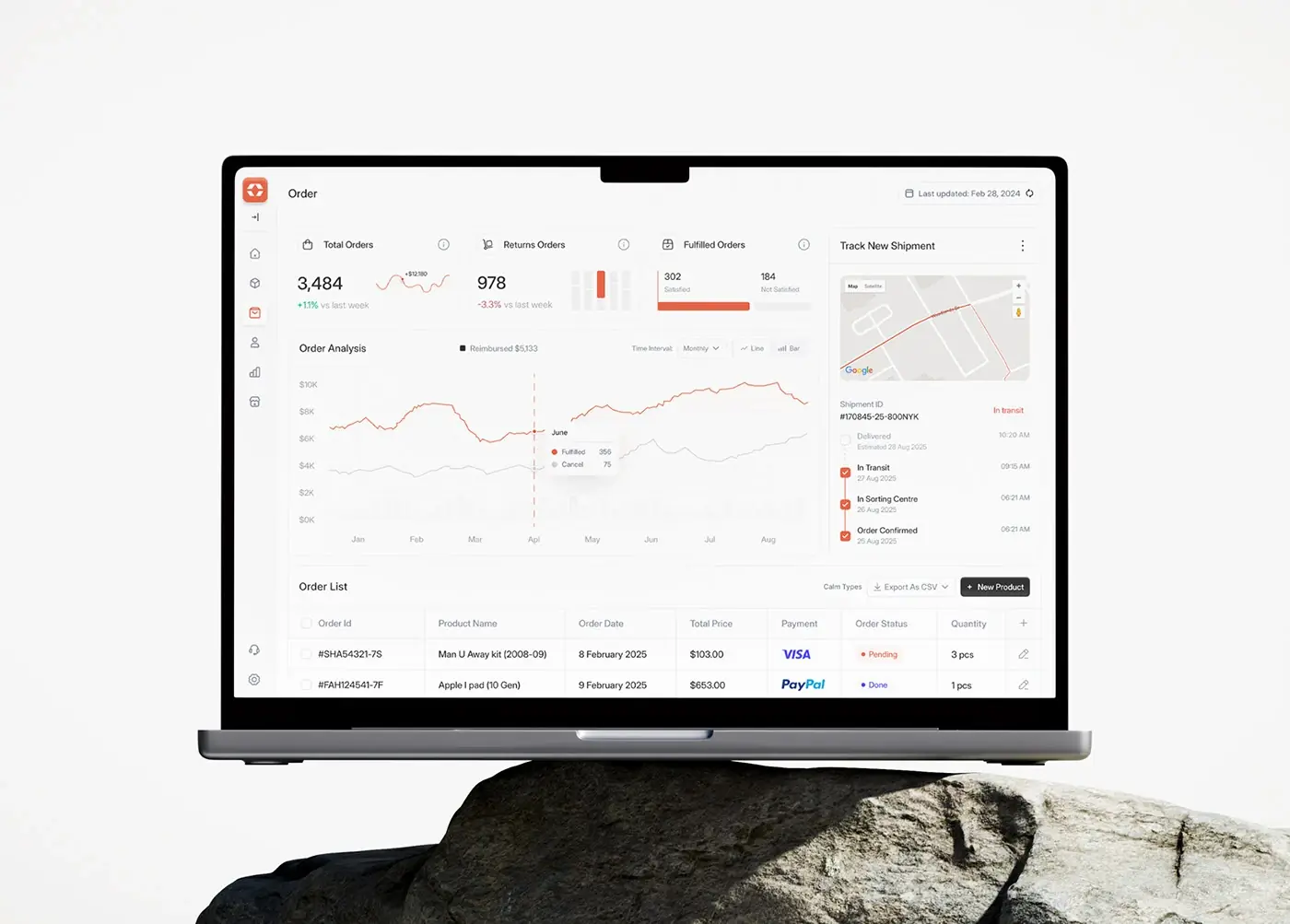
I define two numbers before launch. Activation rate is accounts reaching the activation event within a set window, divided by accounts created in that period. Time to value is the median time from sign-up to that event, since a few slow accounts drag an average.
| Event | Key properties | What it answers |
|---|---|---|
| Signed Up | type, method | Where new accounts come from |
| Account Created | account ID, plan | Where the account funnel starts |
| Sample Data Loaded, Data Imported | source, is_sample | Which start people choose |
| Invite Sent | invitee role | Whether a team forms |
| Core Job Completed | account ID, is_sample | Activation |
Signed Up, Account Created and Invite Sent come from Segment's spec. Google's GA4 recommended events offer sign_up with a method parameter.
Write the conversion window beside the event. Amplitude's funnel documentation defaults to one day and Mixpanel's funnels to seven, so one funnel built in both gives two activation rates. In B2B, count accounts: Segment's spec carries the account as a group ID on each event. In the EU, analytics that touches the device may need consent first; my guide to cookie consent for SaaS in Germany covers it.
Benchmarks? Userpilot's 2025 report gives a 37.5% average activation rate across 62 of its B2B customers and an average time to value of 1 day, 12 hours and 23 minutes. Each set its own activation point, so I compare a product with its own cohorts instead. Still scoping version one? Here's what to keep in an MVP scope.
B2B and self-serve onboarding compared
The principles hold for both; the unit and the blockers change.
| Self-serve | Sales-led B2B | |
|---|---|---|
| Who signs up | The person who'll use it | An admin or buyer, then the team |
| What activation means | One person doing the core job | An account with data and a few active users |
| Usual blocker | An unclear first action | Integrations, permissions, IT approval |
| Who onboards | The product and its emails | The product, plus kick-off and training by people |
| Unit to measure | User | Account |
In sales-led products, customer onboarding runs beside product onboarding. I design the product side so customer success explains less: an admin checklist that mirrors the kick-off plan, and invited users who land on real work.
Accessibility in onboarding
Onboarding piles up overlays and widgets, so it gets its own pass against WCAG 2.2:
| Element | WCAG 2.2 criterion | What I check |
|---|---|---|
| Sign-up and sign-in | 3.3.8 Accessible Authentication (AA) | Paste and password managers work; an emailed code or SSO as an alternative |
| Tooltips and popup tips | 1.4.13 Content on Hover or Focus (AA) | Dismissible, hoverable, persistent |
| Checklist panels, chat widgets | 2.4.11 Focus Not Obscured (AA) | Never fully cover the focused element |
| Checklist progress | 4.1.3 Status Messages (AA) | Announced without moving focus |
| Details asked twice | 3.3.7 Redundant Entry (A) | Prefilled or selectable |
| Animated tours | 2.2.2 Pause, Stop, Hide (A) | Motion over five seconds can be paused |
For modal tours, the W3C's ARIA dialog pattern sets the behaviour: focus moves into the dialog, Escape closes it, and focus returns to whatever opened it.
Where I would start
If activation is the problem, don't start with a tour. Write the activation event as one sentence, sign up to your product with a fresh account and real data, and count every screen, field and wait before that event. Cut whatever the first session doesn't need, then design the first-run screen.
If you'd like help, it's the first thing I look at in my product design work for SaaS teams. It starts with a free 30 minute intro call, then a written scope and one fixed quote. I design the flow in weekly Figma sprints and can build it in React and Next.js, events and emails included.
Frequently asked questions
What is SaaS onboarding design?
It's the design of everything between sign-up and a new user's first real value: the sign-up form, the first-run screen, empty states, setup steps such as invites and integrations, any guidance, and the emails around them. It's judged by one thing: how many new accounts reach that moment, and how quickly.
What are SaaS onboarding best practices?
Define the activation event first. Ask only for what the first session needs. Make the first screen the product itself, with one primary action. Offer labelled sample data beside a blank start. Ask for invites and integrations in context, keep tours optional, trigger emails by behaviour, and measure activation rate and time to value.
How do you define an activation event?
Write one sentence: which user, which action, within how long. Choose an action that shows the product did its job once with real data, such as a first report sent, not one that only shows setup. It can be a count or a mix of events. Later, check that accounts reaching it stay longer.
What is a good activation rate for SaaS?
There's no universal number, because every product defines activation differently. Userpilot reported a 37.5% average across 62 of its B2B customers in its 2025 benchmark, measured in its own tool. Treat that as context, not a target, and compare your product with its own recent cohorts, using the same event and window.
Should SaaS onboarding use product tours?
Rarely as the first thing people see. Nielsen Norman Group found tutorials interrupt people, are often skipped and quickly forgotten, and don't necessarily improve task performance. I use a short tour only for a genuinely new interaction: started by the user, three steps or fewer, ending with the person doing the action.
How long should SaaS onboarding take?
As long as reaching first value honestly takes, and no longer. Measure it as time to value, the median time from sign-up to the activation event. Some products get there in one session; others need an import or a teammate, which can take days. The job is removing every step that moment doesn't need.
What is the difference between customer onboarding and user onboarding?
User onboarding happens inside the product: the screens, empty states and emails that get one person to value. Customer onboarding is the wider process for a B2B account: contracts, kick-off calls, data migration and training, often run by customer success. Good product onboarding makes the customer side lighter.
Sources and method
I read every source on 7 October 2026. The flow and tables are my method, not client data. Baymard's checkout research is applied to sign-up by analogy. The only benchmarks are one vendor's customers; I found no independent activation data. The endowed progress finding is from the abstract.
- Nielsen Norman Group, five articles on onboarding, tooltips and empty states, date read 7 October 2026: nngroup.com, nngroup.com, nngroup.com, nngroup.com, nngroup.com
- Baymard Institute, checkout form fields (June 2024) and password requirements (November 2022), date read 7 October 2026: baymard.com, baymard.com
- NIST, SP 800-63B-4 (July 2025), date read 7 October 2026: pages.nist.gov
- W3C, WCAG 2.2 and the ARIA modal dialog pattern, date read 7 October 2026: w3.org, w3.org
- Apple, Human Interface Guidelines: Onboarding, date read 7 October 2026: developer.apple.com
- Google, sign-up forms, OAuth, GA4 events and Gmail sender rules, date read 7 October 2026: web.dev, developers.google.com, developers.google.com, support.google.com
- Google Research, the HEART framework paper (CHI 2010), date read 7 October 2026: research.google
- PostHog, measuring activation, date read 7 October 2026: posthog.com
- Amplitude, interpreting funnel analysis, date read 7 October 2026: amplitude.com
- Mixpanel, advanced funnels, date read 7 October 2026: docs.mixpanel.com
- Twilio Segment, B2B SaaS spec, date read 7 October 2026: segment.com
- Nunes and Drèze, The Endowed Progress Effect (2006), abstract, date read 7 October 2026: ideas.repec.org
- Userpilot, SaaS Product Metrics Benchmark Report 2025, date read 7 October 2026: userpilot.com
- US Federal Trade Commission, CAN-SPAM compliance guide, date read 7 October 2026: ftc.gov
Tags: SaaS, Onboarding, Product design, Activation, Empty states