

Launching an app in Southeast Asia from Singapore means designing one product that changes in four places as it crosses each border: the language and script, the payment rail, the sign-in and the consent rules. Singapore gives you PayNow, SGQR, Singpass and the PDPA. Malaysia brings DuitNow and a privacy notice that must be in Malay and English. Indonesia brings QRIS and Bahasa Indonesia, Thailand brings PromptPay and a script with no spaces between words.
None of this needs a new app per country. It needs a design system and a checkout built so those four things are settings, not rebuilds. That is the method behind my work as a UI/UX designer in Singapore hours, working remotely for teams whose first market is rarely their last.
This guide is for founders and product leads planning a Singapore launch with Malaysia, Indonesia, Thailand or the Philippines next. I'm a designer, not a lawyer, so have counsel confirm the legal points for your product. For sign-in, see designing a Singpass login integration.
Launching an app in Southeast Asia: what changes per market
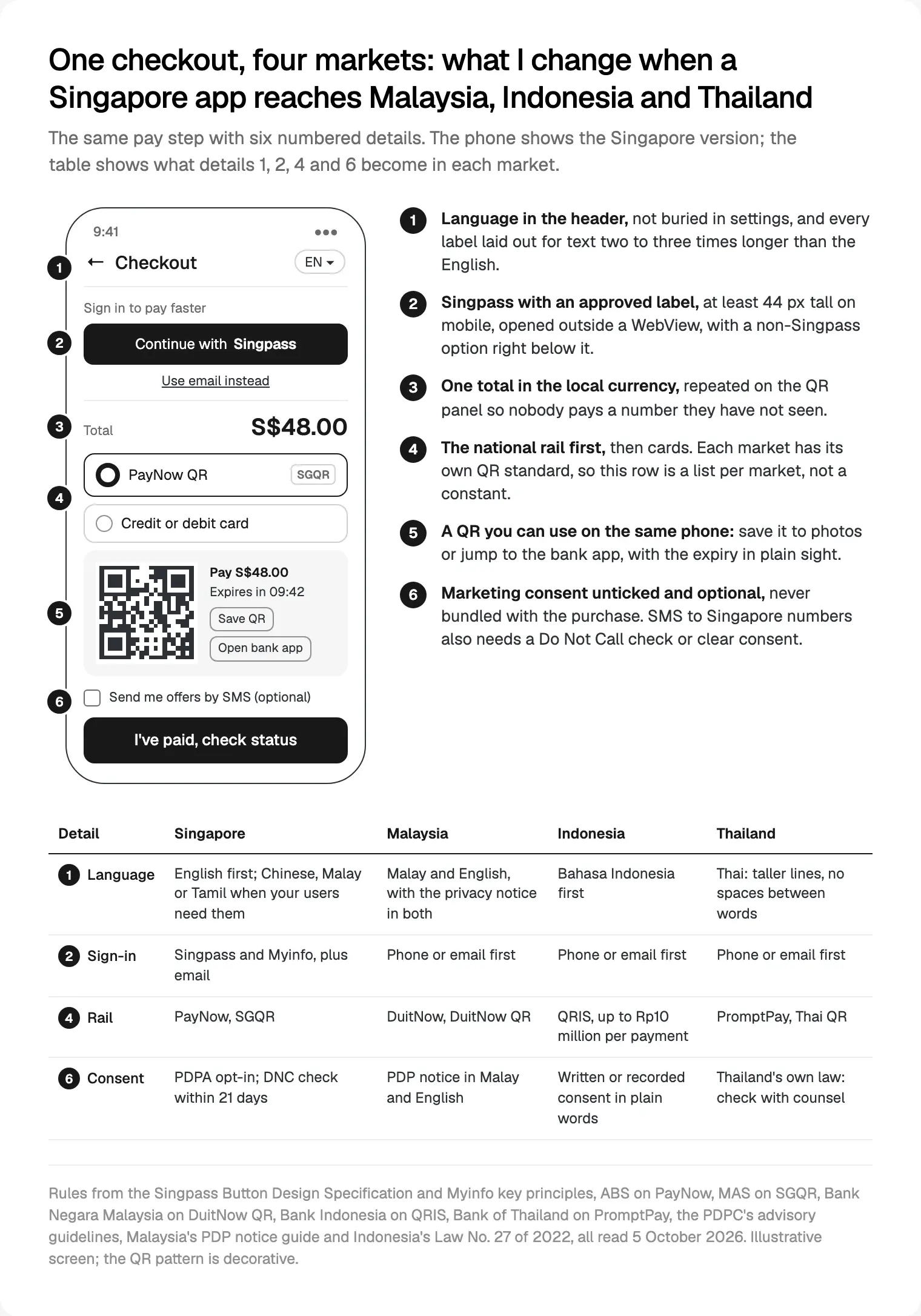
When I scope a regional product, I split every screen into what stays fixed (layout, components, the order of steps) and what changes per market. In practice the second list is short, and the checkout shows almost all of it.
Google, Temasek and Bain's e-Conomy SEA 2025 report says more than 60% of payments in the region are now digital and three in five people shop online. Users arrive with their own wallet and QR habits, and a checkout that only knows Singapore loses them.
Languages and scripts: length, height and line breaks
Singapore alone is multilingual. In the Census of Population 2020, English was the language most often spoken at home for 48.3% of residents aged 5 and over, up from 32.3% in 2010, ahead of Mandarin at 29.9%, Malay at 9.2% and Tamil at 2.5%.
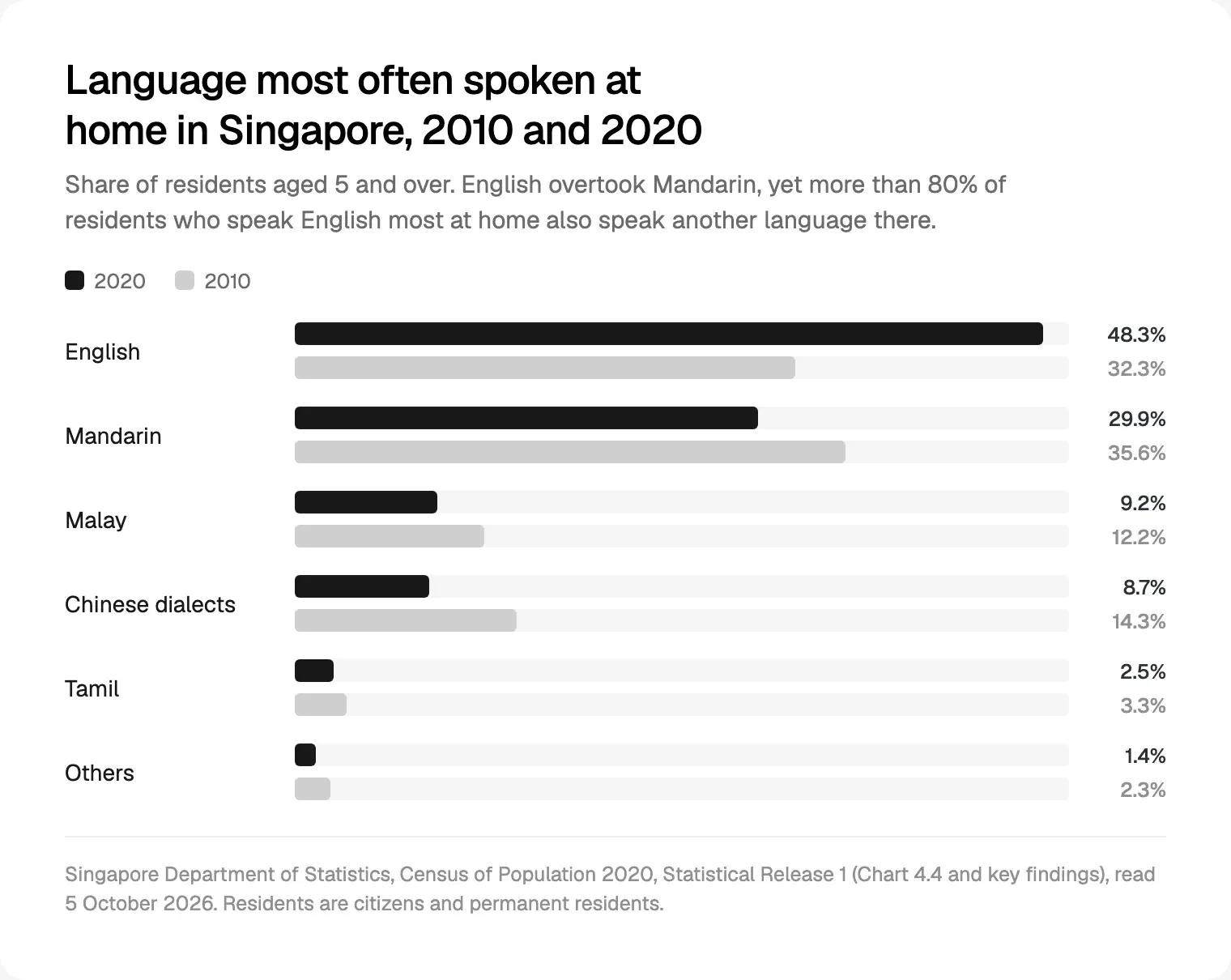
The census also found that over 80% of residents who speak English most at home also speak a vernacular language there. So I launch in English, then add Chinese, Malay or Tamil when the users you are chasing need them, not because the language is official.
Across the region, three things change on screen:
- Length. IBM guidance quoted in the W3C's article on text size in translation puts translations of strings up to 10 characters at 200 to 300% of the English length, and text over 70 characters at about 130%. They are averages for European languages; I found none for Malay, Indonesian or Thai, so I treat them as a margin. Short labels grow most, so buttons and tabs break first.
- Height. The same article shows two lines of Thai taking far more vertical space than two lines of English. The W3C's Thai script resources explain why: a composite vowel can use up to four glyphs plus a tone mark, around the consonant on up to three sides.
- Line breaks and digits. In Thai, spaces separate phrases rather than words, so wrapping cannot rely on spaces, and native Thai digits are commonly used, so decide your digit rule.
I set type tokens per script, with a line height of their own, and choose one family that has matching Thai, Tamil and Chinese faces. For Malay and Chinese on the web, see how I build multilingual sites for Malaysia.
Payment rails: PayNow, DuitNow, QRIS and PromptPay
Every market has a national instant rail and its own QR standard. This is the part of the checkout I design per market:
| Market | Rail and QR | What the central bank or bankers' association says |
|---|---|---|
| Singapore | PayNow, SGQR | PayNow launched on 10 July 2017 and works by mobile number, NRIC/FIN, UEN or a virtual payment address; SGQR puts many schemes on one label |
| Malaysia | DuitNow, DuitNow QR | DuitNow QR is the national QR, operated by PayNet |
| Indonesia | QRIS | QRIS launched 17 August 2019, mandatory from 31 December 2019; up to Rp10 million per transaction |
| Thailand | PromptPay, Thai QR | PromptPay launched in 2016; transfers by citizen ID or mobile number, extended to Thai QR payment |
| Philippines | QR Ph | QR Ph has been the national QR standard since November 2019, running on InstaPay |
The rails also link up. MAS lists cross-border linkages: PayNow and PromptPay since 29 April 2021, with up to S$1,000 or THB25,000 a day by mobile number, and PayNow and DuitNow since 17 November 2023, with up to S$1,000 or MYR3,000 a day. QR links with Malaysia (31 March 2023) and Indonesia (17 November 2023) let travellers scan the other country's codes. So a visitor may pay with a home wallet, and I never assume the payer's bank from the shop's country.
How the checkout adapts to a QR rail
Card checkouts are a form. QR checkouts are a handoff to another app, and that changes the screen:
- Same-phone use. Nobody can scan a QR on their own screen, so I add "Save QR" and a link to the bank app, and keep the amount and expiry visible.
- A name that matches. ABS says PayNow shows the recipient's name before the sender confirms, so the merchant name in my QR panel matches the registered name the bank will display.
- Waiting is a state. I design "checking", "paid", "expired" and "failed" screens, and the paid state comes from your provider's confirmation, never from the user tapping "I've paid".
For cards and buy now, pay later, see how I design a Saudi checkout with mada.
Singpass and Myinfo sign-in, by the spec
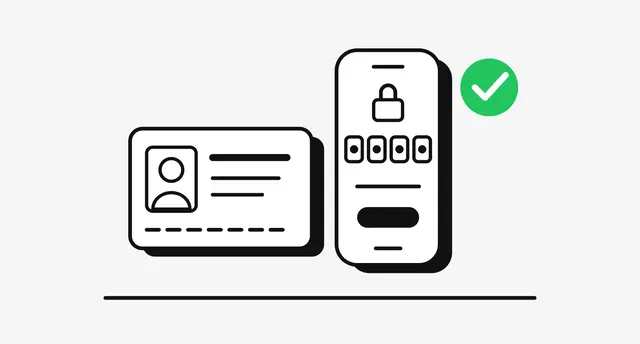
The Singpass Button Design Specification, in force from 1 September 2026, allows only its approved labels (log in, sign up, apply, verify, continue and a few more), in four colour variants. The button is at least 40 px tall on desktop and 44 px on mobile, the logo at least 14 px high, with 16 px clear around it, and screen readers should say "Sing-pass", not spell it out.
Two device rules shape the flow. Singpass does not support WebView browsers, so a mobile app opens a proper in-app browser, and higher-risk actions may trigger face verification, which needs a working front camera. The Login key principles ask you to offer a non-Singpass alternative, which also serves foreign users and your next markets.
Myinfo pre-fill has its own key principles: request only what you need, one purpose per request, show retrieved data as-is, keep government data uneditable while user-provided fields stay editable, and purge data if the form is never submitted. I design the review screen to make that split obvious, with locked fields labelled by source. That is the core of how I design Singpass and PayNow flows for Singapore teams.
PDPA consent and the Do Not Call rules
The PDPC's Advisory Guidelines on Key Concepts in the PDPA (revised 29 April 2026) set four rules I turn into screens:
- No consent beyond what the service needs as a condition. Section 14(2) forbids it, and consent gained by misleading practices is not valid.
- Marketing is opt-in. The PDPC does not consider a pre-checked box appropriate for direct marketing consent.
- Withdrawal is easy and specific. As a rule of thumb, at least 10 business days' notice is reasonable, and people must be able to withdraw optional purposes without losing the necessary ones.
- Breaches have a clock. A breach affecting 500 or more people counts as significant scale, and the PDPC must be told within three calendar days of deciding it is notifiable.
So sign-up separates terms from marketing, settings give each optional purpose its own switch, and breach messages exist as templates before launch.
The Do Not Call guidelines add rules for marketing calls and texts to Singapore numbers. There are three registers (voice, text and fax), and a number must be checked within 21 days before a marketing message, unless the person gave clear and unambiguous consent in written or other accessible form. That consent needs positive action; failing to opt out does not count. Each message must identify the sender with contact details valid for at least 30 days, and calls must not hide the caller ID.
My design answer is one unticked box per channel ("Send me offers by SMS"), stored with its wording and timestamp as evidence. The same habit helps with the privacy choices I design for Texas apps.
What changes in Malaysia and Indonesia
Malaysia. The Commissioner's guide to PDP notices says the notice must be in both Malay and English. The 2024 amendment, Act A1727, adds data protection officers and a right to data portability, so settings need an "export my data" path. The breach notification guideline asks for notice to the Commissioner within 72 hours and to affected people within 7 days after that, with significant scale meaning more than 1,000 people. For the Malaysian marketing site, see my website design for Kuala Lumpur companies.
Indonesia. Law No. 27 of 2022 on personal data protection took effect on 17 October 2022 with two years to comply. Consent must be written or recorded, electronically or not. When a consent request also covers other purposes, it must be clearly distinguishable, easy to understand and written in simple, clear language, or it is void. Processing must stop within 3 x 24 hours of a withdrawal, and after a breach, people and the authority get written notice within 3 x 24 hours. That withdrawal clock is far shorter than Singapore's 10 business day rule of thumb, so the switch must trigger a real process, not a support ticket.
Thailand and the Philippines have their own data laws, not covered here, so ask local counsel before designing their consent screens.
Mobile-first, low-end Android and patchy data
Most of your next users will meet the product on a phone, and not always a new one. Google's Android (Go edition) documentation sets minimum RAM at 1GB for Android 11 and 12 devices and 2GB for Android 13, and warns developers of significant performance, network and battery limits.
I found no official regional figures on device mix, so I design as if the slowest phone is common. Light screens, compressed images, no autoplay video in the checkout, states for offline and retry, and the QR saved locally so a dropped connection doesn't lose the payment. Then I check key flows on an entry-level Android phone before handoff.
The order I design a regional launch in
- Write the market order and, for each market, the language, rail, sign-in and consent rules.
- Build tokens for the longest language and tallest script first, so Singapore English is the easy case.
- Choose payment providers per market and confirm which rails and QR types each one supports.
- Design sign-in with a fallback: Singpass and Myinfo in Singapore, phone or email everywhere.
- Draft consent, notices and breach messages per market for your lawyers to approve.
- Prototype the checkout in each language and test it with real users in the first two markets.
- Hand off with per-market configuration documented, so market three is content work, not a redesign.
Underneath sits my usual approach to product design for regional products: weekly Figma sprints and a written update every 48 hours, so each market's checkout is reviewed while it is cheap to change.
Where I would start
I'd design the checkout first, in the longest language you plan to support, with every payment state drawn. If it works in Bahasa Indonesia and Thai with QRIS and PromptPay, Singapore English with PayNow is easy. I would rather ship two markets properly than four that each feel translated.
If that is your plan, book a free 30 minute intro call. A written scope and one fixed quote follow. Read how I work, or see my product design work for Singapore startups.
Frequently asked questions
What do I need to launch an app in Southeast Asia from Singapore?
Plan four per-market settings: language, payment rail, sign-in and consent. Build one design system with type tokens for the longest language, a checkout that handles PayNow, DuitNow QR, QRIS and PromptPay through your providers, Singpass with a fallback, and consent screens your lawyers approve per country. The next market then becomes content, not a rebuild.
Do I need Singpass login in my app?
No, it is optional, and Singpass's own principles ask you to offer a non-Singpass alternative. If you add it, follow the Button Design Specification in force since 1 September 2026: approved labels only, at least 44 px tall on mobile, and no embedded WebView. Myinfo pre-fill has its own data rules.
How do I accept PayNow in a mobile app?
Through a bank or payment provider that supports PayNow and SGQR. Design the handoff: nobody can scan a QR on their own screen, so offer Save QR and a link to the bank app, show the amount and expiry, and confirm payment from your provider's notification, never from the user's tap.
Does the PDPA require separate consent for marketing?
In practice, yes. The PDPC says a pre-checked box is not appropriate for direct marketing consent, so use an unticked box. For calls and texts to Singapore numbers, check the Do Not Call registers within 21 days before sending, unless the person gave clear and unambiguous consent through positive action, recorded in written or other accessible form.
Which language should my app use in Malaysia and Indonesia?
In Malaysia, English and Malay usually cover the interface, and the privacy notice must be in both, according to the Commissioner's notice guide. In Indonesia, launch in Bahasa Indonesia, and write consent requests in simple, clear language, as Law No. 27 of 2022 requires. Add Chinese or Tamil when your customer evidence says so.
How much longer does translated text get?
IBM's averages for European languages, quoted by the W3C, put strings of up to 10 characters at 200 to 300% of their English length and text over 70 characters at about 130%. Thai also needs taller lines than English. Design buttons, tabs and table headers to wrap or grow rather than truncate.
Can Singapore users pay across borders from their own apps?
Often, yes. PayNow links with PromptPay and DuitNow for transfers by mobile number, with daily limits of S$1,000 (THB25,000 or MYR3,000). For shops, QR links with Malaysia since 31 March 2023 and Indonesia since 17 November 2023 let customers of participating banks and wallets scan the other country's codes.
Should I design for low-end Android phones?
Yes, if you are going beyond Singapore. Android Go edition devices can run with 1GB of RAM on Android 11 and 12, or 2GB on Android 13. Keep screens light, save QR codes locally, design offline and retry states, and test key flows on an entry-level phone.
Sources and method
I read every source on 5 October 2026. Data is thin on device mix in Southeast Asia, which I could not find from an official source. The BSP's site refuses automated requests; I read its QR Ph FAQs through a browser fetch.
- Singapore Department of Statistics, Census of Population 2020, Statistical Release 1, read 5 October 2026: singstat.gov.sg
- W3C, Text size in translation and Thai script resources (Group Note Draft, 20 March 2026), read 5 October 2026: w3.org, w3.org
- Google, Temasek and Bain, e-Conomy SEA 2025 (11 November 2025), read 5 October 2026: blog.google
- Association of Banks in Singapore, PayNow overview, read 5 October 2026: abs.org.sg
- Monetary Authority of Singapore, SGQR and cross-border payment linkages, read 5 October 2026: mas.gov.sg, mas.gov.sg
- Monetary Authority of Singapore, PayNow and PromptPay linkage (29 April 2021) and PayNow and DuitNow linkage (17 November 2023), read 5 October 2026: mas.gov.sg, mas.gov.sg
- Bank Negara Malaysia, QR payments link with Singapore (31 March 2023), read 5 October 2026: bnm.gov.my
- Bank Indonesia, QRIS overview, read 5 October 2026: bi.go.id
- Bank of Thailand, PromptPay, read 5 October 2026: bot.or.th
- Bangko Sentral ng Pilipinas, FAQs on QR Ph person-to-merchant payments, read 5 October 2026: bsp.gov.ph
- GovTech Singapore, Singpass Developer Docs: button design specification, device requirements, Login and Myinfo key principles, read 5 October 2026: docs.developer.singpass.gov.sg, docs.developer.singpass.gov.sg, docs.developer.singpass.gov.sg, docs.developer.singpass.gov.sg
- Personal Data Protection Commission, Advisory Guidelines on Key Concepts in the PDPA (revised 29 April 2026), read 5 October 2026: pdpc.gov.sg
- Personal Data Protection Commission, Advisory Guidelines on the Do Not Call Provisions (revised 1 February 2021), read 5 October 2026: pdpc.gov.sg
- Personal Data Protection Commissioner Malaysia, guide to preparing PDP notices (January 2022), Act A1727 and the data breach notification guideline (25 February 2025), read 5 October 2026: pdp.gov.my, pdp.gov.my, pdp.gov.my
- Ministry of Communication and Digital Affairs (JDIH), Law No. 27 of 2022 on Personal Data Protection, with the full text on Wikisource, read 5 October 2026: jdih.komdigi.go.id, id.wikisource.org
- Android Developers, Android (Go edition) overview, read 5 October 2026: developer.android.com
Tags: Singapore, Southeast Asia, Localisation, Payments, Privacy, Mobile