

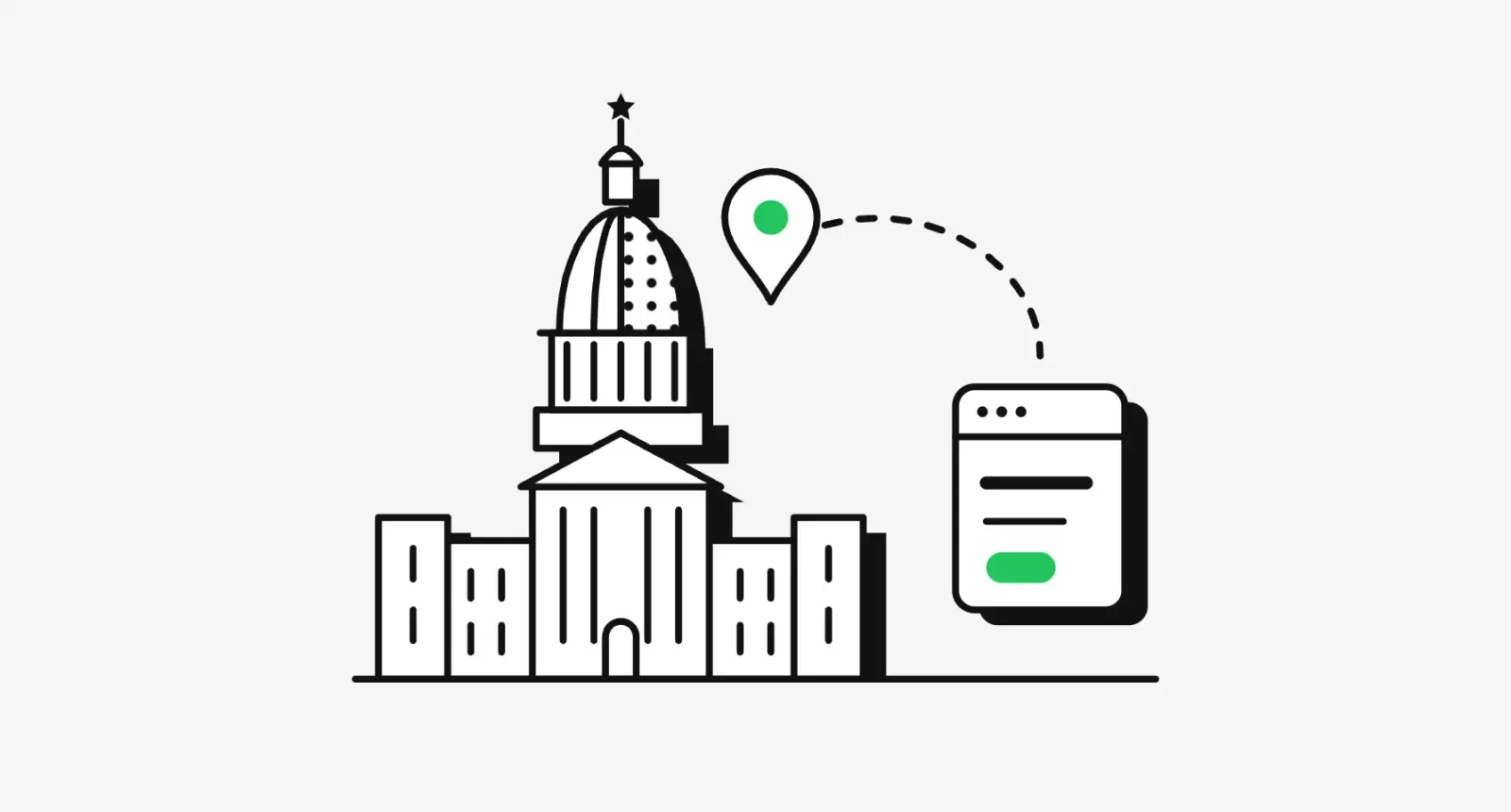
Texas privacy law app design comes down to a handful of screens. Since 1 July 2024, the Texas Data Privacy and Security Act (TDPSA) has let Texans see, correct, delete and copy their data, and opt out of targeted ads, sale and some profiling. Your app needs a clear notice, a request flow that never demands a new account, three opt-outs, consent before sensitive data, and, since 1 January 2025, respect for a universal opt-out signal.
That is the checklist I bring to founders looking for a SaaS product designer in Austin. AI adds one line: since 1 January 2026, HB 149 makes health care providers and government agencies disclose AI in plain, conspicuous words. It sets no general chatbot label for other private apps.
This guide is for founders and product leads shipping a web app, SaaS or mobile app that Texans use, with the section of law behind each screen. I'm a designer, not a lawyer: this isn't legal advice, and your counsel decides which duties apply to you.
Texas privacy law app design on one screen
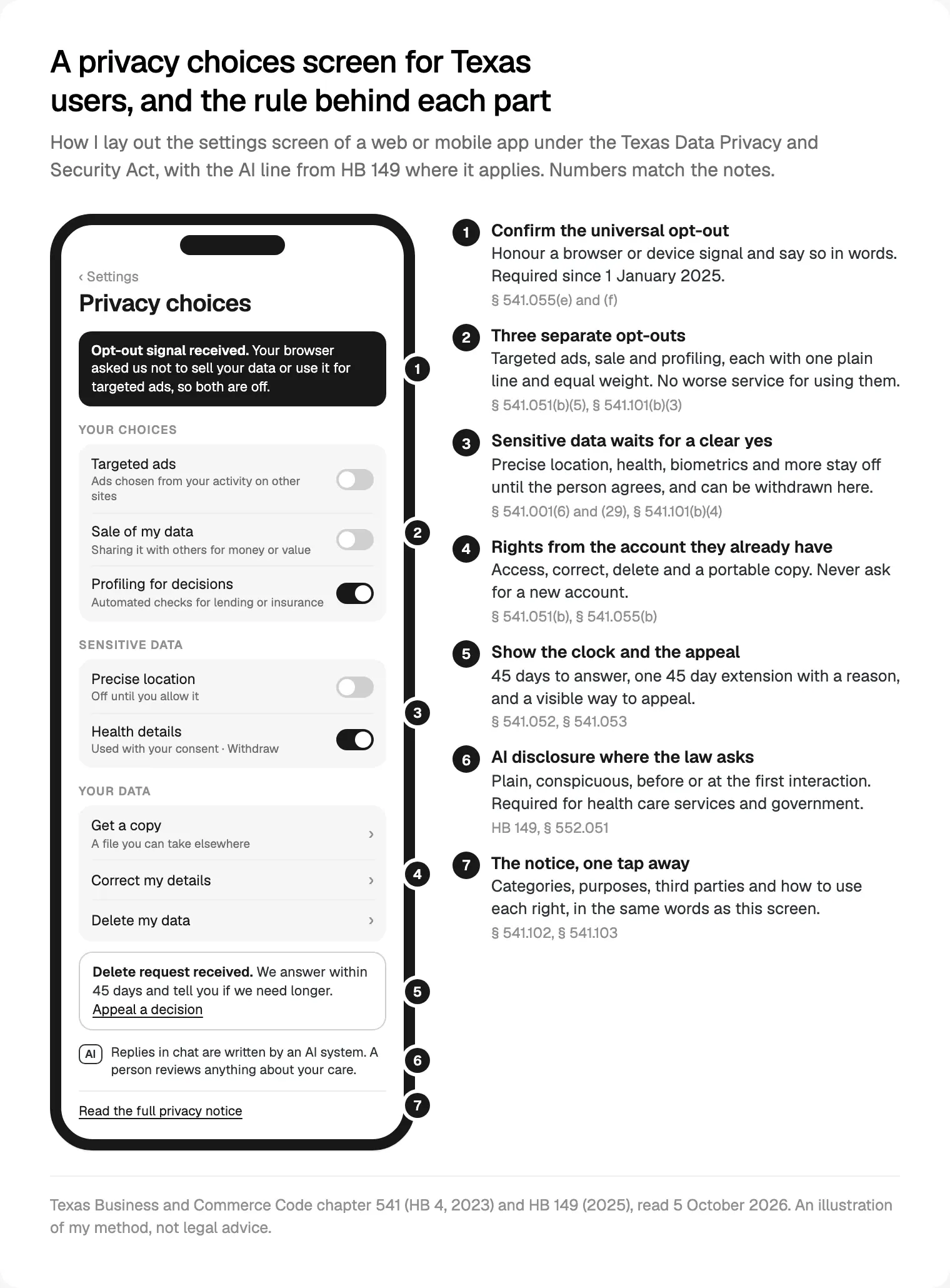
Most of the Act lands on one privacy choices screen in settings, plus the notice it links to. I design it before sign-up, because every other screen borrows its words.
Does the TDPSA apply to your app?
Section 541.002 sets three tests: you do business in Texas or make a product Texans use, you process or sell personal data, and you are not a small business as the US Small Business Administration defines it. The Texas text has no user count or revenue threshold. SBA standards vary by industry code; its summary says most non-manufacturing businesses under $7.5 million in average annual receipts are small. Even then, section 541.107 bars selling sensitive data without consent.
For SaaS, two details matter. A "consumer" acts in an individual or household context, not a commercial or employment one. And some sectors are exempt as entities, including financial institutions under the Gramm-Leach-Bliley Act and HIPAA covered entities.
| Your product | Likely position | What I still design |
|---|---|---|
| Consumer app or SaaS, not an SBA small business | Covered | Everything in this guide |
| SBA small business | Mostly exempt | Consent before any sale of sensitive data |
| B2B SaaS used for work | Those users are not "consumers" | Marketing site, trials, personal sign-ups |
| HIPAA covered entity | Entity exempt | HIPAA flows, plus the AI disclosure for care |
| Health or wellness app outside HIPAA | Covered; diagnoses are sensitive | Consent before health data |
What the Attorney General has enforced so far
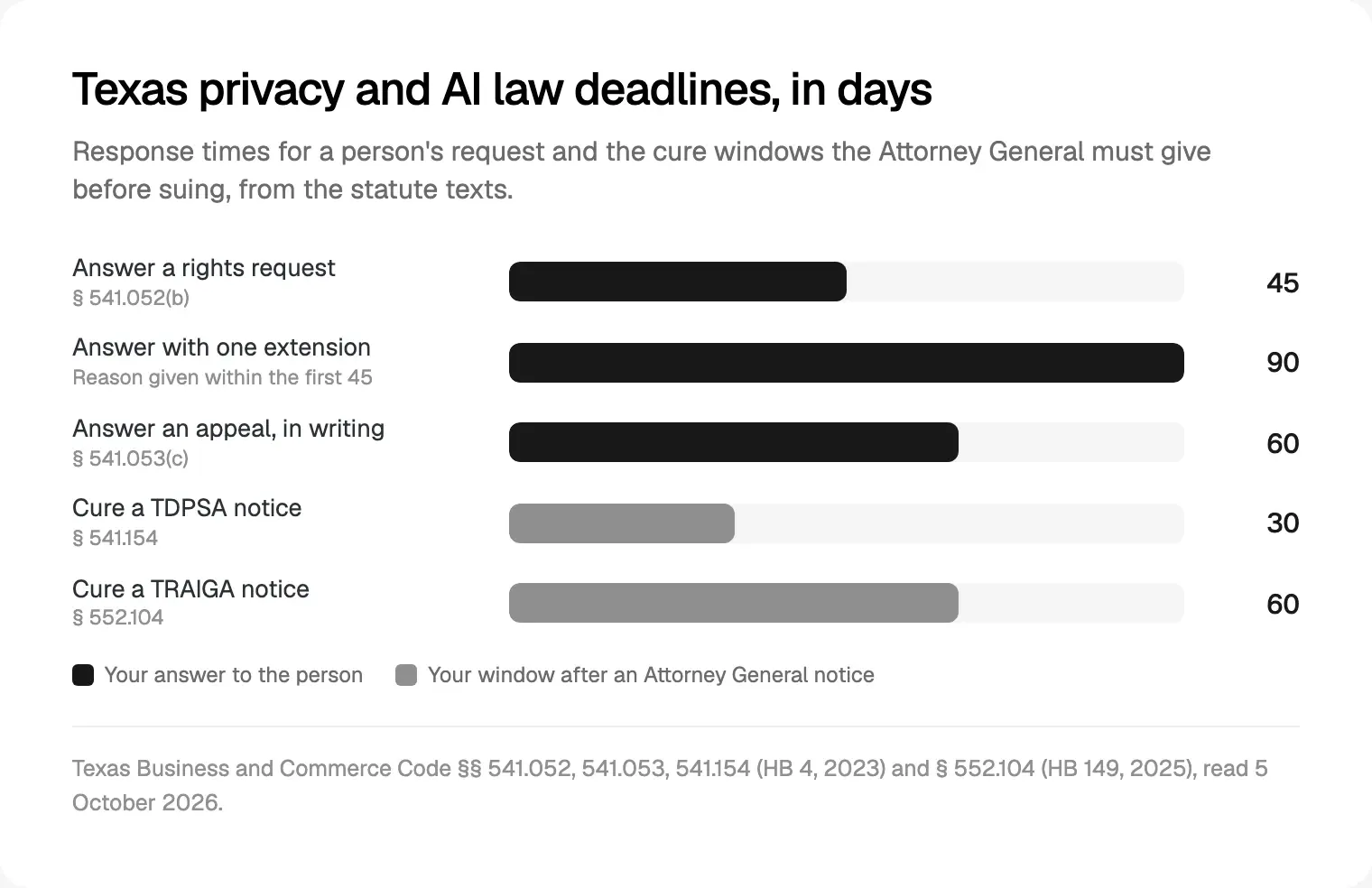
Only the Attorney General enforces the Act. Before suing, the office must give written notice and 30 days to cure; after that, it's up to $7,500 per violation, with no private right of action (sections 541.151 to 541.156). The Attorney General's TDPSA overview restates the duties plainly.
On 13 January 2025 the office sued Allstate and its subsidiary Arity, alleging that software embedded in other companies' apps collected location and driving data that was sold without notice or consent. Its summary of 21 July 2025 reported investigations into more than 200 companies, "dozens" of TDPSA violation notices and over 2,000 complaints in a year. In a smart TV case announced as settled on 11 May 2026, LG agreed to a pop-up disclosure and a clear, simple way to opt out.
Notice how often the remedy is a screen.
The privacy notice: what it must say and where it lives
Section 541.102 asks for a "reasonably accessible and clear" notice covering the categories of data you process (sensitive data called out), why, how people use their rights and appeal, what you share with third parties and with whom, and how to submit requests. If you sell sensitive data, it must say "NOTICE: We may sell your sensitive personal data", and for biometric data the same line with "biometric". Section 541.103 adds that sale and targeted ads must be disclosed clearly and conspicuously, with how to opt out.
How I lay it out:
- A short table at the top: data category, purpose, who receives it.
- The full notice below, with headings that match the settings screen.
- Links from sign-up, settings, the website footer and the app store listing.
- The statutory lines copied exactly. Paraphrasing them only invites an argument.
Rights requests: access, correct, delete and a portable copy
Section 541.051 gives five rights: confirm and access, correct, delete, a portable copy of what the person provided, and opt out. Under section 541.055 you need two or more secure and reliable ways to ask, and you may not require a new account, though you may ask people to use an existing one. A business that is only online, with a direct relationship, may offer just an email address.
The clocks are in sections 541.052 and 541.053: 45 days to answer, one 45 day extension if you explain why within the first 45, free twice a year. Declines need a reason and appeal instructions. Appeals must be conspicuous, get a written answer within 60 days, and a denial must point to the Attorney General's complaint form.
The flow I design, in order:
- Entry. "Your data" in settings, plus a web form or email for people without the app.
- Choose. Plain options; one request can carry several rights.
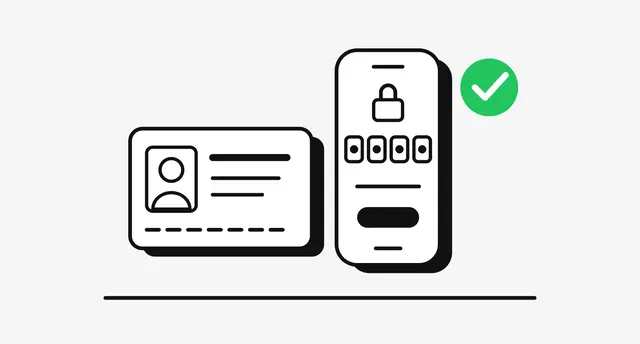
- Verify lightly. A signed-in session, or a code to the email on file. The law asks for commercially reasonable effort, not a passport scan.
- Confirm. The date received and the 45 day promise, on screen and by email.
- Deliver. A JSON or CSV download for the copy, and for deletion a plain note on anything kept and why.
- Decline with a door. The reason, and an "Appeal" button that reopens the same form.
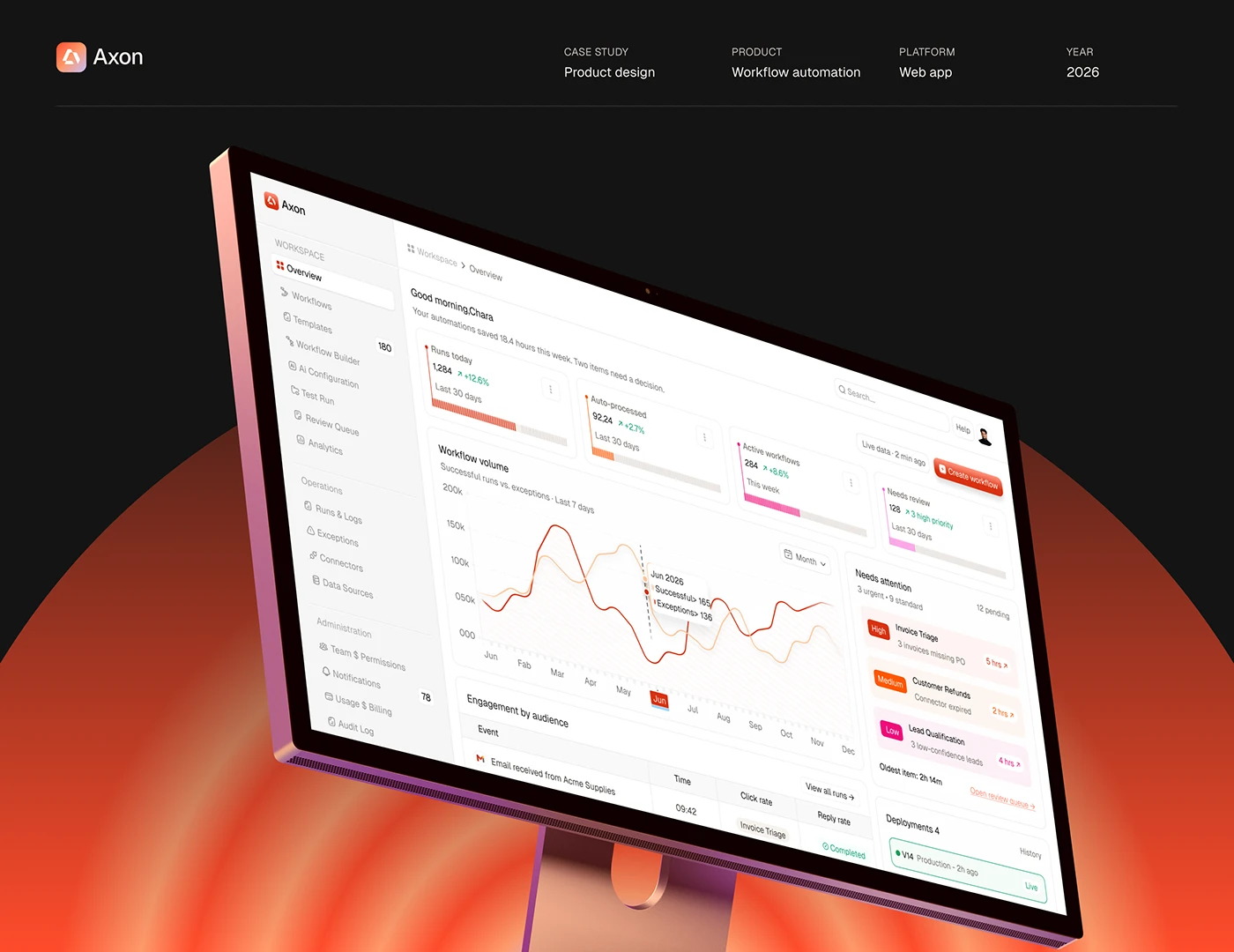
- The admin queue. Open requests by due date, built like dashboards founders actually open.
Opt-outs for targeted ads, sale and profiling
Each opt-out has a narrow meaning, and the labels should follow it. "Targeted advertising" means ads chosen from activity across non-affiliated sites or apps; ads based on your own product or the current page don't count. "Sale" covers money or "other valuable consideration", which can catch an ad SDK paid in data, but not disclosures to your processors or to deliver what the person asked for.
The profiling opt-out covers solely automated decisions with legal or similarly significant effects: lending, housing, insurance, health care, education, employment, criminal justice and basic necessities. For an AI personal finance dashboard like WealthWise, which I designed, the wording matters: personal tips are one thing, but a score that decided on credit would be profiling people can refuse.
My rules for the three controls:
- Three separate switches, each with one plain line underneath.
- No penalty. Section 541.101(b)(3) bars worse service or higher prices for using a right, though bona fide loyalty programmes may differ.
- An SDK list beside each screen, because any SDK sending data to an ad network may be a sale.
The switches are easy to draw; the inventory behind them is the real part of how I design Texas privacy flows for Austin startups.
The universal opt-out mechanism, in force since 1 January 2025
Section 541.055(e) took effect on 1 January 2025, six months after the rest of the Act, under section 7 of the enrolled HB 4. A person can opt out of targeted ads and sale (not profiling) through "an Internet browser setting or extension, or a global setting on an electronic device". You must honour it if you can verify it with commercially reasonable effort. One of the four exceptions is a trap: you may refuse if you don't process similar requests under other states' laws. Honour the signal anywhere and that exit closes. The signal must reflect an affirmative choice, not a default.
The Act names no signal. The one browsers send is Global Privacy Control, a W3C Working Draft dated 24 September 2026, sent as a Sec-GPC header and readable as navigator.globalPrivacyControl. I treat it as the Texas signal on the web: a short confirmation, the matching switches shown off with "Set by your browser", and no prompt to undo it.
In native apps I know of no system-wide signal like GPC, so the in-app switches are the mechanism. Apple's separate App Tracking Transparency prompt is needed before tracking people across other companies' apps and websites; when someone declines it, I keep targeted ads off in settings too.
Sensitive data and consent, without dark patterns
Sensitive data covers race or ethnicity, religion, a mental or physical health diagnosis, sexuality, citizenship or immigration status, genetic or biometric data used for identification, data from a known child, and precise geolocation within 1,750 feet (section 541.001(29)). It needs consent; for a known child under 13, the verifiable parental consent rules of the FTC's COPPA Rule apply.
Consent must be a clear affirmative act, freely given, specific, informed and unambiguous. Accepting broad terms doesn't count, nor does hovering, muting or closing content, nor agreement obtained through a dark pattern. A dark pattern is an interface designed or manipulated "with the effect of substantially subverting or impairing user autonomy", including any practice the FTC calls one. The test is the effect, not the intent. The FTC's 2022 report, Bringing Dark Patterns to Light, lists four common tactics, including steering privacy choices towards the most sharing.
My consent pattern:
- Ask at the moment of use, when someone taps "near me", not at first launch.
- Keep it apart from the terms, with nothing pre-ticked.
- Give "Allow" and "Not now" the same size, weight and number of taps.
- Say what, why, who sees it and for how long, in two lines.
- Let people withdraw in settings with one tap and no guilt copy.
- Ask once. A prompt repeated until people give in is what "subverting autonomy" describes.
A switch a screen reader can't announce works like a hidden one, so I test these as in ADA accessibility for New York fintech apps.
Data protection assessments: the design file does half the work
Section 541.105 requires a documented assessment for targeted ads, sale, risky profiling, sensitive data and any other high-risk processing, weighing benefits against risks after safeguards. The Attorney General can demand it; it stays confidential, and one made for another law can count if comparable.
Lawyers write it, but the facts come from product. I hand over a data map per screen: each field or event, its purpose in the notice's words, whether it is sensitive, who receives it (processor, SDK or third party), and the control that governs it. Processors must supply what the controller needs (section 541.104(a)(3)), and since HB 149 they must also help secure personal data held in an AI system.
AI features under TRAIGA, from 1 January 2026
The Texas Responsible Artificial Intelligence Governance Act (HB 149) reaches anyone doing business in Texas or deploying AI there, but its disclosure duty, section 552.051, is narrow. A government agency must disclose an AI system that talks with people, before or at the interaction, even when it is obvious. A provider using AI in health care service or treatment must disclose it no later than the date care is first given. The disclosure must be clear, conspicuous, in plain language, free of dark patterns, and may be a hyperlink. Separately, SB 1188 has required practitioners using AI for diagnosis to tell patients since 1 September 2025.
Other duties reach every AI product: no AI intended to incite self-harm, harm or crime, or to unlawfully discriminate (sections 552.052 and 552.056). The Attorney General gives 60 days to cure; penalties run from $10,000 to $12,000 per curable violation, $80,000 to $200,000 per uncurable one, and $2,000 to $40,000 a day if it continues. One defence covers problems found by internal review while substantially complying with the NIST Generative AI Profile (NIST AI 600-1).
For health products I design three layers: a line at the first AI interaction, a small "AI" marker on generated content, and a link to a plain page on when a person takes over. Elsewhere I keep it by choice; more in how I ship AI features people trust.
Where I would start
With Texas users today, I would go in this order: the SDK and data inventory, the privacy choices screen and notice written together, the request flow and its admin queue, Global Privacy Control on the web, then the AI disclosure if anything touches care. None of it needs a rebuild.
That is the work behind my product design work for Austin founders, part of my wider product design for SaaS teams. It starts with a free 30 minute intro call, then a written scope and one fixed quote, with no retainer. My evening calls land in your Central Time morning; more about me.
Frequently asked questions
Do I have to honour Global Privacy Control in Texas?
Since 1 January 2025, section 541.055(e) has required controllers to honour opt-outs of targeted ads and sale sent through a browser setting, extension or device setting, if they can verify them with commercially reasonable effort. The Act doesn't name Global Privacy Control, but it is the signal browsers send today. If you honour it for any other state, you can't refuse it for Texas.
How long do I have to respond to a privacy request in Texas?
Forty-five days from receipt. You may extend once by another 45 days, but you must tell the person why inside the first 45. If you decline, explain why within 45 days and say how to appeal. Appeals get a written answer within 60 days, and a denial must point to the Attorney General's online complaint form.
Can I make users create an account to delete their data?
No. Section 541.055(b) bars requiring a new account to use any right, though you may ask people to use an account they already have. You need at least two secure and reliable ways to submit a request. A business that operates only online, with a direct relationship, may offer just an email address.
Is location data sensitive data under Texas law?
Precise geolocation is: data that locates a person within a radius of 1,750 feet, from GPS or similar technology. Processing it needs consent, and selling it means adding "NOTICE: We may sell your sensitive personal data" to your privacy notice. Asking for city-level location often avoids the question.
Do I need to tell users they're talking to an AI in Texas?
It depends who you are. Under HB 149, from 1 January 2026, government agencies must disclose AI systems that interact with people, and health care providers must disclose AI used in someone's care. Other private apps have no general chatbot disclosure duty under that law, though a plain label is still good design.
What is the penalty for breaking the Texas privacy law?
Up to $7,500 per violation, but only after the Attorney General sends written notice and you fail to cure within 30 days. Only the Attorney General can sue; there is no private right of action. HB 149's AI rules allow 60 days to cure and carry higher penalties.
Sources and method
I read every source on 5 October 2026. I read chapter 541 from the enrolled HB 4, which created it, and checked HB 149, whose only change to it is section 541.104(a); Holland & Knight's 2025 review, used as secondary support, lists no other. Data is thin in three places: I found no Attorney General guidance on which opt-out signals count, so treating Global Privacy Control as the Texas signal is my reading; notices are counted only as "dozens"; and I did not follow the Allstate case past its filing.
- Texas Legislature, Business and Commerce Code chapter 541, read 5 October 2026: statutes.capitol.texas.gov
- Texas Legislature, HB 4 (2023) enrolled, effective dates in section 7, read 5 October 2026: capitol.texas.gov
- Texas Attorney General, TDPSA overview, read 5 October 2026: texasattorneygeneral.gov
- Texas Attorney General, Allstate and Arity lawsuit, 13 January 2025, read 5 October 2026: texasattorneygeneral.gov
- Texas Attorney General, privacy enforcement summary, 21 July 2025, read 5 October 2026: texasattorneygeneral.gov
- Texas Attorney General, LG settlement, 11 May 2026, read 5 October 2026: texasattorneygeneral.gov
- Texas Legislature, HB 149 (2025) enrolled, TRAIGA, read 5 October 2026: capitol.texas.gov
- Texas Legislature, SB 1188 (2025) enrolled, AI in health records, read 5 October 2026: capitol.texas.gov
- W3C, Global Privacy Control Working Draft, 24 September 2026, read 5 October 2026: w3.org
- FTC, Bringing Dark Patterns to Light, September 2022, read 5 October 2026: ftc.gov
- FTC, press release on the dark patterns report, 15 September 2022, read 5 October 2026: ftc.gov
- FTC, Children's Online Privacy Protection Rule, read 5 October 2026: ftc.gov
- NIST, AI 600-1 Generative AI Profile, 26 July 2024, read 5 October 2026: nist.gov
- Apple, App Tracking Transparency documentation, read 5 October 2026: developer.apple.com
- US Small Business Administration, size standards, read 5 October 2026: sba.gov
- Holland & Knight, Texas privacy legislation in 2025, 23 February 2026, read 5 October 2026: hklaw.com
Tags: Texas, Privacy, TDPSA, Consent, AI, Product design