


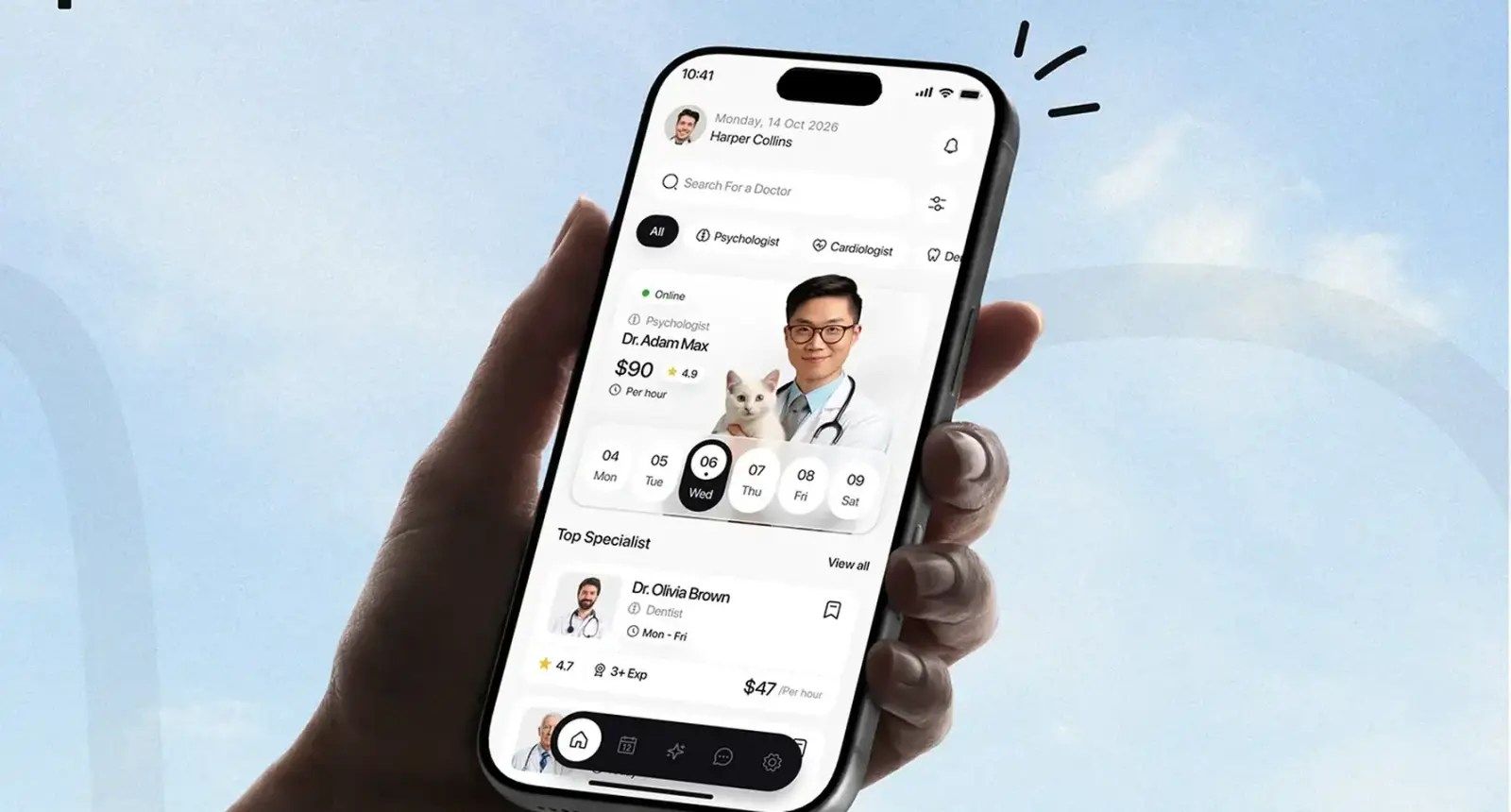
Telehealth app development means building the whole remote visit: a patient app to find a clinician, book, join a video visit and message; a clinician side with a calendar, the visit and notes; and a back end that keeps health data private, with a video service under a business associate agreement, encrypted records, access control and an audit log. In the US, HIPAA sets the rules if you're a covered provider or build for one; outside HIPAA the FTC's Health Breach Notification Rule may apply; in the EU, health data is a special category under the GDPR. The cost is set by the platforms, the integrations and how much of the care model you build yourself.
I'm a design engineer: I design apps and build them, iOS and Android in React Native or Flutter and web in React and Next.js, the work behind my mobile app design and healthcare pages. Here's how I'd take a telehealth app from the first call to launch, with CareUp, a doctor booking app I designed, as the worked example.
Build a telehealth app or use an existing platform?
If you run a clinic and want video visits next month, buy. An off-the-shelf telehealth platform is built to handle the visit, and its vendor carries much of the security work.
Building makes sense when:
- telehealth is the product. A health startup's app is its business, and its patient experience is how it competes.
- the care model is specific. Programme-based care, chronic condition follow-ups or messaging between visits rarely fit a generic visit tool.
- you run a marketplace of independent doctors, each with their own availability, fees and specialties.
- you combine visits with your own data, such as devices or an existing patient app.
The middle path is the one I'd pick for most founders: build your own patient and clinician apps, and rent the hard infrastructure, video from a HIPAA-eligible provider and records from an existing EHR through its API. You own the experience without rebuilding video calling.
Must-have features in a telehealth app
For patients:
- Sign-up and identity, with consent captured where the clinic needs it.
- Search by specialty, with each doctor's credentials, availability and fee.
- Booking against real availability, in the patient's time zone, with their location recorded.
- A pre-call check of camera, microphone and connection, and a fallback when video fails.
- The video visit itself, plus secure messaging before and after.
- Visit summaries, prescriptions and records in one place.
- Reminders and payments.
For clinicians and staff: a calendar and availability, a queue for today's visits, notes during the call, permission-based access to records, follow-ups, and an admin view of staff, schedules and an audit log.
Integrations: health records, payments and notifications. For records, HL7 FHIR is the standard to ask about. HL7 describes it as "a standard for exchanging healthcare information electronically", and its current published version is Release 5.
My post on designing health products covers the screens in depth; this one is about building them.
HIPAA, the FTC rule and GDPR: what shapes the build
None of this is legal advice. Your counsel decides which rules apply to you. My job is to build a product that can meet them.
HIPAA. HHS's telehealth guidance says all telehealth services from covered providers and health plans must comply with the HIPAA Rules, and that they must use technology vendors who comply and will sign business associate agreements. The COVID-19 enforcement discretion that let providers use non-public facing video apps in good faith expired on 11 May 2023, with a transition period that ended at 11:59 pm on 9 August 2023.
Business associate agreements. HHS's cloud guidance says a cloud provider that creates, receives, stores or transmits electronic health data for a covered entity is a business associate, even if it holds only encrypted data and lacks the key. In practice that means a BAA with your hosting, database, video, messaging and email providers, and analytics kept off screens that show health data unless the vendor signs one. AWS, for example, lists its Chime SDK as HIPAA eligible and says not to use it for protected health information without an AWS business associate agreement.
The Security Rule. HHS's summary lists technical safeguards, among them access control, audit controls, integrity, authentication and transmission security, and requires a risk analysis. I build each as a feature: roles per clinic, an audit log on every record view and change, multi-factor sign-in for staff, and TLS everywhere.
Breaches. The HIPAA Breach Notification Rule applies to breaches of unsecured health information, and HHS guidance names encryption and destruction as the methods that make it secured. So data is encrypted at rest and in transit from the first release.
If HIPAA doesn't cover you. A direct-to-consumer health app outside HIPAA may fall under the FTC's Health Breach Notification Rule. The FTC says a breach isn't only hacking: sharing health data with an advertiser without consent counts too. People must be told without unreasonable delay, and no later than 60 calendar days after discovery.
Licensing across states. Telehealth.HHS.gov says the ability to treat across state lines varies by state, and advises providers to verify the patient's location and get consent before an appointment. So booking asks where the patient will be, and the app only offers clinicians licensed there.
GDPR. Article 9 prohibits processing data concerning health unless an exception applies, such as explicit consent. Article 35 requires a data protection impact assessment for large-scale processing of special categories of data.
The Gulf. In the UAE, Federal Law No. 2 of 2019 regulates information technology in health care, and the government portal says providers must keep health data confidential. I couldn't open the law's own text, so ask a UAE lawyer where data may be hosted before the architecture is fixed.
How I'd approach a telehealth build
- A free 30 minute intro call. Who books, who treats, which states or countries, which records system, and whether you're a covered entity or building for one.
- A written scope and one fixed quote, listing the apps, roles, integrations and compliance work, with what's in the first release and what waits.
- Vendors chosen early, each with its BAA, since they shape the architecture.
- Design in weekly sprints in Figma, with a review call each week and a written update in Slack every 48 hours.
- The build: patient apps in React Native or Flutter, the clinician and admin side in React and Next.js, with the audit log and roles from the first release. I use AI coding tools where they save time, and every change is reviewed against the design by someone who knows it. I'd build on test data, not real patient records.
- Testing with clinicians, including dropped calls, late joins and wrong time zones.
- Launch and handoff, with the code, a documented design system and the risk analysis notes your compliance lead needs.
I'm in Dhaka (UTC+6), with evening calls from 7 to 10 pm Dhaka time for teams in the Americas.
Case study: CareUp, from symptom to booked visit
CareUp is an AI healthcare app for finding a doctor and booking an appointment. I designed the iOS app, from user research and wireframes to the final UI, including an AI health assistant.
The research. An empathy map and a persona, a 34 year old working professional who wants to save time and reach the right doctor, led to three needs: booking in a few taps, doctor profiles showing credentials, ratings and availability before anyone decides, and appointments, consultations and records in one place.
The screens.
- Onboarding introduces the main features, including AI that finds the right specialist and chat with your doctor at any time.
- Home has doctor search, specialty chips and a featured doctor card with online status, fee per hour, rating and a date strip, so booking can start on the first screen.
- The doctor details screen splits About, Reviews and Availability, with a date strip, time slots and Make Appointment pinned to the bottom.
- Appointments split into Upcoming, Completed and Cancelled. The next visit sits on top with a countdown, a chat icon and a full-width Join Now button.
- The AI assistant asks one question per screen, then shows possible causes, an urgency level and a "Why this assessment?" panel, pointing people towards a doctor rather than replacing one.
What I'd carry into the build. Join Now is where the engineering sits: the video session is created on the server shortly before the visit, the pre-call check runs, and if video fails the visit drops to audio or a call-back. The countdown needs times stored in one zone and shown in the patient's. Online status needs live presence from the clinician side. For the assistant, I'd log every assessment, keep the reasons visible, and ask counsel early whether it counts as a regulated medical device in your market.
For the clinic side, VitalHealth, a healthcare SaaS I designed, has a week view of appointments with the time zone shown and filters for online and offline appointments.
What decides the cost of a telehealth app
I don't publish prices, because scope sets them. What moves the number:
- platforms: iOS, Android and web, where React Native or Flutter shares one codebase across the phones;
- the clinician and admin side, often as big as the patient app;
- records integration, which depends on the EHR and its API;
- compliance work: vendor agreements, audit logging, risk analysis and a security test before launch;
- messaging, payments and insurance;
- AI features, and the review they need.
Public running costs. Amazon's Chime SDK pricing page lists video at $0.0017 per attendee-minute, so a 20 minute visit between one patient and one doctor uses 40 attendee-minutes, about $0.07. Recording a composited 1080p call adds $0.0125 per minute. For build time, the US Bureau of Labor Statistics puts the median annual wage for software developers at $135,980 in May 2025. My guide on how to scope an MVP shows how to keep the first release small.
How to choose who builds your telehealth app
- Will they need real patient data? Anyone who does may be a business associate under HHS's definition. I'd work on test data, and it's worth asking the same of anyone you hire.
- Which vendors will they use, and will each sign a BAA? Get the list before you sign.
- Who owns the code, the cloud account and the data? You should, from day one.
- What happens when a call fails? The answer tells you how much they've thought about real visits.
Frequently asked questions
How much does it cost to build a telehealth app?
It depends on platforms, the clinician side, records integration and compliance work. Video is cheap to run, about $0.07 for a 20 minute two-person visit on Amazon's published Chime SDK rate. I give one fixed quote after the intro call and written scope.
Does a telehealth app need to be HIPAA compliant?
If it's offered by or for a HIPAA covered entity, such as a clinic or health plan, yes, and every vendor handling health data needs a business associate agreement. A consumer app outside HIPAA may fall under the FTC's Health Breach Notification Rule. Ask your counsel which applies.
Can I use any video tool for telehealth visits?
Not since August 2023 for covered providers. HHS says the vendor must comply with HIPAA and sign a business associate agreement. Amazon, for example, lists its Chime SDK as HIPAA eligible under a BAA.
Can a telehealth app serve patients in several US states?
Yes, but clinicians need to be able to practise where the patient is. HHS advises checking the patient's location before each appointment, so the app should record it and only offer clinicians licensed there.
How long does it take to build a telehealth app?
It depends on scope, the records integration and vendor agreements. I give a timeline in the written scope after the intro call, and I'd start with one platform and one visit type.
Sources and method
I read every source on 1 November 2026. Prices are from Amazon's US pricing page that day and change often. Nothing here is legal advice.
- Telehealth.HHS.gov, HIPAA Rules for telehealth technology (last updated 6 November 2023), date read 1 November 2026: telehealth.hhs.gov
- HHS Office for Civil Rights, HIPAA and Telehealth, expiry of the COVID-19 enforcement discretion (last reviewed 18 October 2023), date read 1 November 2026: hhs.gov
- HHS, Guidance on HIPAA and Cloud Computing, date read 1 November 2026: hhs.gov
- HHS, Summary of the HIPAA Security Rule (last reviewed 7 August 2026), date read 1 November 2026: hhs.gov
- HHS, Breach Notification Rule, date read 1 November 2026: hhs.gov
- Federal Trade Commission, Complying with FTC's Health Breach Notification Rule (July 2024), date read 1 November 2026: ftc.gov
- Telehealth.HHS.gov, Licensing across state lines (last updated 30 April 2025), date read 1 November 2026: telehealth.hhs.gov
- Regulation (EU) 2016/679, the General Data Protection Regulation, Articles 9 and 35, date read 1 November 2026: eur-lex.europa.eu
- UAE Government portal, ICT in the health sector, date read 1 November 2026: u.ae
- HL7, FHIR overview, Release 5, date read 1 November 2026: hl7.org
- Amazon Web Services, Amazon Chime SDK pricing, date read 1 November 2026: aws.amazon.com
- Amazon Web Services, HIPAA eligible services reference (last updated 15 October 2026), date read 1 November 2026: aws.amazon.com
- US Bureau of Labor Statistics, Occupational Outlook Handbook, Software Developers, Quality Assurance Analysts, and Testers (pay for May 2025), date read 1 November 2026: bls.gov
If you're planning a telehealth app, see my development services. A project starts with a free 30 minute intro call, then a written scope and one fixed quote.
Tags: Telehealth, Healthcare, HIPAA, Mobile apps, Development