

A fintech app development company is the right choice when you need many specialists at once, cover outside office hours and a vendor that carries the delivery risk. It isn't the only choice. You can also hire an in-house team, or work with one design engineer who designs the product and builds it in code, with outside specialists for the parts that need them. Whichever you pick, judge them on the same things: fintech screens they've shipped, how they handle the rules that apply to money apps, who writes the code, and whether you own every account and repository at the end.
I'm a design engineer, not a company. I design products and build them in production code: iOS and Android apps in React Native or Flutter, and web apps in React and Next.js. I compete with companies for the same projects, so I'll say plainly where a company is the better fit. My service page for this work is mobile app design.
What a fintech app has to include before anyone builds it
The screens are the smaller half. A working money app also needs:
- A licensed partner. Unless you hold the licences, a bank, payment provider or broker moves the money, and its API decides what the app can do.
- Identity checks, usually through a verification provider. The design job is the waiting, the failed check and the retry.
- A ledger and a history. Every payment needs a record the user and support can both find.
- An admin panel for refunds, disputes, frozen accounts and limits. Unscoped, support runs on spreadsheets.
- Security work: storage, sessions, PINs and biometrics, tested against a public standard.
- Store paperwork, covered below.
Ask each builder which of these they've done and which they'd hand to someone else. A good answer names the parts they won't do.
The rules that shape a fintech build
This is general information, not legal advice. Your lawyer and your licensed partner decide what applies to you.
Apple. Guideline 5.1.1(ix) of the App Store Review Guidelines says apps in highly regulated fields, banking and financial services among them, should be submitted by the legal entity that provides the services, not by an individual developer. So the app goes out under your company's account, not your builder's.
Google Play. Play Console Help says that "all developers that have an app published on Google Play must complete the Financial features declaration", on the App content page. Loan and crypto apps have extra country rules in the Financial Services policy.
Card data. The PCI Security Standards Council says PCI DSS applies to entities that store, process or transmit cardholder data. I design card entry so the payment provider's own fields take the card number, which keeps raw numbers off your servers. Your provider and assessor confirm what stays in scope.
Money transmission in the US. A money services business registers with FinCEN on Form 107 within 180 days of being established and renews every two years, according to FinCEN's registration page. Whether you are one is a question for counsel before design starts.
Security testing. The OWASP Mobile Application Security Verification Standard groups its controls into storage, cryptography, authentication, network, platform, code quality, resilience and privacy. It's a fair checklist to ask any builder about, and a basis for the outside test I'd always recommend.
Company, in-house or one design engineer
None of the three is right for every fintech app.
| Development company | In-house team | One design engineer | |
|---|---|---|---|
| Who's accountable | The company, under a contract | You, as the employer | One person, under a contract |
| Strength | Many roles at once, cover for holidays and sickness | Product knowledge stays with you | Design and code by the same person, few handoffs |
| Risk | The people who sell may not be the people who build | Slow to hire, fixed cost after launch | Limited capacity, one person to replace if it goes wrong |
| Best when | A large scope, a fixed launch date, round the clock support | Fintech is your core business for years | A first version, a redesign or a product that must look and work exactly as designed |
Pick a company when you need backend, mobile, QA and DevOps at the same time, or someone on call at night after launch. Ask to meet the people who'll actually build your app, not only the sales lead.
Pick an in-house team when the app is the business and you'll change it for years. The US Bureau of Labor Statistics puts median pay for software developers at $135,980 a year, from May 2025 data, in its Occupational Outlook Handbook, before benefits and recruiting.
Pick one design engineer when the hard part is the product: the flows, the trust, every money screen, and a build that stays true to the design. The trade-off is capacity. I don't run a night support desk or replace a backend team for a core banking system; there, I'd design the product, build the front end and work alongside the developers who own the ledger. If you're weighing the two design roles, my post on design engineer vs product designer covers who to hire first.
Common mistakes when choosing who builds your fintech app
Choosing on the screens alone. Beautiful wallets tell you little about failed identity checks, refunds or the admin panel. Ask for those screens.
Letting the builder own the accounts. Keep the developer accounts, cloud, payment keys and repository in your company's name.
No independent security test. Whoever builds the app shouldn't be the only one testing it.
Picking the partner after the design. Your bank or provider decides what the app can show and when, so shortlist it first.
Scoping everything at once. One account type, one currency and one way to add money is a real first release.
Questions to ask any fintech builder
- Can I see the failure screens and the admin side of a fintech product you shipped?
- Who writes the code, and who checks it matches the design?
- Which security standard do you test against?
- Who submits the app, and under whose developer account?
- What do I get at the end: design files, design system, code, documentation?
- How is the price set? A written scope with one fixed price tells you what you're buying.
How I'd approach your fintech app, from intro call to launch
- A free 30 minute intro call about what the app does with money and who your licensed partner is.
- A written scope and one fixed quote for the whole project. No retainer, nothing billed by the hour.
- The money map. Before any screen, I list every action that moves or shows money and the states it can be in: pending, done, failed, reversed.
- Weekly design sprints in Figma, with a written update in Slack every 48 hours and a review call each week.
- A documented design system, with tokens and components named the same in Figma and in code.
- The build. iOS and Android in React Native or Flutter, and the web admin panel in React and Next.js. I use AI coding tools where they save time, and a person who knows the design reviews every change.
- Store submission under your accounts, with the financial declarations and privacy details ready before review.
For the sector side, see my fintech industry page. For the rules of the screens themselves, I wrote up fintech app design best practices from seven projects.
Case study: ZenPay, a mobile wallet
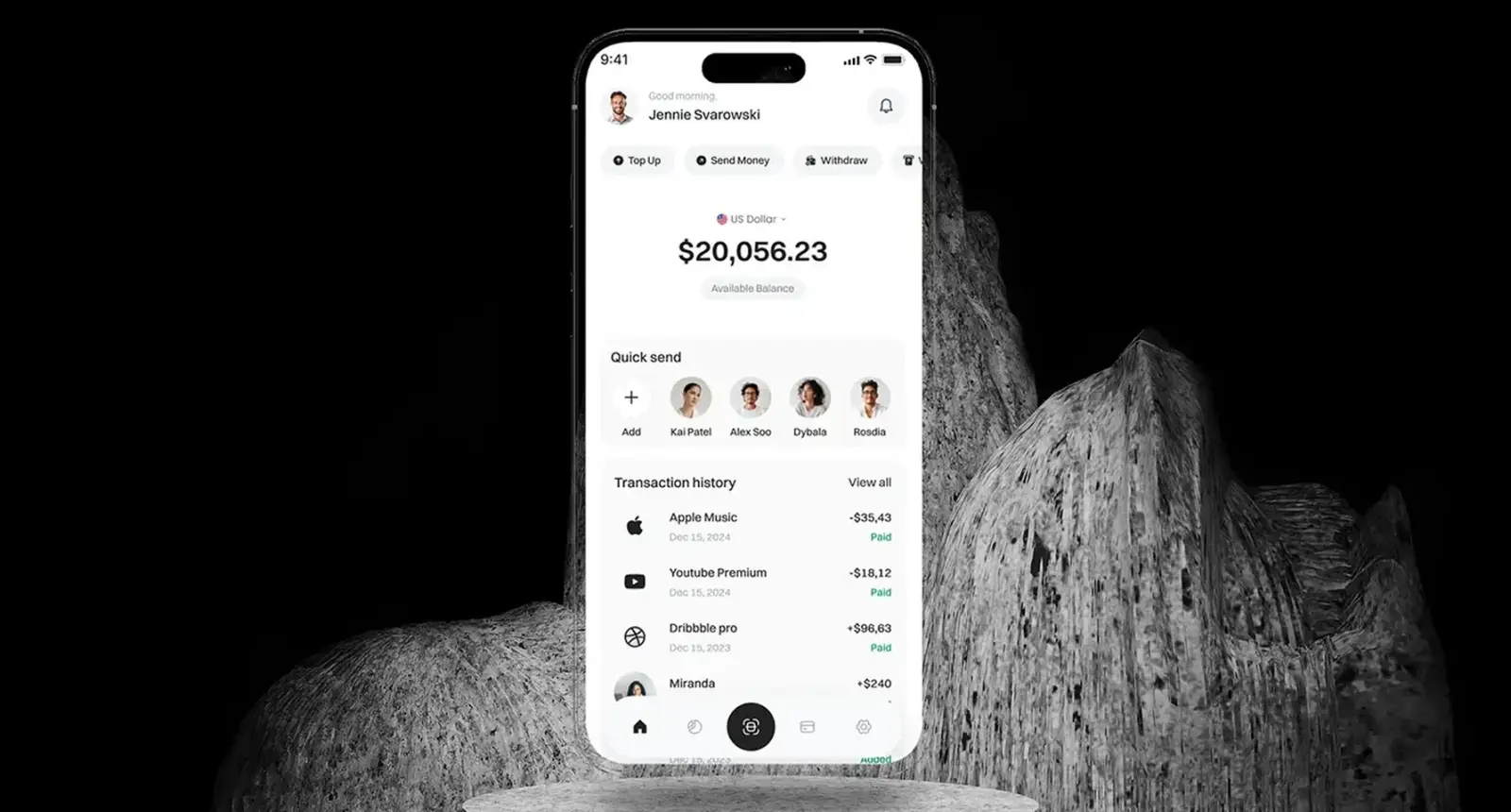
ZenPay is a mobile wallet for sending and receiving payments, tracking expenses and setting budgets in one place. I designed the mobile app, from personas and user flow to the final screens, and a landing page that sells it.
The challenge. Earn trust in a crowded fintech market while meeting data security rules, let a busy user send money quickly, and give a freelancer paid by several clients one clean record.
The process. One week of research with personas for a busy professional and a freelancer, then a user flow from onboarding to home, cards, analytics and profile. Two weeks of greyscale wireframes, two of visual design in Switzer on a monochrome palette, then a design system of reusable components.
The screens. Every screen that moves money follows the same order: who, how much, what it costs, then confirm. Before the button, each flow lists the value, the charge and the total. Paying needs a PIN, and a receipt with status, transaction ID, date, time and type follows. The project summary lists 50+ screens across 20 flows.
Two more fintech products I designed
Nexfolio is an AI-powered investment dashboard. I designed the web app, with AI forecasts, a confidence score and suggested actions beside the numbers they explain.
WealthWise is an AI personal finance dashboard of more than 40 web screens, from cash flow and budgets to debt and tax. Each AI insight sits next to the figure it comes from, phrased as a plain next step.
What decides the cost of a fintech app
I don't publish prices; after the intro call you get one fixed quote for your scope. These are what move it:
- Your partner's API. A well documented one shortens the build; a thin one leaves more logic to you.
- Platforms and sides. React Native or Flutter shares most of the work between iOS and Android; the admin panel is its own build.
- Money states. Refunds, disputes, limits and reversals take longer than the happy path.
- Security testing, including the independent test before launch.
- Store accounts. The Apple Developer Program is $99 a year, and a Google Play developer account is a US$25 one-time fee.
Frequently asked questions
How do I choose a fintech app development company?
Ask to see failure screens and the admin side of fintech products they shipped, who writes the code, which security standard they test against and how the price is set. Then check every account stays in your name.
Is a company better than hiring one person for a fintech app?
It depends on scope. A company suits a large build with many roles and night support. One design engineer suits a first version or a redesign where product detail matters most, with specialists alongside for the ledger and security testing.
Can an individual developer publish a banking app on the App Store?
Apple's guideline 5.1.1(ix) says apps in banking and financial services should be submitted by the legal entity that provides the services, not by an individual developer. Plan for your company's developer account from the start.
What security standard should a fintech app follow?
The OWASP MASVS is a public standard for mobile app security. If you handle card data, PCI DSS applies too. Have an independent tester check the app before launch.
Do I need a licence to launch a fintech app?
It depends on what the app does, where, and with which partner. Many apps work through a licensed bank or provider; in the US, money services businesses register with FinCEN. Ask a lawyer before you scope the build.
Can you design and build the whole fintech app?
Yes. I design the product and build it, mobile apps in React Native or Flutter and admin panels in React and Next.js, with a design system so the code matches the design. ZenPay, Nexfolio and WealthWise are design case studies.
Sources and method
I read every source on 1 November 2026; rules and fees change, so check them. I used no market sizes or vendor rankings, because the ones I found came from companies selling the service.
- Apple, App Store Review Guidelines, 5.1.1(ix), date read 1 November 2026: developer.apple.com
- Google, Play Console Help, Financial features declaration, date read 1 November 2026: support.google.com
- Google, Play Console Help, Financial Services policy, date read 1 November 2026: support.google.com
- PCI Security Standards Council, PCI DSS, date read 1 November 2026: pcisecuritystandards.org
- FinCEN, MSB registration, date read 1 November 2026: fincen.gov
- OWASP, Mobile Application Security Verification Standard, date read 1 November 2026: mas.owasp.org
- US Bureau of Labor Statistics, Occupational Outlook Handbook, Software Developers, date read 1 November 2026: bls.gov
- Apple Developer Program, date read 1 November 2026: developer.apple.com
- Google, Play Console Help, registration fee, date read 1 November 2026: support.google.com
If you're deciding who should build your fintech app and want the product designed and built by the same person, book a free 30 minute intro call. After it, you get a written scope and one fixed quote.
Tags: Fintech, Mobile apps, Case study, Product design, Development