

The pricing page examples worth studying don't win on layout. They win because a buyer leaves with every money question answered: which plan is mine, what usage will cost, what happens when the trial ends, whether yearly is really cheaper, what "talk to sales" means, and whether tax or a fee appears at checkout.
I design pricing sections as part of my landing page design services, and these are the twelve live SaaS pricing pages I opened on 13 October 2026 to check the patterns I work from. They're grouped by the decision each one helps a buyer make, followed by the EU, UK and US price rules that now shape these pages.
It's for founders, product leads and marketers publishing or reworking a pricing page. Prices quoted are the companies' own, in US dollars as seen that day. I quote no conversion numbers, because none were published. I'm a designer, not a lawyer, so have counsel confirm how the rules apply to you.
Pricing page examples at a glance
Each group answers one question a buyer brings to a pricing page.
| # | The buyer's decision | Pages I opened | The pattern to take |
|---|---|---|---|
| 1 | Which plan is mine? | Linear, Figma | Plans named for who they suit |
| 2 | What will usage cost? | Vercel, Twilio, Zapier | Included amount, next-unit price, a cap |
| 3 | Free plan or trial? | Intercom, Resend, Framer | Trial terms next to the button |
| 4 | Yearly or monthly? | Slack, Calendly, Figma | Both numbers on the card |
| 5 | Must I talk to sales? | Calendly, Webflow, Linear | A starting point and what changes |
| 6 | What if billing goes wrong? | Airtable, Zapier, Framer, Resend | A billing FAQ in plain words |
| 7 | Is this the price I'll pay? | Vercel, Framer, Twilio | Tax, currency and fees up front |
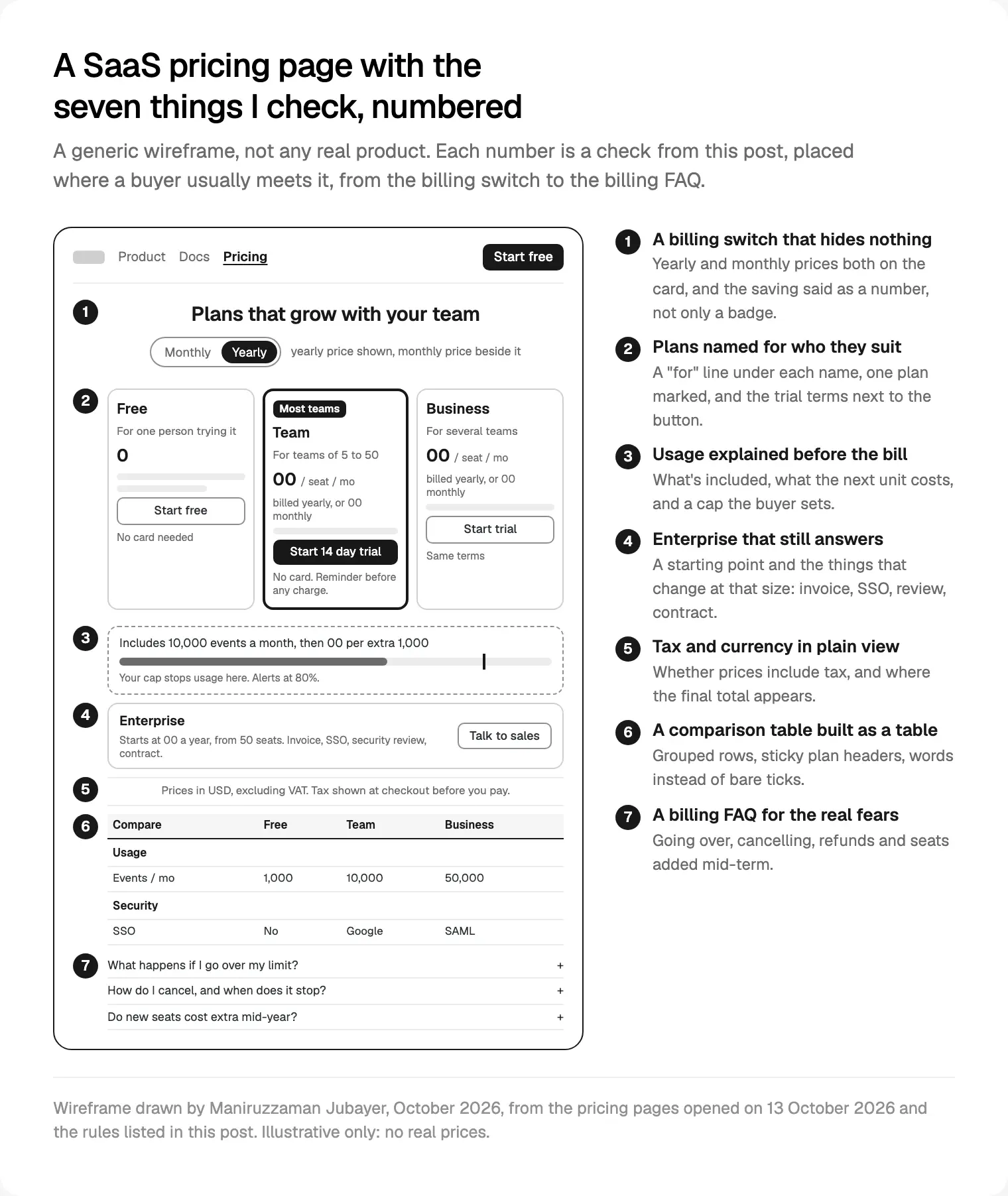
For the page around a pricing section, see my landing page examples sorted by the job they do. For whole-site patterns such as free limits, see SaaS website examples grouped by pattern.
1. Plan comparison: help the buyer find their plan
Most buyers don't compare every feature. They want to spot their plan, then check two or three limits.
What I saw. Linear's pricing page states free limits as numbers on the card (250 issues, 2 teams), marks paid prices "billed yearly", and groups its comparison table by job: core, triage, AI and agents, integrations, security, support. Figma's pricing page prices three seat types separately and puts a short "Choose Professional if you" list under each plan, so buyers match on who they are.
What I take. A "for" line under each plan name, limits as numbers, and one plan marked as the usual choice. NN/g's guidance on comparison tables (9 February 2024) suggests about five items at most, sticky column headers, and about two columns at a time on mobile.
What I'd skip. Rows of bare ticks. A tick says a feature exists, not how much you get.
How I build it. As real table markup with header cells marked, which the W3C's tables tutorial explains is how screen readers know which plan a cell belongs to.
2. Usage-based pricing, explained before the bill
The fear with usage pricing isn't the unit price. It's the bill nobody saw coming.
What I saw. Vercel's pricing page shows, for each metered line, what each plan includes and the rate after it, with spend management it says will "stop usage before you go over budget", plus a flat-rate network option with no overages. Twilio's US SMS pricing page carries a "current as of October 2026" line, a country selector and a downloadable price list; its FAQ gives a base rate of $0.0083 per SMS segment and explains that carrier fees are passed through on top. Zapier's pricing page lets you pick a task tier and currency, defines a task in plain words, and says failed actions don't use tasks.
What I take. Define the unit where the price sits, show one worked example for a typical customer, give the buyer a cap and alerts, and say what happens at the limit: stop, slow down or charge more.
3. A free tier or a trial, said plainly
A free plan says "you can stay here". A trial says "here's the paid product, for a while". The page must say which, and what happens when the clock runs out.
What I saw. Intercom's pricing page puts "14-day cardless free trial" above the plans, and its FAQ says you only pay once you choose a plan and add payment details. Resend's FAQ answers the trial question with a plain no and points to its free-forever plan. Framer's pricing page says its free plan suits non-commercial use.
What I take. Trial length, card or no card, and what happens at the end, next to the trial button. If the trial turns into a paid plan by itself, say so there.
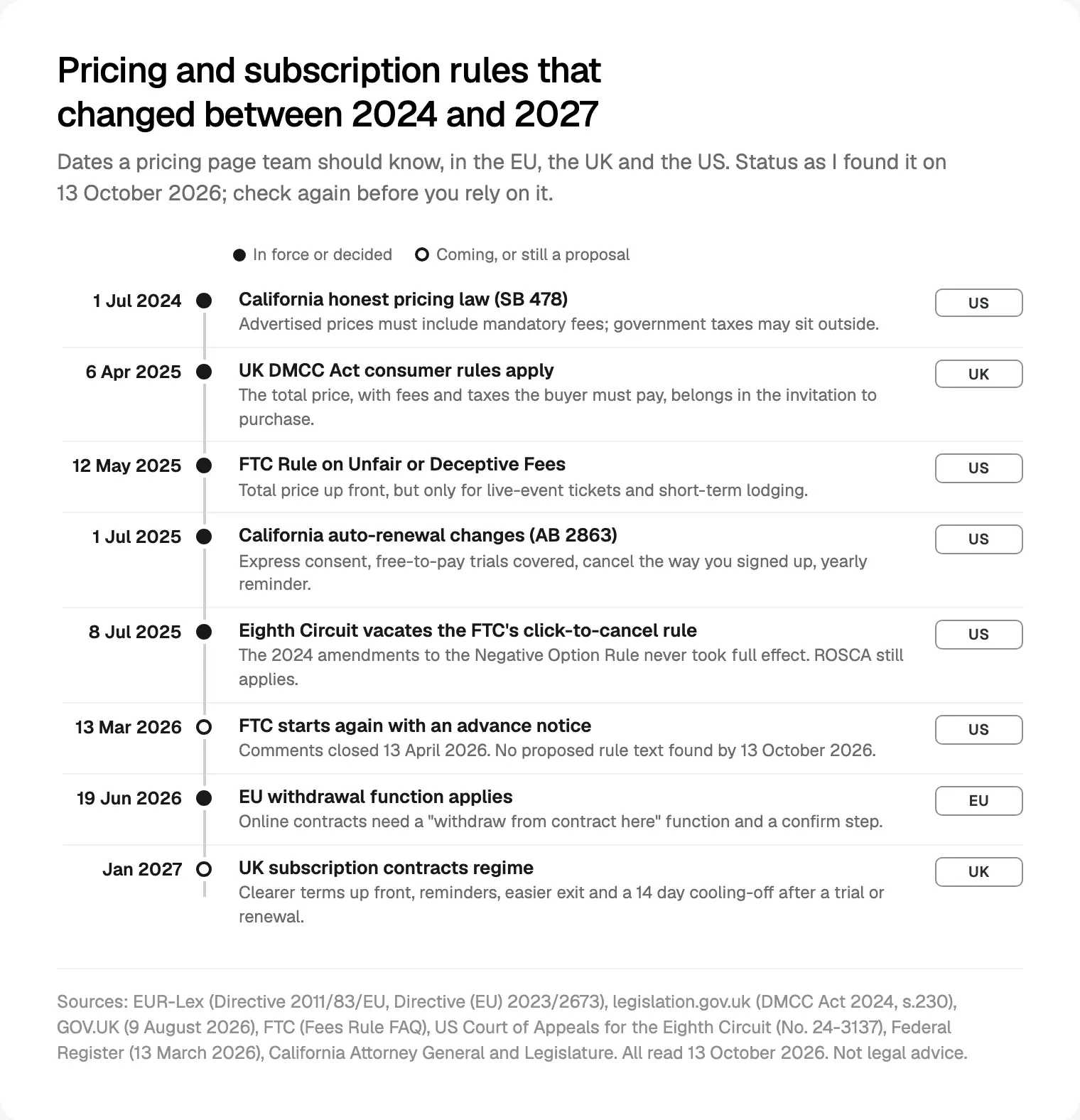
That's now law in places. California's AB 2863, for contracts made or renewed from 1 July 2025, covers free-to-pay conversions, requires express consent and requires cancelling in the medium used to sign up. What the first trial session should do is a separate design job.

4. Annual or monthly: show both numbers
A yearly toggle is the most common pricing pattern and the one most often used to hide something. A "save 20%" badge beside only the yearly per-month figure leaves the buyer doing sums.
What I saw. Slack's pricing page prints both prices on one card: for Pro, $8.75 per user per month paying monthly and $7.25 paying annually. Its introductory 50% off offer comes with terms saying it doesn't apply to annual plans and that standard pricing follows. Calendly's pricing page shows the saving per plan (17% on one, 20% on another) and says invitees don't need a seat. Figma's FAQ explains that on Professional, seats added mid-year are billed monthly at the monthly price.
What I take. Both prices on the card, the saving as a number, the yearly total nearby, and the mid-term seats question answered before it reaches an invoice.
For EU consumer subscriptions, this is close to a legal minimum. Article 6(1)(e) of the Consumer Rights Directive says the total price includes taxes, covers the total costs per billing period, and for fixed-rate subscriptions also means the total monthly cost.
5. Enterprise "talk to us", done well
"Contact sales" alone fails because the buyer can't tell whether it starts at twice the top plan or twenty times it.
What I saw. Calendly's Enterprise card gives a starting point ("starts at $15k" a year, from 50 seats) and lists what you get: SSO and SAML, an audit log, a data deletion API, onboarding. Webflow's pricing page shows its Team platform plan at $2,500 a month with "annual contract required" before the button, and lists what procurement asks for: custom invoicing, security questionnaires, MSAs and SLAs. Linear's Enterprise column lists invoice or PO billing, SAML and SCIM, and migration support.
What I take. A starting point or minimum, and what changes at that size: how you pay, how you sign in, the security review, the contract.
6. FAQs that answer billing fears
A pricing FAQ is for the moments a buyer pictures going wrong: a limit, a cancellation, a charge for idle users, lost data.
What I saw. Airtable's FAQ says that at record limits it "will never remove your data"; you just can't add more until you upgrade. It also says read-only collaborators aren't charged. Zapier's FAQ says you keep your paid plan to the end of the billing cycle after cancelling. Framer's FAQ lets you exceed bandwidth for one month with an email warning, and says EU and Turkish customers can claim a refund within 14 days. Resend's FAQ says overage billing is something you switch on; leave it off and you're offered an upgrade instead.
What I take. Questions in the buyer's words, answers that start with yes or no, and the uncomfortable ones included: overages, cancelling, refunds, seats, data.
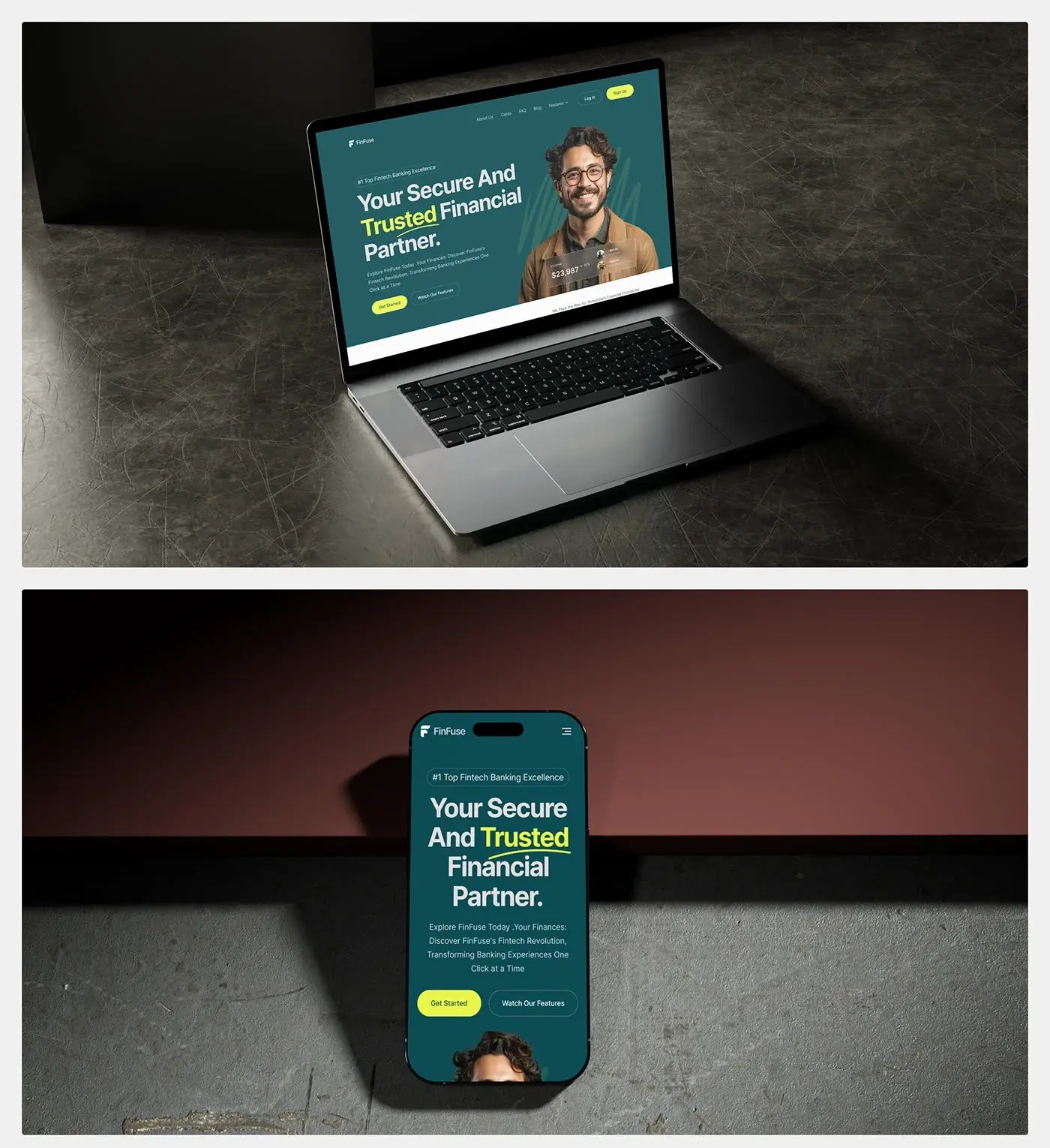
On FinFuse, a landing page for a fintech partner, I answered fees, security and devices in an FAQ on the page itself.
7. Price transparency rules for pricing pages in 2026
Most of these rules protect consumers, so a business-only product may fall outside some. Plenty of SaaS sells to individuals too, and I design to the strictest rule a client might sell under. Status as I found it on 13 October 2026:
| Rule | Where | Status | What it means for the page |
|---|---|---|---|
| Consumer Rights Directive, Articles 6 and 8 | EU | In force | Total price with taxes, cost per billing period, an order button that says it means paying |
| Withdrawal function, Directive (EU) 2023/2673 | EU | Applies from 19 June 2026 | "Withdraw from contract here", then "confirm withdrawal" |
| DMCC Act, section 230 | UK | In force since 6 April 2025 | Total price, with fees and taxes the buyer must pay |
| Subscription contracts regime | UK | Due January 2027 | Reminders, easier exit, 14 day cooling-off |
| FTC Rule on Unfair or Deceptive Fees | US | In force since 12 May 2025 | Total price, but only tickets and short-term lodging |
| FTC Negative Option Rule rewrite | US | Advance notice only | Click-to-cancel vacated; ROSCA still applies |
| SB 478 and AB 2863 | California | In force | Fees in the advertised price; consent and easy cancelling |
EU. Article 8(2) of the Consumer Rights Directive requires the order button to say "order with obligation to pay" or an unambiguous equivalent, or the consumer isn't bound. My reading, not legal advice: "Pay now" says it, while "Get started" on the step that charges a card doesn't. Directive (EU) 2023/2673 adds a withdrawal function for online contracts, applied by member states from 19 June 2026.
UK. Under section 230 of the DMCC Act 2024, the total price includes fees, taxes and charges the buyer will necessarily pay. The CMA's price transparency summary (updated 7 January 2026) names VAT as mandatory and puts fines at up to 10% of turnover or £300,000, whichever is greater. The government said on 9 August 2026 that subscription rules start in January 2027.
US. The FTC's fees rule covers only live-event tickets and short-term lodging. Its 2024 click-to-cancel amendments were vacated by the Eighth Circuit on 8 July 2025; an advance notice followed on 13 March 2026, and I found no proposed text since. The Restore Online Shoppers' Confidence Act still requires clear terms before billing details, express consent and a simple way to stop charges. California's SB 478 has required mandatory fees in advertised prices since 1 July 2024.
What I saw. Vercel says under its plans that prices exclude VAT and other taxes, added by billing address. Framer says sales tax is added at checkout. Twilio's FAQ discloses a $0.001 fee per failed message instead of leaving it for the invoice.
What I check when I design a pricing page
I run this in the first week of how I design pricing sections for SaaS launches.
- The plan sentence. Can a stranger say who each plan is for?
- Every limit. A number, not "generous".
- The billing switch. Both prices, the saving as a number, the yearly total.
- The usage line. The unit, what's included, the next-unit price, a cap.
- Trial terms. Length, card or no card, what happens at the end.
- The enterprise card. A starting point and what changes.
- Tax and currency. Included or not, and where the final total appears.
- The table. Real markup, grouped rows, sticky headers, two plans on phones.
- The billing FAQ. Overages, cancelling, refunds, mid-term seats, data.
- The way out. Where cancelling lives, in the medium used to sign up.
Prices change, so I build plans, prices and limits from one data source in code. Change a limit once and the card, the table and the FAQ agree.
Where I would start
Open your pricing page on your phone and answer the seven questions in the table as a buyer would. I usually fix the plan sentences and the trial terms first, then the billing FAQ, then usage, then the enterprise card.
If you'd rather hand it over, a project starts with a free 30 minute intro call, then a written scope and one fixed quote for the whole project. I work in weekly design sprints in Figma, with a written update in Slack every 48 hours and a review call each week. See my landing page work for SaaS and startups, or read about me.
Frequently asked questions
What makes a good SaaS pricing page?
It answers the money questions in order: which plan suits me, what usage will cost, what happens after the trial, whether yearly is cheaper, what enterprise involves, and whether the price shown is the price paid. Name plans for who they suit, state limits as numbers, put trial terms beside the button and answer billing fears in a short FAQ.
How many plans should a pricing page show?
Usually three or four, counting a free plan or enterprise option. Past that, comparing gets hard. NN/g's 2024 guidance on comparison tables suggests about five items at most side by side, and about two at a time on a phone. If you need more, let buyers choose which plans to compare.
Should a SaaS pricing page show prices or say contact sales?
Show prices for every self-serve plan. For a negotiated tier, give a starting point or minimum and list what changes: invoicing, single sign-on, security review, contract. On 13 October 2026, Calendly's Enterprise card gave a yearly starting figure and a 50 seat minimum before its talk to sales button.
How should you show annual and monthly pricing?
Put both numbers on the card, the saving as a figure and the yearly total nearby, so nobody does the maths. Slack's page did this on 13 October 2026. In the EU, consumer subscriptions must state the total cost per billing period, and the total monthly cost for fixed-rate plans.
How do you show usage-based pricing on a pricing page?
Define the unit where the price sits, say what each plan includes, show the next unit's price and give one worked example for a typical customer. Then remove the fear of a runaway bill with alerts, a spend cap and a clear line on what happens at the limit.
Is the FTC click-to-cancel rule in effect in 2026?
No. The Eighth Circuit vacated the FTC's 2024 amendments on 8 July 2025. The FTC published an advance notice on 13 March 2026, comments closed on 13 April, and I found no proposed rule text by 13 October 2026. The Restore Online Shoppers' Confidence Act still requires clear terms, express consent and a simple way to stop recurring charges.
Do prices have to include VAT in the EU and UK?
For consumers, in practice yes. EU law requires the total price inclusive of taxes, and the UK's DMCC Act counts taxes the buyer must pay as part of the total, with the CMA naming VAT as mandatory. Business pricing is often shown without VAT, as Vercel's is; if you do that, say so beside the prices.
Sources and method
I opened every example page on 13 October 2026 and read its text and, where needed, its HTML. I reproduce no screenshots, copy or logos, and rank no company. EUR-Lex, legislation.gov.uk and some FTC pages refused automated requests, so I read them in a browser. This is not legal advice.
- Nielsen Norman Group, Comparison Tables for Products, Services, and Features, Kate Moran and Taylor Dykes, 9 February 2024, read 13 October 2026: nngroup.com
- W3C WAI, Tables Tutorial, read 13 October 2026: w3.org
- EUR-Lex, Directive 2011/83/EU on consumer rights, Articles 6 and 8, read 13 October 2026: eur-lex.europa.eu
- EUR-Lex, Directive (EU) 2023/2673, Articles 1 and 2, read 13 October 2026: eur-lex.europa.eu
- legislation.gov.uk, DMCC Act 2024, section 230, read 13 October 2026: legislation.gov.uk
- CMA, price transparency summary, updated 7 January 2026, read 13 October 2026: gov.uk
- GOV.UK, everyday fixes and subscription traps, 9 August 2026, read 13 October 2026: gov.uk
- FTC, Rule on Unfair or Deceptive Fees FAQ, read 13 October 2026: ftc.gov
- US Court of Appeals for the Eighth Circuit, No. 24-3137, filed 8 July 2025, read 13 October 2026: ca8.uscourts.gov
- Federal Register, Negative Option Rule advance notice, 13 March 2026, read 13 October 2026: federalregister.gov
- US Code, 15 U.S.C. 8403 (ROSCA), read 13 October 2026: govinfo.gov
- California Attorney General, SB 478 hidden fees, read 13 October 2026: oag.ca.gov
- California Legislature, AB 2863, chaptered 24 September 2024, read 13 October 2026: leginfo.legislature.ca.gov
- Pricing pages, opened 13 October 2026: Linear, Figma, Vercel, Twilio, Zapier, Intercom, Resend, Framer, Slack, Calendly, Webflow, Airtable
Tags: Landing pages, SaaS, Pricing pages, Conversion, Subscriptions, Compliance