

A fractional real estate investing app sells a slice of a building, not the building. So it has to do far more than a listing app. It needs a marketplace, a property page that proves the price, a verified investing flow, a wallet that shows rent arriving, a way to sell before the fund ends, a vote when it does, and records good enough for Zakat.
A listing app ends at the enquiry. A fractional app starts there. The investor stays for years, so every screen has to answer three questions: what do I own, what did it earn, and what happens next.
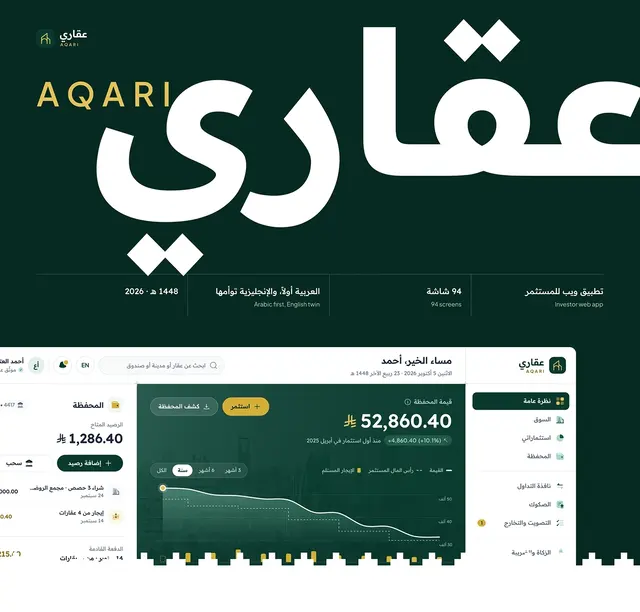
In Saudi Arabia the rules are unusually concrete. The Capital Market Authority's real estate fund regulations ask for two accredited valuers, a revaluation at least every six months and every fee disclosed. Those rules map straight onto screens. This guide is the method I use, and I show it through AQARI, a web app I designed for Shariah-compliant fractional property investing in Saudi Arabia.
The investing flow, with Nafath inside it
Investing is where trust is spent, so the flow should be short and should never surprise. I design it as one modal with a visible progress bar, not a chain of pages.
A typical order is: choose shares and review, sign the fund or SPV agreement, verify identity, pay, receive a certificate. Each step says what happens next.
Identity verification
Saudi users verify through Nafath, the national single sign-on. If the platform is a financial institution supervised by SAMA, the rule is firm: a SAMA circular effective 26 November 2022 requires Nafath biometric authentication at a high verification level or above whenever a relationship starts remotely. Even where that circular does not apply, Nafath can return later in the product to sign votes.
The waiting screen matters most. Show the number the user must pick in the Nafath app at display size, add a countdown, and offer resend and cancel. My Nafath sign-in guide covers every state.
Payment
Offer the local methods investors already use, with bank transfer for larger tickets. My guide to Saudi checkout with mada and Tamara covers the payment screens. Instalment schemes are a poor fit for buying fund units, so leave them out of this flow.
Wallet, payouts and reinvesting
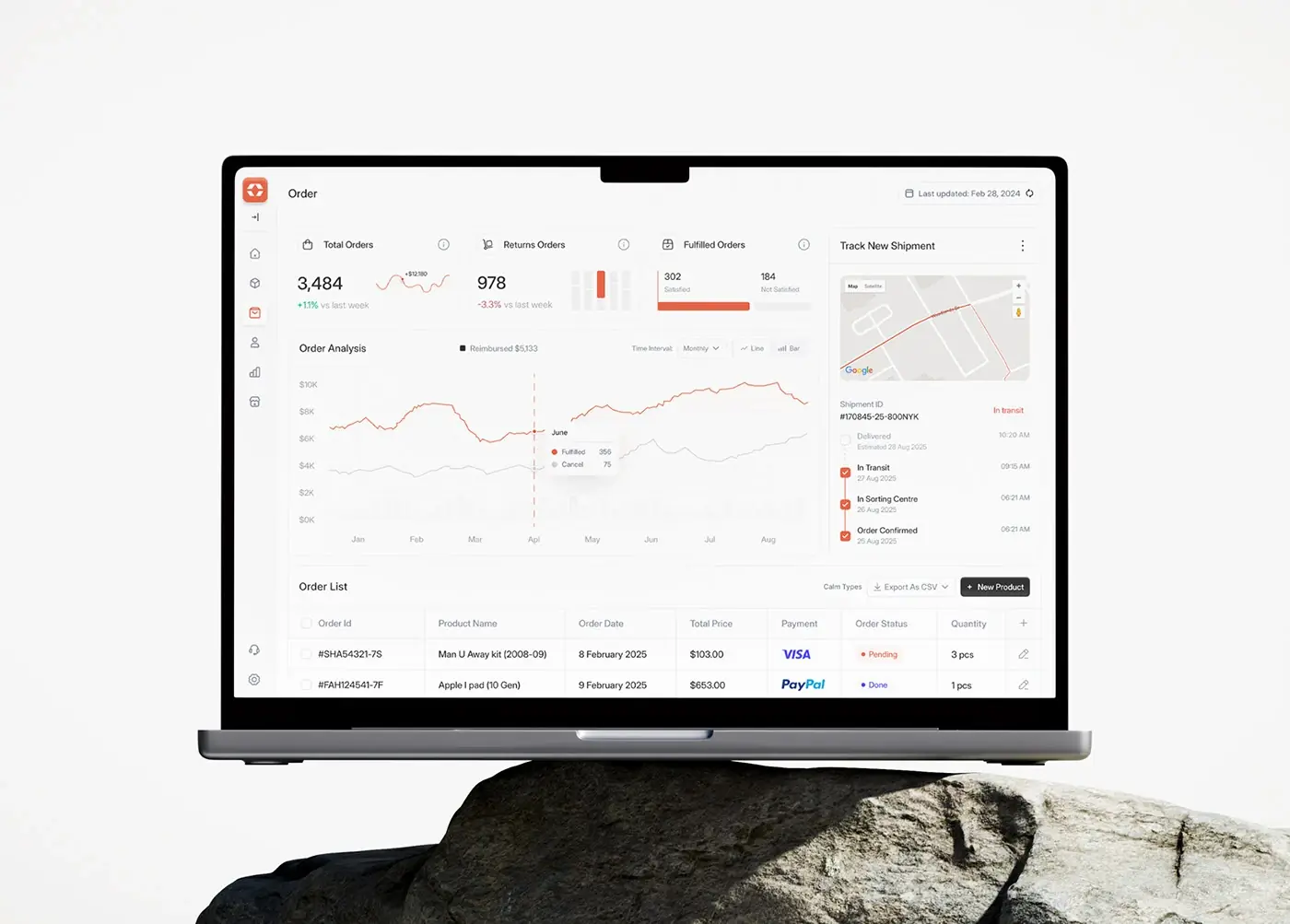
Rent is the reason most people buy a share, so the wallet deserves the best screen in the product.
- Available balance on top, with add funds and withdraw beside it.
- A payout timeline with the next amount and date picked out in one accent colour.
- A distributions calendar that shows Hijri and Gregorian dates together.
- Reinvest choices: back into the same property, into the highest yield, or spread across holdings.
- Type filters on transactions: deposit, purchase, rent, fee, sale, withdrawal.
If the platform distributes listed REIT units, the regulations set the floor: Article 47 says a REIT must distribute at least 90% of its net profits each year. Private funds set their own policy in their terms. Either way, show the policy in words on the property page and the actual history in the wallet.
One rule I hold to: money never animates. Counting numbers up looks lively, but on a balance it reads like a slot machine. Motion belongs to state changes, not to amounts.
Trading windows, price bands and exit votes
The fear "my money is locked for years" is the hardest one to answer. Closed-ended property funds are not instantly liquid, and the app should say so plainly. What it can offer is a predictable way out.
The trading window
One answer is a scheduled window in which holders can sell to other investors. Show the next window's dates on the portfolio, send a reminder before it opens, and keep the order screen honest:
- Limit or market order, with the reference price from the last valuation.
- A slider that marks the allowed price band.
- Quantity, fees and expected net proceeds before the confirm button.
- Three states drawn properly: inside the band and ready, outside the band with a red field and a plain reason, and filled with a confirmation.
The exit vote
At the end of a term, or when a building gets an offer, holders decide. Article 24 of the regulations gives each unitholder one vote per unit and allows meetings and voting through modern technology under CMA requirements. Notice must go out between 10 and 21 days before the meeting, and the agenda documents must be available when the call is published. A decision passes with more than 50% of units present, or more than 75% where that threshold applies.
That reads like a product spec. A vote screen needs the meeting date, the documents, the options as clear cards (for example sell, extend or abstain), a signature step, and a results screen with bars. Holders with at least 10% of the fund's units can add topics to the agenda, so large holders need a route to do that too.
Arabic first, Hijri dates and the riyal
A Saudi investing app should be drawn in Arabic first and mirrored into English, not the other way round. Charts and progress bars flip in RTL. Video scrubbers stay left to right. A direction mark keeps neutral text, such as unit codes and IBANs, starting on the correct side.
Dates come in pairs. The hawl is counted in Hijri months, and many people track payouts and votes the same way, while bank statements use Gregorian. Show both, and let the user choose which one leads. Settings should also let people pick digits and currency display, and the official riyal symbol should sit beside every amount.
Quiet hours that pause alerts at prayer time help too. My guide to Arabic RTL interface design goes into mirroring, digits and mixed text.
Saudi regulation that shapes the screens
I'm not a lawyer, and your counsel and compliance team own the final wording. But knowing which regulator sits behind which screen saves weeks of redesign.
- CMA, real estate funds. The Real Estate Investment Funds Regulations, last amended on 21 May 2025, set the valuation, fee, meeting and REIT distribution rules above. Since 2016 the CMA has not accepted fund valuation reports unless the valuers are Taqeem members.
- CMA, equity crowdfunding. On 27 September 2022 the CMA approved a framework for equity crowdfunding through authorised arranging institutions, including custody of client money.
- SAMA, debt crowdfunding. If the product lends to a developer instead of selling equity, SAMA's Rules for Engaging in Debt-Based Crowdfunding apply. They ask for an electronic risk acknowledgment in a pop-up before use, project pages with fees and expected returns, a statement that a listing is not advice, default rates on the homepage updated at least quarterly, and an SMS or email within 72 hours of a default.
- REGA, fractional ownership. The Real Estate General Authority announced the first tokenisation of a title deed on 19 November 2025. On 13 February 2026 it launched a second regulatory sandbox with a fractional ownership track, and said the first batch of nine platforms that built the fractional model now operates officially.
- SDAIA, PDPL. The Personal Data Protection Law came into effect on 14 September 2023, with a year for controllers to comply. Consent, rights requests and data export need real screens, which I cover in Saudi PDPL privacy screens for apps.
A screen-by-screen checklist
| Screen | Must show | Rule or reason |
|---|---|---|
| Marketplace card | Funding status, yield, minimum, days left, Shariah badge | Fast comparison, proof at a glance |
| Property page | Two valuations with valuer and date, next revaluation, rental market value | CMA REIF Articles 36 and 37 |
| Fee table | Every fee, on the investor and on the fund | CMA REIF Article 23 |
| Structure diagram | Investor, fund, SPV, property, tenant | Explains what is owned |
| Invest modal | Shares, agreement, Nafath, payment, certificate | One flow, no surprises |
| Wallet | Balance, next payout, Hijri and Gregorian dates, reinvest | The investor's first question |
| Sell order | Window dates, price band, fees, net proceeds, error reason | Liquidity without false promises |
| Vote | Notice, documents, options, signature, results | CMA REIF Article 24 |
| Zakat | Intention, Hijri year estimate, hawl months, fund figure | ZATCA individual Zakat guide |
| Settings | Digits, calendar, currency, quiet hours, data export and deletion | Arabic users and PDPL rights |
For more on the wider category, see my fintech app design guide, the real estate case studies and the real estate industry page. The full AQARI flow, from listing to ownership certificate, is in the AQARI case study.
If you are building a property investing product for Saudi investors, I design the screens and can build the web app in code too. See how I work on product design for Saudi teams in Riyadh. A project starts with a free 30 minute intro call, then a written scope and one fixed quote.
Sources and method
I read every source below on 25 October 2026, extracted the CMA regulations and the ZATCA guide as full text, and left out any claim I could not open and check.
- Capital Market Authority, Real Estate Investment Funds Regulations (unofficial English translation, amended 21 May 2025), read 25 October 2026: cma.gov.sa
- Capital Market Authority, CMA requires Taqeem membership for evaluators of real estate investment funds, 2016: cma.gov.sa
- Capital Market Authority, amendments setting out a framework for equity crowdfunding, 27 September 2022: cma.gov.sa
- Saudi Central Bank, Rules for Engaging in Debt-Based Crowdfunding, 1 December 2021: rulebook.sama.gov.sa
- Saudi Central Bank, biometric authentication for remote customer relationships through Nafath, 26 November 2022: rulebook.sama.gov.sa
- Zakat, Tax and Customs Authority, Guidelines: Zakat Jurisprudence of Individuals, read 25 October 2026: zatca.gov.sa
- Saudi Press Agency, REGA announces completion of first real estate tokenization, 19 November 2025: spa.gov.sa
- Saudi Press Agency, REGA launches regulatory sandbox featuring real estate tokenization, 13 February 2026: spa.gov.sa
- DLA Piper, Data Protection Laws of the World, Saudi Arabia, read 25 October 2026: dlapiperdataprotection.com
Tags: Real estate, Fintech, Saudi Arabia, Proptech, Product design