

A Google Ads landing page in the UAE has three readers before it has a customer. Google reads it for landing page experience and, since September 2026, for the language your ads match on. The person who tapped reads it on a phone, often in Arabic. And the rules read it, which is why my landing page design services in Dubai plan permits and consent into the first draft.
So the page has to keep the ad's promise in the ad's language, work for Google's crawler, offer WhatsApp without losing the lead, and leave room for what your sector must show. It goes wrong when the page comes first and the campaign is fitted to it afterwards.
This is for marketing leads and founders running paid search into the Emirates. It's design guidance, not legal advice; your compliance team owns the wording.
What Google Ads checks on a UAE landing page
Google's Quality Score help page scores keywords from 1 to 10 on expected clickthrough rate, ad relevance and landing page experience: how relevant and useful the page is to people who click. Each part is rated against advertisers who showed for the exact same search over the last 90 days.
Google also says Quality Score "is not an input in the ad auction". Its page on ad quality explains why you still care: ad quality feeds Ad Rank, decides whether some assets show, and "higher quality ads typically cost less per click". So I read a below average rating as a symptom that tells me where to look, not a number to design for.
The general checks are in the landing page checklist I run before launch; this post covers what the UAE adds.
The September 2026 change: your page's language now picks the ad
For bilingual campaigns this is the change that matters most. Google's help page on language targeting says that starting in September 2026 the campaign language setting is removed from Search campaigns and no longer applies to the Search part of Performance Max. Search ads "will automatically match based on the language of your ads", and Google checks whether the user understands "the language of the creative and landing page".
The same page gives the tie-break. When someone can read your ads in more than one language, Google prioritises the ad and page that match the language of the search; for searches without a clear language, such as brand names, it favours the person's preferred language.
That much is confirmed. My reading: in the UAE many people read both languages, so your page's language now helps decide which ad shows. An Arabic headline over English body copy sends Google a mixed signal, and the visitor a worse one. So language belongs to the whole path:
- The Arabic ad group has Arabic ads and an Arabic final URL.
- That page is Arabic throughout: headline, body, buttons, form labels, errors, consent banner and thank-you state.
- The
htmlelement carrieslang="ar"anddir="rtl", so browsers, screen readers and crawlers agree. - The English group mirrors it on its own URL, and neither page swaps language by itself.
A Google Ads landing page for the UAE, annotated
This is the pattern I draw for a property campaign with one ad group per language. The numbers are the checks I run before media goes live.
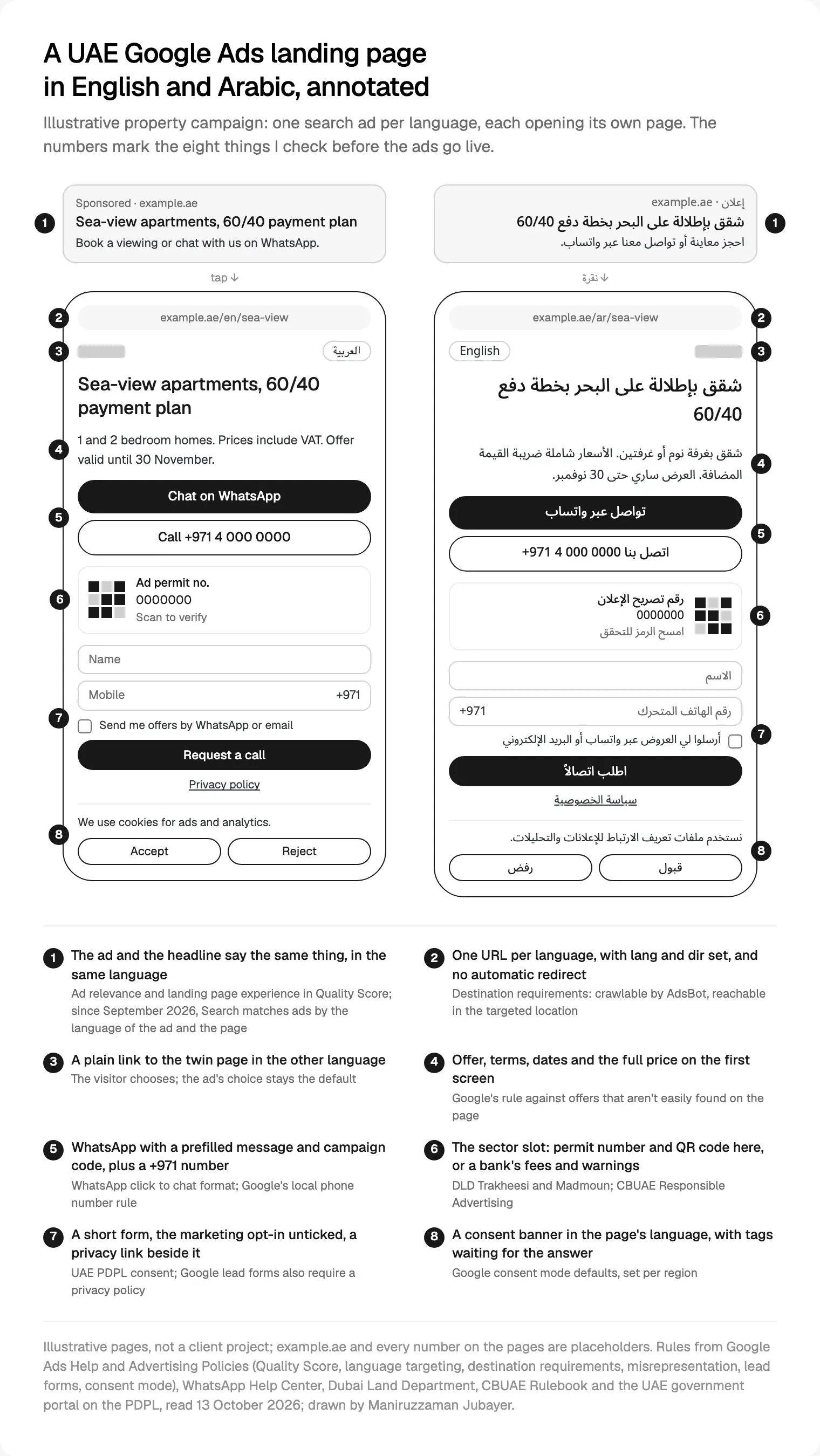
Fixed URLs (2). Google's destination requirements can disapprove ads whose pages return an error to its AdsBot crawler, redirect to another domain or aren't "accessible in the targeted location". A script that swaps the page by browser language or IP can show the crawler something other than what the person sees, so /ar/ and /en/ stay fixed and the visitor switches.
The switch (3). A plain text link in the other language: "English" on the Arabic page, "العربية" on the English one, never a flag.
The offer on the first screen (4). Google's misrepresentation policy bans offers in the ad that "aren't easily found from the destination". If the Arabic ad promises a payment plan, the Arabic page shows it near the top, with its dates and conditions beside it.
Build and test for Android first: Statcounter put it at 73.3% of UAE mobile web traffic in September 2026, and the Arabic page usually carries the heavier font files. The rest of the Arabic craft is in my guide to right to left layouts for UAE products.
Destination rules that catch UAE campaigns
Most disapprovals are plumbing, not copy. These are the ones I check for the Emirates:
| Rule | Source | What I do on the page |
|---|---|---|
| Page must work for AdsBot where you target | Destination requirements | Test both final URLs with tracking parameters; no geo or language redirects |
| Display domain must match the final URL | Destination requirements | Campaign pages on your own domain or a clear subdomain |
| Call asset numbers must be "local or domestic" | Destination requirements | One +971 number that reaches your team, on the page and in call assets |
| The ad's offer must be easy to find | Misrepresentation | Offer, dates and terms on the first screen of each language |
| Business name must clearly represent you | Misrepresentation | The same name in the ad, the page header and the footer |
Location settings matter too. Google's page on location targeting says the default reaches people in a place and people who've shown interest in it, and that interest "isn't restricted to a person's country". For Dubai property that means buyers abroad, so the phone field takes any dialling code and call-back hours are stated in Gulf time.
WhatsApp as the conversion path
Many UAE leads would rather chat than fill in a form, so I usually put WhatsApp first. There are three ways to offer it.
A click to chat button on the page. The WhatsApp Help Center gives the format: https://wa.me/<number> in full international format, without zeros, brackets or dashes, plus ?text= for a URL-encoded prefilled message. Its branded "Chat on WhatsApp" button is only available in English, WhatsApp notes, so on the Arabic page I design a plain button reading تواصل عبر واتساب.
A Google message asset. Message assets add a button to responsive search ads that opens WhatsApp or SMS from the ad. Google says they're in beta and need advertiser verification, and a headline tap still goes to your website.
A Google lead form asset. Lead forms collect details inside the ad. They need a privacy policy link, and Google keeps leads for only 60 days, so connect a webhook or CRM first.
| Path | What you get | What you lose |
|---|---|---|
| Click to chat on the page | The page's context before the chat | The click ID, once the person leaves for WhatsApp |
| Message asset | A chat straight from the ad | The page, and it's beta |
| Lead form asset | Details without a page load | Your own form design; leads expire in 60 days |
| Form on the page | Click ID, consent record, CRM fields | People who would rather chat |
Measuring WhatsApp is the hard part: a chat brings a phone number but no click ID. So I record the tap as its own conversion and end each prefilled message with a short campaign code ("AR-SEA-01") that sales can tag in the CRM. For form leads I set up enhanced conversions for leads, which matches hashed form details with later sales. Google notes that from 15 June 2026 those uploads moved to the Data Manager API, so check your CRM connector moved too.
UAE advertising rules that touch the page itself
Al Tamimi & Company's overview of UAE media law (12 December 2025) explains that Federal Decree-Law No. 55 of 2023 has applied since 1 December 2023, with executive regulations since 31 October 2024. It covers electronic and digital media, rules out misleading claims, exaggeration and claims of exclusivity, and carries fines from AED 5,000 to AED 1 million. That's why "the best", "only" and "guaranteed" stay out of campaign headlines unless your team can prove them.
The advertiser permit is narrower. Middle East Briefing reported on 2 February 2026 that the Media Council's permit has applied since 1 February 2026 to influencers, individual advertisers, agencies and companies publishing promotional content on social media, excluding purely personal content and individuals promoting their own registered business. Brands must check a creator's permit before working with them.
I found no source saying whether a brand needs a permit for its own landing page. My reading: the permit belongs to the social account, and the page answers to the content standards. So each creator gets a tracked page variant that repeats the approved offer exactly.
Regulated sectors: property, finance and health
Three sectors carry most of the UAE's campaign rules, and each needs its slot drawn in from the first frame.
| Sector | Rule I design around | What the page needs |
|---|---|---|
| Dubai property | Trakheesi permit; the Madmoun QR code on every real estate ad (DLD, 24 April 2025) | Permit number and a scannable QR code near the offer, swappable per project |
| Banks and finance firms | CBUAE Consumer Protection Standards, section 2.3 | Both languages, name and contact details, readable footnotes, a link to this offer's criteria |
| Dubai clinics | DHA standards for medical ads, reported by Gulf News (updated 1 September 2026) | No "the best" or "no side effects"; matched before and after photos with a "results can vary" note |
The Central Bank text is the most specific. Section 2.3.1.2 covers websites, apps and social media; 2.3.1.3 asks for ads in both Arabic and English unless one language market is targeted; 2.3.1.4 sets a minimum font size of 10; and 2.3.1.6 says a link to details must lead to the criteria for that advertisement only, which rules out a generic "terms apply" PDF. Google's financial products and services policy points the same way, asking you to "include specific disclosures required by local law".
The DHA standards are written for social media, but I give the page the same restraint. For property, the permit workflow is in my guide to Trakheesi permits on Dubai property sites.
The order I build a UAE campaign page in
Language and rules are cheap to plan and expensive to retrofit, so the order matters. This is how I design bilingual campaign pages for Dubai launches:
- The ad plan, on the free 30 minute intro call: ad groups, languages, offers, launch date, sector rules.
- A path table: per ad group, the language, final URL, headline, offer, main action and campaign code.
- Copy in both languages in one document, the Arabic approved by a native speaker on your side.
- Both pages side by side in Figma, with the permit or disclaimer slot in place.
- Build and wiring: fixed URLs,
langanddir, consent defaults, conversions for form, call and WhatsApp. - Checks: both URLs with tracking parameters, an Android phone on mobile data, a test lead into the CRM.
A written scope and one fixed quote come first, as with my landing page design for paid campaigns anywhere.
Where I would start
Start with a spreadsheet. List every ad group, its language, its exact offer and the URL it should open. If an Arabic ad opens an English page, fix that first: since September it affects which ad Google shows. Then add how each lead arrives, how you'll know which ad sent it, and what your sector requires on the page.
If you'd like me to take that path from ad to lead in both languages, start with my landing page work for UAE campaigns. It begins with a free 30 minute call (I'm two hours ahead of Dubai), then a written scope and one fixed quote.
Frequently asked questions
What makes a good Google Ads landing page in the UAE?
One that keeps the ad's promise in the ad's language, loads fast on a mid-range Android, offers WhatsApp beside a short form, and shows what your sector requires, such as a property permit. It should pass Google's destination checks from inside the UAE: no language redirects, a local phone number, the offer on the first screen.
Should Arabic and English Google Ads go to separate landing pages?
Yes, in my view. Since September 2026 Google matches Search ads on the language of the ad and the landing page, so an Arabic ad group should open a page that is Arabic throughout, on its own URL with lang="ar" and dir="rtl". Link the two versions to each other, but don't switch language automatically.
Did Google Ads remove language targeting?
For Search, yes. Google's help page says that from September 2026 the campaign language setting is removed from Search campaigns and no longer applies to Search inside Performance Max. Ads match on their own language, and Google checks whether the user understands the ad and landing page. YouTube and Display still use the setting.
Can a Google Ads final URL be a WhatsApp link?
Google's route for WhatsApp in search ads is the message asset, still in beta. The final URL should be your landing page, which Google's crawler must be able to read, and a headline tap goes there even with a message asset attached. Put the WhatsApp button on that page, with a prefilled message carrying a campaign code.
Does Quality Score affect how much I pay per click?
Not directly. Google says Quality Score is a diagnostic tool, not an input in the ad auction. Ad quality, which the score summarises, does feed Ad Rank and cost: Google says higher quality ads typically cost less per click. So a better landing page can lower what you pay, but aim at the visitor's experience, not the number.
Does a Dubai property landing page need the Trakheesi permit?
Yes. Dubai Land Department rules require a Trakheesi permit for property ads, electronic ones included, and the Madmoun QR code on every real estate advertisement. I place the permit number and a scannable QR code near the offer in both languages, swapped per project. Your broker or developer confirms each campaign's details.
Sources and method
I read every source on 13 October 2026; Google's undated help pages change often, so check them before launch. The UAE legislation portal blocked automated access, so the PDPL summary comes from the government portal. Data is thin on whether the advertiser permit or the DHA standards reach landing pages; I flag both above.
- Google Ads Help, About Quality Score for Search campaigns, date read 13 October 2026: support.google.com
- Google Ads Help, About ad quality, date read 13 October 2026: support.google.com
- Google Ads Help, About language targeting (changes from September 2026), date read 13 October 2026: support.google.com
- Google Advertising Policies Help, Destination requirements, date read 13 October 2026: support.google.com
- Google Advertising Policies Help, Misrepresentation, date read 13 October 2026: support.google.com
- Google Ads Help, About targeting geographic locations, date read 13 October 2026: support.google.com
- Google Ads Help, About message assets, date read 13 October 2026: support.google.com
- Google Ads Help, About lead form assets, date read 13 October 2026: support.google.com
- Google Ads Help, About enhanced conversions for leads, date read 13 October 2026: support.google.com
- Google Advertising Policies Help, Financial products and services, date read 13 October 2026: support.google.com
- Google for Developers, Set up consent mode on websites, updated 30 July 2026, date read 13 October 2026: developers.google.com
- WhatsApp Help Center, How to use click to chat, date read 13 October 2026: faq.whatsapp.com
- Statcounter Global Stats, mobile operating system market share in the UAE, September 2026, date read 13 October 2026: gs.statcounter.com
- UAE Government portal, Data protection laws, date read 13 October 2026: u.ae
- Al Tamimi & Company via Mondaq, Media law and advertising standards in the UAE, 12 December 2025, date read 13 October 2026: mondaq.com
- Middle East Briefing, UAE influencers must obtain advertiser permit, 2 February 2026, date read 13 October 2026: middleeastbriefing.com
- Dubai Land Department, AI-enabled real estate advertising governance (Madmoun QR code), 24 April 2025, date read 13 October 2026: dubailand.gov.ae
- Central Bank of the UAE Rulebook, Consumer Protection Standards, section 2.3 Responsible Advertising, date read 13 October 2026: rulebook.centralbank.ae
- Gulf News, Dubai issues social media rules for doctors, health facilities and influencers, updated 1 September 2026, date read 13 October 2026: gulfnews.com
Tags: UAE, Google Ads, Landing pages, Arabic, WhatsApp, Compliance